


How Trustees Approve Trust Loans in Singapore Within the Two Thirds Limit


Yes, a Singapore trust can lend its own money, including to a beneficiary, but only within tight limits. The trustee needs either an express power in the trust deed or reliance on the Trustees Act 1967, documented “proper advice” from a qualified valuer, and a loan that stays within the statutory two-thirds security limit. Skip any of these steps, and the trustee risks personal liability for breach of trust.
TL;DR:
Trustees must have an express power in the trust deed or rely on documented, qualified advice within the two-thirds security limit to lend trust money to beneficiaries.
Proper documentation, including independent valuation reports, legal opinions, and signed loan agreements, is essential to defend the loan and avoid personal liability.
IRAS may treat interest-free or subsidized trust loans as taxable benefits unless a commercial interest rate and formal documentation are maintained.
Common breach scenarios include self-dealing, undocumented advice, delayed beneficiary account access, and unsecured loans, all of which can lead to litigation.
Building a standardized, compliant loan process in advance is critical for trustees to prevent disputes and ensure legal and tax compliance.
Table of Contents
Trustee Act 1967 Rules That Govern a Loan From Trust Singapore Arrangements
The starting point for any loan from trust Singapore structures is the trust deed itself. If the settlor built lending powers into the deed, those terms govern, and the Trustees Act fills gaps only where the deed stays silent. Where the trust instrument expresses a contrary intention, the statutory powers apply only insofar as they don’t conflict with what the settlor wrote.
Where the deed is silent or ambiguous, trustees fall back on the statute. Two provisions matter most for anyone considering trust fund loans in Singapore:
Section 9 lets a trustee lend on the security of property, but shields the trustee from breach-of-trust liability only if the loan doesn’t exceed two-thirds of the property’s value as stated in a qualified adviser’s valuation report.
Section 11 allows a trustee to contract that a loan may have contractual terms delaying call-in for a limited period, provided interest payments and covenant terms stay current throughout.
Courts don’t treat these as paperwork formalities. In Lalwani Shalini Gobind v Lalwani Ashok Bherumal [2017] SGHC 90, the Singapore High Court reinforced that trustees must act impartially between beneficiaries, keep proper accounts, and avoid using trust assets for personal benefit without clear authorization. A trustee who borrows from the trust for personal use, without documented consent and independent advice, is walking directly into the fact pattern that court punished.
When Should a Trust Actually Lend Money to a Beneficiary?
Not every request from a beneficiary deserves a “yes,” and not every payout labeled a loan actually functions as one. Legitimate trust financing tends to fall into a few recurring patterns.
Secured housing assistance. A beneficiary buying a home can receive trust financing secured against the property itself, with the trust holding a registered charge that protects the capital.
Bridging finance. Short-term loans that let a beneficiary cover a gap, such as a business cash flow shortfall, without forcing a premature sale of trust-held investments.
Capital preservation loans. Lending against an asset rather than liquidating it, especially where selling would trigger a bad-timing loss or an unwanted tax event.
What should raise a flag: any arrangement that functions as an outright distribution dressed up as a loan, with no interest, no repayment schedule, and no realistic expectation of collection. That’s not personal trust loans in any meaningful sense, it’s a gift, and treating it otherwise invites both tax and fiduciary challenges. The clearest test is simple. If the trustee wouldn’t extend the same terms to a stranger, the “loan” probably isn’t one.
What Documentation Do Trustees Need Before Approving a Loan?
Getting this wrong is where most disputes start. The checklist below reflects how a defensible loan from trust assets actually gets built, step by step.
Check the deed first. Confirm whether the settlor granted an express lending power, and read any restrictions carefully.
If relying on statute, obtain a formal valuation from an independent, qualified valuer, one that explicitly states “value for security purposes” so it ties directly back to the two-thirds rule.
Secure a written legal opinion confirming the loan structure complies with both the deed and the Trustees Act.
Draft a proper loan agreement covering principal, interest rate, repayment schedule, and default terms, alongside a security instrument that registers the trust’s charge.
Record trustee resolutions or meeting minutes documenting the decision and the advice relied on.
File the transaction in the trust’s accounts, ready for beneficiary inspection.
Where more than one beneficiary exists, or where the borrower is also a trustee, bring in an independent trustee or advisory panel to remove any appearance of self-dealing. If doubt remains about whether a proposed loan sits within the trustee’s powers, applying to the court for directions is far cheaper than defending a breach claim after the fact.
Pro Tip: Never rely on verbal or informal valuation advice, however credible the source. Courts and IRAS both expect a dated, written report tied to the specific loan, not a general market opinion offered in passing.
Does IRAS Tax Interest-Free or Subsidized Trust Loans?
Trustees often assume that because the money technically belongs to the family, tax rules don’t apply the same way. That’s a costly assumption. IRAS guidance on benefits relating to loans makes clear that interest-free or subsidised loans can create taxable benefits in some contexts, particularly where the arrangement resembles an employment or director relationship rather than a straightforward family loan.
The safest position is to treat every trust loan as if a tax examiner will eventually review it, because one might.
Charge a commercial or near-market interest rate, or document clearly why a reduced rate is justified.
If principal or interest is later waived, record the waiver formally and consider whether it creates a separate taxable event.
Retain the loan agreement, valuation report, and legal advice indefinitely, not just until the loan is repaid.
There’s no single published rate that applies to every trust loan in Singapore. What matters is documented commerciality: an arm’s-length interest rate, a real repayment schedule, and paperwork that would survive scrutiny from both a tax authority and a disgruntled beneficiary years down the line.
Where Trustees Get Sued: Common Breach Scenarios
Most disputes over trust lending don’t stem from bad intentions. They stem from shortcuts. A trustee approves a loan quickly, skips the independent valuation, or fails to explain the decision to other beneficiaries, and years later the loan becomes the centerpiece of a family dispute.
Self-dealing without consent. A trustee lending trust money to themselves, a spouse, or a closely connected business, without informed beneficiary consent, mirrors the exact conduct criticized in Lalwani.
Undocumented advice. Relying on an informal chat with a valuer instead of a signed, dated report tied to the two-thirds rule leaves no defense if the loan later underperforms.
Failure to account. Beneficiaries have a right to inspect trust accounts, and refusing or delaying that access is one of the most common triggers for litigation.
No registered security. An unsecured “loan” that was meant to be secured leaves the trust exposed if the borrower defaults or the property is sold to a third party.
The fix in each case is the same: independent valuation, independent oversight where conflicts exist, formally recorded consent, and a registered charge that survives a later dispute over priority.
A Step-by-Step Checklist for Approving a Trust Loan
Trustees rarely have the luxury of figuring this out mid-crisis, so building the process before a request lands is worth the effort.
Review the trust deed and power matrix immediately. Identify whether lending is expressly authorized, silent, or restricted, and note any conditions attached.
Instruct an independent valuer and legal counsel in parallel. The valuation should state its purpose explicitly for security lending; legal counsel should confirm the loan fits within both deed and statute.
Prepare the loan agreement, security documents, and trustee minutes. This is also the point to decide on interest rate, repayment term, and what happens on default, and to record a charging clause protecting trust priority if the loan funds a property purchase.
Register the charge and lodge updated trust accounts. A charge that exists only on paper without registration offers weak protection if the borrower faces other creditors.
Valuation reports typically take one to three weeks depending on the asset and appraiser availability, so building that lead time into any beneficiary request avoids rushed decisions. If the loan will run under a Section 11 arrangement with a call-in delay of up to five years, calendar the review date now rather than relying on memory later. Involve estate counsel, a tax adviser, an independent valuer, and, where the loan touches banking arrangements, a trust bank account specialist to handle disbursement and repayment tracking.
Pro Tip: Build a standing “loan request” template into the trust’s governance documents now, before any beneficiary asks. Having the checklist ready removes the pressure to cut corners when a real request arrives.
How Elite Legacy Planning Approaches Trust Lending for HNW Families
Trustees who come to Elitelegacyplanning with a loan request usually have the same worry: they want to help a beneficiary without exposing themselves or the trust to a future claim. Our approach starts with the deed, not the request, because most disputes trace back to a power that was assumed rather than confirmed.
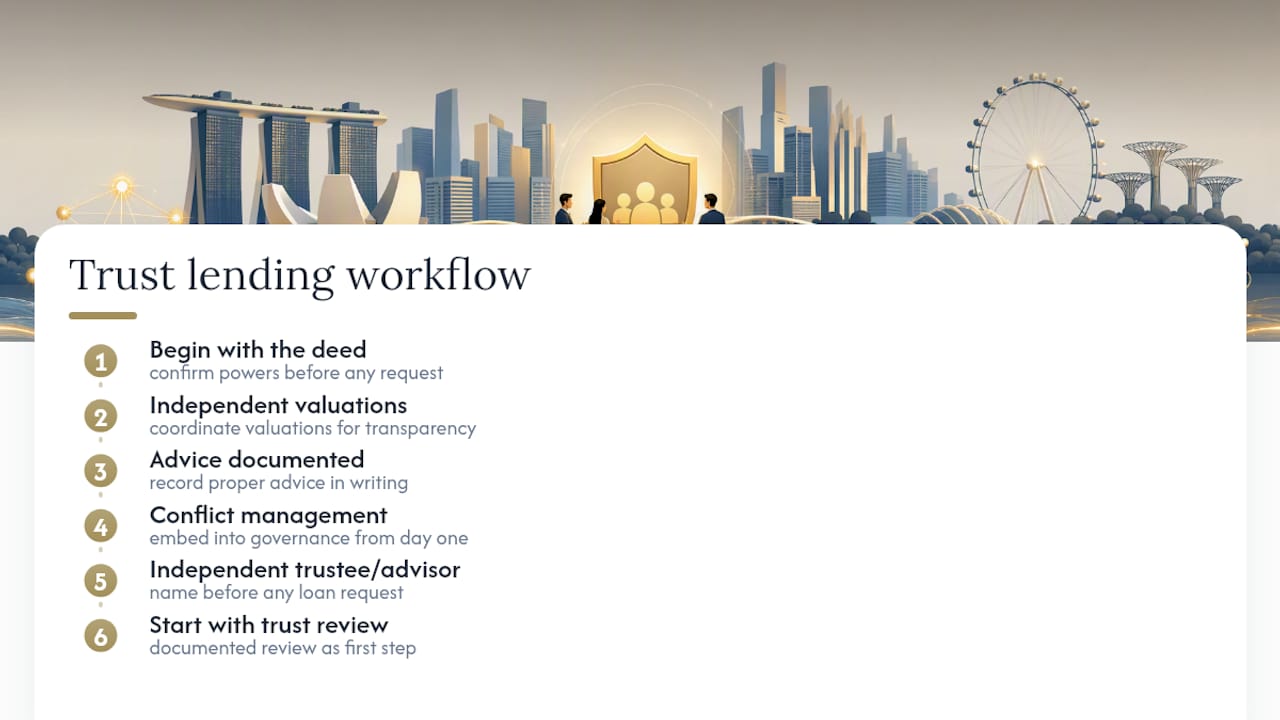
For clients using a Living Trust or a Private Trust Company structure, we coordinate independent valuations, document proper advice in writing, and build conflict management into the governance framework from day one. That means naming an independent trustee or advisory voice before a loan request ever surfaces, not after a dispute forces the question.
If you’re weighing a loan from trust assets and want it reviewed properly, a documented trust review is the place to start.
— Joseph
Get a Documented Trust Loan Review From Elite Legacy Planning
A generic law firm can tell you what the Trustees Act says. What most trustees actually need is someone who builds the valuation, the loan documentation, and the governance structure together, so the paperwork holds up if a beneficiary or IRAS ever asks questions later. That’s the gap Elitelegacyplanning fills for HNW families across Singapore.

Our trust consultation and lifetime advisory service walks trustees through exactly what’s outlined above: confirming deed powers, coordinating an independent valuation, drafting a compliant loan and security agreement, and setting up the governance needed if a Private Trust Company structure is involved. An initial consultation typically produces a clear legal opinion on whether the proposed loan is permissible, a coordinated valuation timeline, and draft loan documents ready for trustee sign-off. If you’re a trustee, settlor, or beneficiary facing a lending decision right now, book a consultation and get the review done properly before any money moves.
This article is general information, not a substitute for advice from a qualified lawyer. Consult a qualified legal professional about your own circumstances before acting on anything here.
Sources
Recommended
Comments