


S$15k–S$35k Setup: Singapore Education Trusts for Affluent Families


An education trust in Singapore is a private legal structure that holds and manages assets specifically to fund a beneficiary’s schooling, using a licensed trustee governed by the Trustees Act and Trust Companies Act. It fits affluent parents who want intergenerational control over how education money is spent, not just who receives it. If that describes your situation, a consultation with a specialist like Elite Legacy Planning is the logical next move.
TL;DR:
A standalone discretionary trust is suitable for most families with assets under S$30 million due to lower setup and ongoing costs.
Larger families exceeding S$50 million may benefit from a Private Trust Company with a family council but face higher costs and longer setup times.
Effective distribution planning involves separate education categories, milestone triggers, and clear Letters of Wishes to prevent family conflicts.
Trustees should have transparent reporting and a well-defined governance structure, favoring professional trustees for impartiality and continuity.
Budget estimates range from S$15,000 to S$35,000 for setup, with ongoing costs up to S$60,000 annually, and initial setup takes roughly four to eight weeks.
Table of Contents
What Is an Education Trust in Singapore?
An education trust is a private arrangement where a settlor transfers assets to a trustee, who holds and applies them for a beneficiary’s education under terms the settlor defines. This is distinct from charitable education trusts that distribute scholarships to disadvantaged students. Here, the asset is yours, the beneficiaries are your children or grandchildren, and the purpose is narrowly education, not general charity.
For the trust to hold up legally, it needs the three certainties: certainty of intention (you clearly meant to create a trust, not just a gift), certainty of subject matter (the assets are identifiable), and certainty of objects (the beneficiaries are ascertainable). Families typically reach for this structure when children are minors who cannot hold property directly until age 21, when a beneficiary has special needs requiring long-term protection, or when the family spans multiple jurisdictions and wants a Singapore-anchored vehicle for consistency.
Which Trust Structures Work Best for Education Funding?
Three structures dominate Singapore’s practitioner landscape, and the right one depends heavily on scale.
Standalone discretionary trust. A licensed trust company acts as trustee, and the deed grants discretion over how and when education distributions happen. This is the default for most families and the fastest to set up.
Private Trust Company (PTC) with CLG governance. Larger families sometimes create a PTC, often overlaid with a Company Limited by Guarantee (CLG), to give the family board more say in trustee decisions. PTCs are typically used by families with consolidated wealth north of roughly S$50 million, partly because Singapore requires a resident director and a licensed administrator for AML/CFT compliance.
Reserved-powers trust under Section 90A. This lets the settlor retain specific powers, most commonly investment direction, while a professional trustee handles administration and distributions.
Asset complexity drives the choice more than sentiment does. A common and costly mistake is opting for a PTC when the estate sits well under S$30 million; the governance overhead and compliance cost rarely justify themselves at that scale, and a standalone discretionary trust with a strong Letter of Wishes usually does the job better.
How Do You Design an Education-Focused Distribution Framework?
Money released without structure tends to become a family argument. The fix is a deliberate framework, built in stages.
Ring-fence an education pot separate from general maintenance, healthcare, or housing categories, so a request for tuition doesn’t compete with a request for a car.
Set milestone triggers such as enrollment confirmation, semester completion, or graduation, rather than a single lump sum at 18.
Add conditional mechanics like matching contributions for scholarships earned, or caps by education level (undergraduate versus postgraduate).
Draft a Letter of Wishes that guides the trustee’s discretion without binding it legally, covering preferred institutions, acceptable spending categories, and how to handle a beneficiary who defers or changes course.
Separating categories this way is one of the clearer levers for reducing family conflict over time.
Pro Tip: Write the Letter of Wishes as if the trustee has never met your family. Vague language like “support their education reasonably” invites disputes; specific language like “cover tuition and accommodation up to S$60,000 per academic year at an accredited institution” does not.
How Should Governance Be Structured to Avoid Family Disputes?
Choosing between a professional trustee and a family member as trustee is really a choice between impartiality and familiarity. Professional trustees bring regulatory accountability and continuity; individual trustees bring intimate family knowledge but can struggle with saying no to relatives. A CLG governance overlay, paired with a PTC as the administrative vehicle, lets a family council retain a voice in major decisions while a licensed entity handles day-to-day compliance.
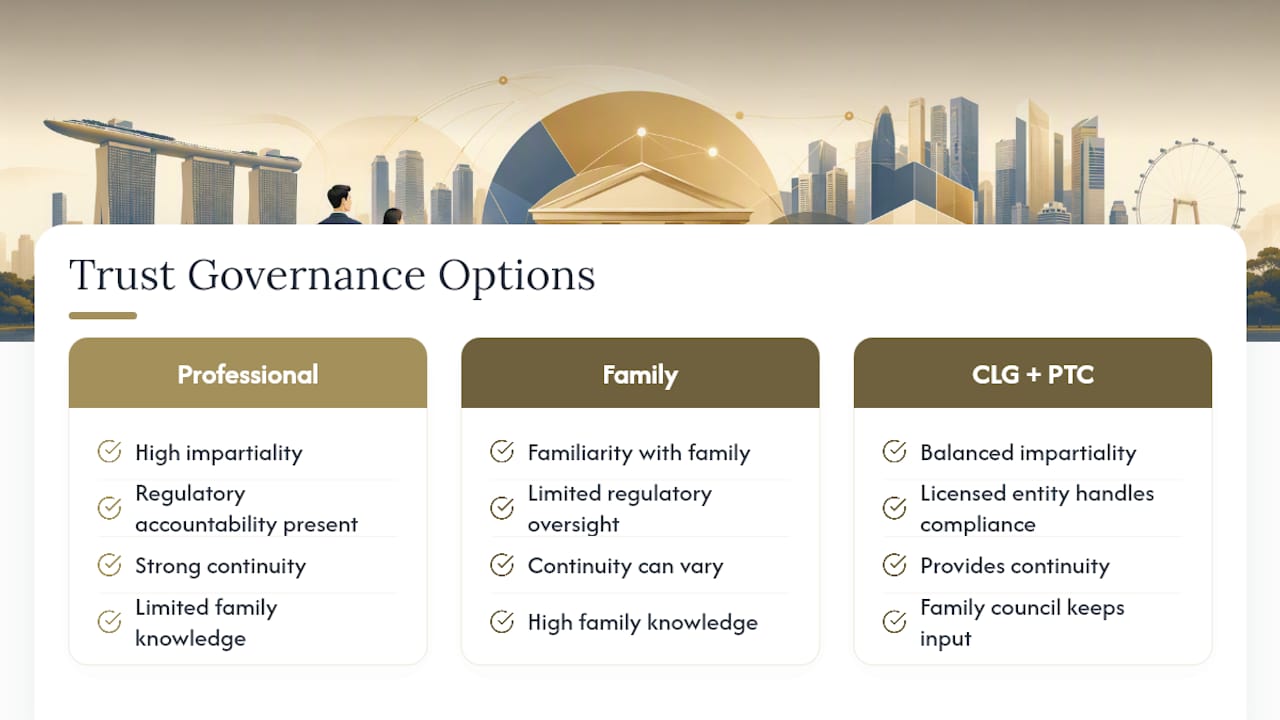
Annual or semi-annual reporting to adult beneficiaries, rather than silence until a payout, tends to prevent the sense that the trust is a black box. The most common governance failure isn’t fraud. It’s ambiguity: no one clearly owns the decision to say yes or no to an unusual request, and every ambiguous case becomes a family fight.
How Do Investment and Tax Rules Affect Education Trusts?
Education outflows are lumpy and predictable years in advance, which makes liquidity planning unusually straightforward compared to other trust objectives. Near-term tuition needs (the next two to three years) generally sit in cash or short-duration instruments, while longer horizons, funding for a child currently in primary school, can carry growth assets.
Trust deeds should specify an explicit liquidity rule and reserve ratio so trustees aren’t forced to sell growth assets at a bad moment just to cover next semester’s fees. This single drafting detail prevents a surprising amount of downstream stress.
On the regulatory side, Singapore’s Trustees Act and Trust Companies Act form the statutory backbone, MAS enforces AML/CFT obligations on licensed administrators, and certain foreign-sourced income can qualify for favorable tax treatment under specific conditions. None of this is a substitute for tailored tax advice, but it’s the framework your adviser will be working within.
What Do Costs and Timelines Actually Look Like?
Budget expectations vary sharply by structure, and knowing the range before your first meeting saves time.
Standalone discretionary trust: setup fees typically run S$15,000 to S$35,000, with annual administration between S$15,000 and S$60,000. Setup usually takes four to eight weeks.
PTC with CLG governance: setup and annual running costs sit materially higher, and the process commonly stretches 12 to 20 weeks or longer once resident director appointments and compliance onboarding are factored in.
The checklist that keeps timelines tight: family conversation on objectives, structure selection, trustee appointment, a full asset audit, deed drafting and execution, then funding the trust. Delays usually trace back to an incomplete asset audit or a family that hasn’t agreed on distribution philosophy before the deed goes to drafting.
What Should You Bring to a First Trust Consultation?
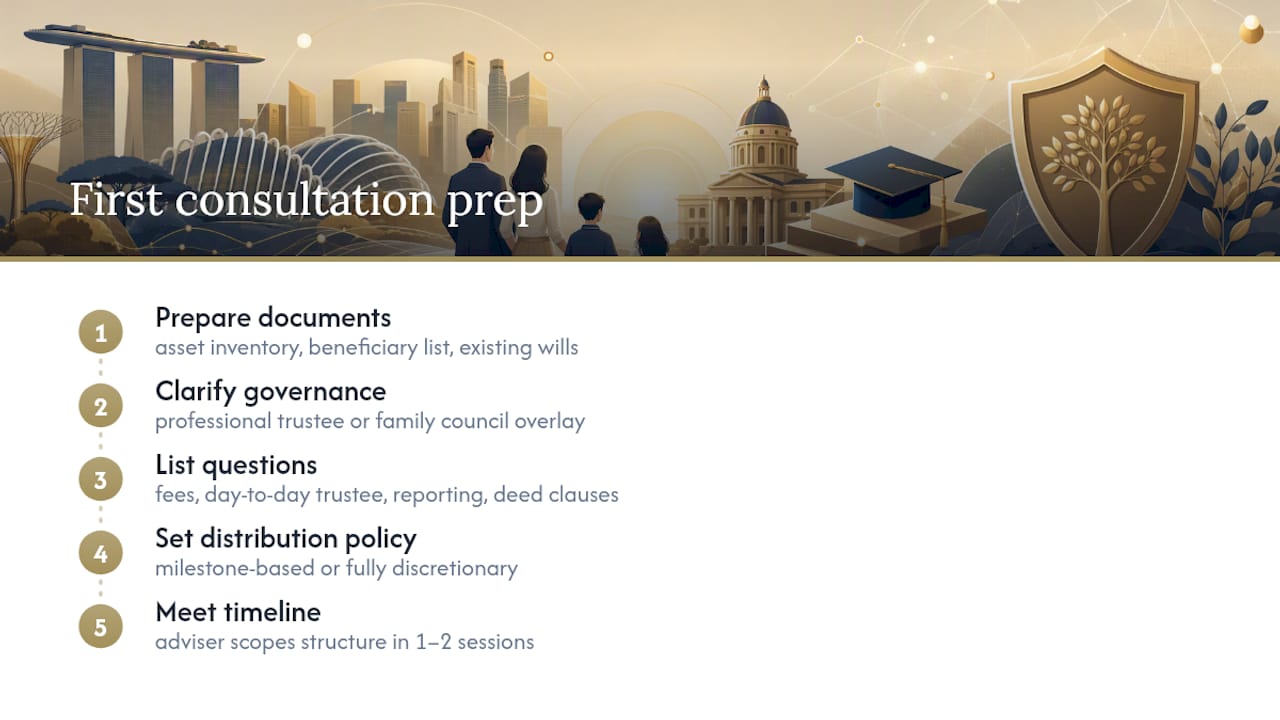
A productive first meeting runs faster when you arrive with an asset inventory, a beneficiary list with ages, any existing wills, and a rough sense of your governance preferences (professional trustee alone, or a family council overlay). Bring questions too: how fees scale with asset value, who exactly serves as trustee day to day, how often you’ll receive reporting, and whether you can review sample deed clauses before committing.
Most advisers can scope a structure recommendation within one or two sessions once they understand your asset base and family dynamics. The decision that speeds things up most is settling on your distribution philosophy, milestone-based versus fully discretionary, before the drafting stage begins.
What Do Practitioners Get Wrong About Education Trusts?
The biggest mistake I see repeated across family trust planning is treating the deed as a finished product rather than a living document. Families sign it, file it, and assume the governance question is solved forever. It isn’t. Circumstances change: a child’s education path shifts, a trustee relationship sours, a family council member steps back.
A PTC earns its cost when a family has the scale and the internal governance discipline to use it well, generally north of that S$50 million mark. Below it, a standalone trust with a sharply written Letter of Wishes and disciplined reporting does more for less. Either way, treat the first year after signing as the start of stewardship, not the end of the project.
— Joseph
How Elite Legacy Planning Supports Your Education Trust Setup
Elite Legacy Planning gives you a single point of contact for the whole process, structuring, drafting, and years of ongoing stewardship, instead of juggling a law firm, a trustee, and a tax adviser separately. That matters most with education trusts, where the deed needs revisiting as children grow and circumstances shift.
Their services span trust consultation and lifetime advisory for families choosing between a standalone trust and a more complex structure, Private Trust Company setup advisory for families at the scale where a PTC makes sense, and Standby/Living Trust arrangements for those who want a trust ready to activate without waiting on probate. Every engagement starts confidential, with governance design built around how your family actually makes decisions, not a template. If you’re ready to talk through your specific situation, book a consultation and bring your asset inventory and beneficiary list to make the first session count.
Sources
This guide draws on Singapore trust practitioner data on structures, costs, and governance from Raffles Corporate Services, Singapore Legal Practice, and legal primers. Confirm current tax and regulatory specifics with a qualified adviser before acting.
This article is general information, not a substitute for advice from a qualified financial advisor. Consult a qualified financial professional about your own circumstances before acting on anything here.
Recommended
Comments