


6 Steps for Families to Set Up a Discretionary Trust in Singapore

A discretionary trust is a Singapore legal structure where a trustee holds legal title to assets and decides how to distribute income or capital among a defined group of beneficiaries. Families use it for succession planning, asset protection, and privacy when a will alone won’t cut it. If you hold significant, complex, or cross-border assets, the next move is a proper consultation with a trust specialist before drafting anything.
TL;DR:
Discretionary trusts in Singapore are ideal for complex estates, cross-border assets, or family needs that a will cannot adequately address.
Proper setup requires clear beneficiary classes, detailed deed drafting, formal asset transfer, and choosing an appropriate trustee structure, often a licensed trust company.
Trustees owe fiduciary duties under Singapore law, with decision rules, a Letter of Wishes, and regular reporting crucial to prevent disputes.
Trusts are taxed based on income source and distribution, with no estate duty or capital gains tax; stamp duty applies on property transfers into trusts.
Common pitfalls include vague beneficiary language, assets not properly retitled, and neglecting to revisit decision guidelines as family circumstances evolve.
Table of Contents
What Is a Discretionary Trust Singapore Structure, Exactly?
Three people (or roles) make a trust work: the settlor, who creates it and transfers assets in; the trustee, who holds legal title and manages those assets; and the beneficiaries, who hold the benefit of the trust without owning the assets directly. Under Ministry of Law guidance, an express trust splits ownership this way, legal title sits with the trustee while beneficial ownership rests with beneficiaries, and the trustee must act according to the trust deed and Singapore law.
The word “discretionary” matters here. In a fixed trust, beneficiaries have a guaranteed share. In a discretionary trust, they hold expectancies, meaning the trustee decides who gets what, when, and how much, within the boundaries the deed sets.
Common assets funded into Singapore trusts include:
Residential and commercial property
Listed and private company shares
Cash and bank deposits
Insurance policies and investment portfolios
For a trust to exist legally at all, it needs to satisfy the “three certainties”: certainty of intention, certainty of subject matter, and certainty of objects (the beneficiaries). Section 7 of the Civil Law Act requires trusts over land to be evidenced in writing, and most practitioners apply the same discipline to every asset class to avoid disputes later.
Why Do Singapore Families Set Up Discretionary Trusts?
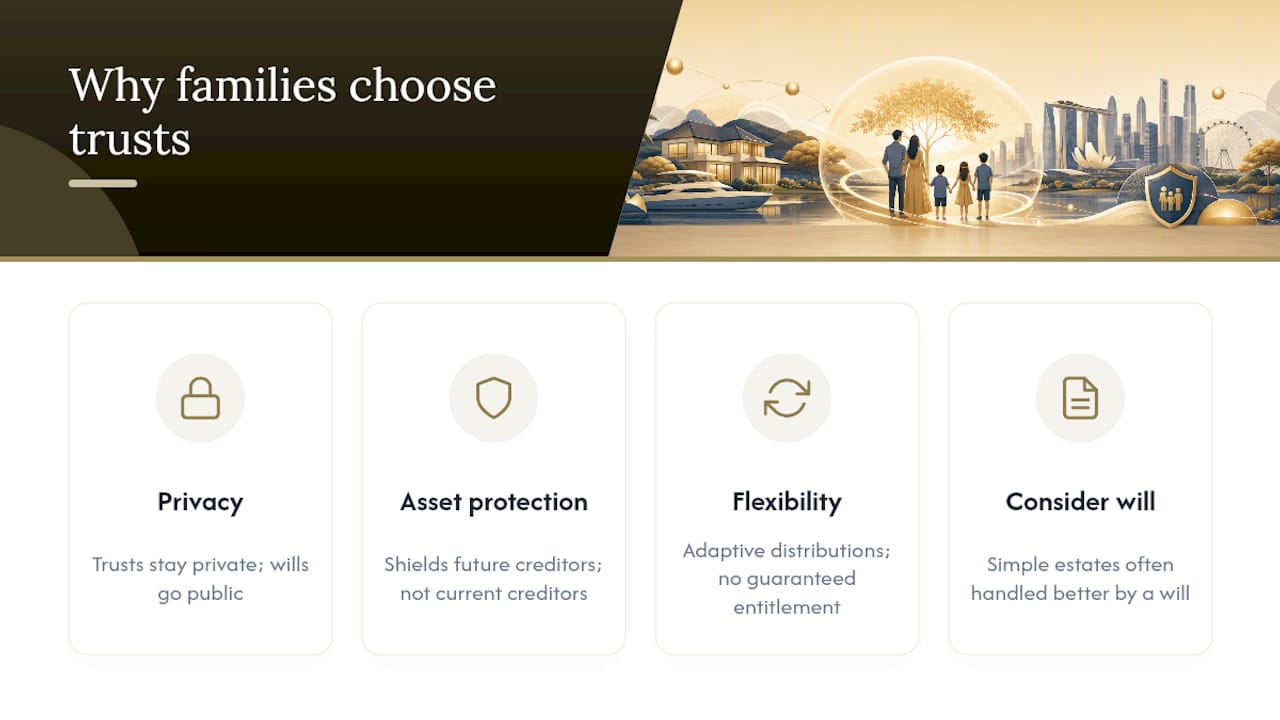
Privacy tops the list for most clients. A will becomes a public document once it passes through probate. A trust, by contrast, operates privately, no court filing broadcasts who inherits what or when. That alone drives a lot of interest from business owners who don’t want employees, competitors, or extended family reading their affairs in a probate file.
Asset protection is the second big draw, though it comes with real limits. Placing assets into a properly constituted trust ahead of time can shield them from a beneficiary’s future creditors or a messy divorce. It does not protect against your own current creditors or an insolvency you saw coming, courts routinely unwind transfers made to defraud existing claims.
Flexibility is the third benefit. A discretionary trust lets a trustee respond to a beneficiary’s circumstances years or decades after the deed was signed, a child who develops a disability, a grandchild who needs school fees before others need capital, a beneficiary going through bankruptcy. The trade off is that no beneficiary can point to a guaranteed entitlement, which unsettles some families more than others.
A trust isn’t always the right call. If your estate is straightforward, a Singapore property, a bank account, and two adult children splitting everything equally, a well-drafted will handles that at a fraction of the cost and complexity.
How to Set Up a Discretionary Trust in Singapore
Setting up a trust properly takes more than signing a document. Here’s the sequence most advisers follow:
Define your objectives and beneficiary classes. Decide who benefits (children, grandchildren, a spouse, a charity), and whether you want equal treatment or trustee discretion weighted toward need.
Draft the trust deed. This document sets out trustee powers, beneficiary classes, distribution rules, and investment authority. Pair it with a Letter of Wishes, a non-binding but practically important guide to how you want discretion exercised.
Satisfy the legal formalities. The deed must meet the three certainties and, where land is involved, comply with the writing requirement under Section 7 of the Civil Law Act.
Fund the trust. Transfer property titles, retitle bank accounts, and assign shares into the trustee’s name. This step gets skipped or half-finished more often than people expect, an unfunded trust is a legal document with nothing in it.
Choose your trustee structure. An individual trustee (often a family member), a licensed trust company, or a Private Trust Company (PTC) each carry different governance and cost profiles. Market guidance on Singapore trust structures shows most families use licensed trustees, reserving PTCs for very large, governance-heavy structures.
Check tax, cross-border, and philanthropic angles. If you’re a foreigner with Singapore assets, or setting up a charitable trust, additional rules apply.
Pro Tip: Fund the trust before you finalize other estate documents. A beautifully drafted deed holding zero assets does nothing for your family, confirm every transfer of title has actually gone through before you consider the structure complete.
Setting up a family trust in Singapore usually takes weeks to a few months, faster for simple cash and share transfers, slower when property, cross-border assets, or a PTC are involved.
What Do Trustees Actually Owe Beneficiaries?
Trustees aren’t just administrators, they’re fiduciaries. The Trustees Act 1967 sets out these duties in Singapore law: acting with care, avoiding conflicts of interest, investing prudently, and treating beneficiaries impartially unless the deed says otherwise.
Discretion without structure invites disputes. The tools that keep discretionary decisions predictable rather than arbitrary include:
A written Letter of Wishes recording the settlor’s priorities for distributions
A documented investment policy so trustees aren’t making ad hoc calls
A clear distribution policy setting review timing and criteria
A protector role, someone with veto power over major trustee decisions, for extra oversight
Regular reporting to beneficiaries or their representatives
One provision worth understanding well: Section 90A of the Trustees Act 1967 lets a settlor reserve investment powers to themselves rather than handing full control to the trustee, without invalidating the trust. Settlors who are active investors and don’t want to lose the wheel on their portfolio use this often. The safeguard is documenting exactly which powers are reserved and how they interact with the trustee’s remaining duties, vague reservation clauses cause more arguments than they prevent. A clear, periodically updated Letter of Wishes does more to head off family disputes than almost any other single document, precisely because it puts settlor intent on paper while leaving legal discretion intact.
What Does a Discretionary Trust Cost in Singapore?
Costs scale with complexity, not with good intentions. A standard trust deed with a licensed trustee costs meaningfully less to establish and run than a Private Trust Company, which requires its own incorporation, board, and compliance infrastructure.
Setup: legal drafting fees for the deed and Letter of Wishes, plus trustee onboarding costs
Ongoing: trustee administration fees, annual accounting, tax filing, and compliance reviews
Timeline: straightforward trusts with cash and shares can be live within weeks; trusts involving property transfers, cross-border assets, or a PTC structure often take a few months
Complexity multiplier: a PTC adds real governance value for very large family structures but brings materially higher setup and running costs than a licensed trustee, per industry guidance
A Private Trust Company makes sense once family governance, not just asset protection, becomes the priority.
Where Discretionary Trusts Go Wrong
Most trust failures aren’t legal, they’re operational. A deed can be perfectly valid and still fail the family it was built for. Legal commentary on Singapore trust practice makes this point directly: a discretionary trust performs best inside a real governance system, and often fails in practice without one, even when the underlying document is sound.
The recurring mistakes:
No decision rules for the trustee to follow, leaving every distribution feeling arbitrary to beneficiaries
Vague beneficiary language (“my descendants” without defining generations or inclusion criteria)
Assets that were never properly retitled into the trust’s name
A Letter of Wishes written once and never revisited as family circumstances change
Pro Tip: Review your Letter of Wishes every time a major family event happens, a birth, a marriage, a falling out. A five-year-old wish letter that ignores a divorce or a new grandchild causes more friction than having no letter at all.
How Are Discretionary Trusts Taxed in Singapore?
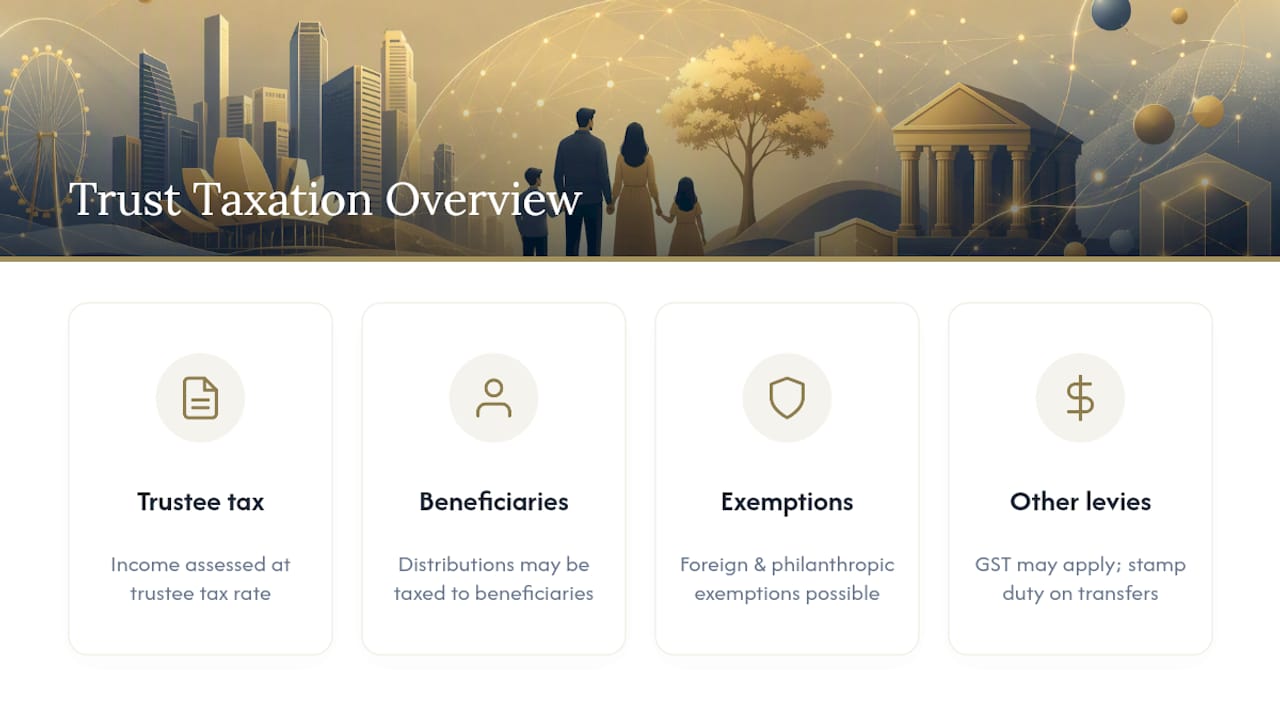
Trust taxation in Singapore hinges on where income comes from and how it’s distributed, not on the existence of the trust itself. Trust income is generally assessed at the prevailing trustee tax rate, though distributions to Singapore-resident beneficiaries can, depending on the trust’s terms and the income’s nature, be taxed instead in the beneficiary’s hands.
Foreign-sourced income held through certain qualifying trust structures may benefit from exemptions, and philanthropic purpose trusts follow their own regime entirely: the Income Tax (Exemption of Income of Foreign Account of Philanthropic Purpose Trust) Regulations 2007 sets out specific exemption criteria for qualifying charitable structures holding foreign accounts.
Singapore has no estate duty and no capital gains tax, which is part of why trusts here focus more on control, privacy, and succession than tax avoidance. That said, GST considerations can arise where a trust operates a business or receives certain taxable supplies, and stamp duty applies when property is transferred into or out of a trust, the same buyer’s stamp duty and additional buyer’s stamp duty rules that apply to any Singapore property transaction generally apply to a transfer into trust, so factor that into your funding plan rather than treating it as a later surprise.
Cross-border families should also check Monetary Authority of Singapore guidance and relevant tax treaties before funding a trust with foreign assets, since treatment can differ sharply from a purely domestic structure. None of this is a substitute for a tax adviser reviewing your specific asset mix.
Discretionary Trusts vs. Wills, FLPs, and Nominee Arrangements
A will is cheaper and simpler, but it only takes effect on death, goes through probate publicly, and offers zero flexibility once you’re gone. A testamentary trust can be written into a will to add some of a discretionary trust’s flexibility, but it still starts only after death and still passes through the probate process first.
A Family Limited Partnership structures ownership of a family business or investment portfolio among partners, with a general partner controlling management. FLPs suit families who want centralized control over an operating business more than they suit pure succession or asset protection planning, and they don’t offer the same privacy from creditors that a properly funded trust can.
Nominee arrangements, where someone holds an asset in their name for your benefit informally, are the weakest option here. They carry no fiduciary duties, no written governance, and minimal legal protection if the nominee dies, becomes incapacitated, or simply refuses to cooperate. They’re sometimes used for short-term convenience but shouldn’t substitute for proper estate structuring.
A living trust takes effect immediately, during your lifetime, which is the core distinction from both a will and a testamentary trust: it lets you see the structure work, adjust it, and pass control smoothly if you become incapacitated, without a court ever getting involved.
Appointing and Removing Trustees Under Singapore Law
The trust deed itself usually sets out who has power to appoint or remove a trustee, commonly the settlor during their lifetime, then a named protector or the majority of beneficiaries afterward. Where the deed is silent, the Trustees Act 1967 provides default mechanisms for appointing replacement trustees, including when a trustee dies, becomes unfit, refuses to act, or wants to retire.
Removing a trustee for poor performance is possible but not casual. Courts and deeds generally require a genuine reason, breach of duty, conflict of interest, incapacity, rather than simple dissatisfaction with a discretionary decision the beneficiaries didn’t like. This is exactly why governance documents matter so much: a trust with clear decision rules and reporting requirements gives everyone an objective basis for judging trustee performance, rather than relying on subjective disappointment after the fact.
When appointing a new trustee, whether replacing someone or adding a co-trustee, families should confirm the candidate’s capacity to act, check for conflicts of interest (a trustee who is also a major beneficiary raises questions), and formally document the transfer of trust assets and records. Skipping the paperwork here creates exactly the kind of ambiguity that turns into a dispute five or ten years down the line.
Staying Compliant: AML and Reporting Obligations
Singapore’s trust industry operates under real anti-money laundering scrutiny. Licensed trust companies must conduct customer due diligence on settlors and beneficiaries, verify the source of funds going into a trust, and file suspicious transaction reports where warranted, obligations that sit alongside their duties under the Trustees Act 1967.
For families funding a trust with foreign-sourced assets, expect deeper due diligence, documentation proving legitimate asset origin, and possibly additional scrutiny under Monetary Authority of Singapore oversight of the trust and wealth management sector. This isn’t unique to Singapore, but Singapore’s reputation as a trusted wealth hub depends on maintaining these standards, so expect thorough onboarding rather than a rubber stamp.
Charitable and philanthropic trusts carry their own compliance layer on top of standard AML checks: registration with the Commissioner of Charities and ongoing compliance under the Charities Act, including annual reporting obligations that private discretionary trusts don’t face at all. If you’re structuring a philanthropic vehicle rather than a family trust, budget time for this registration process separately from the trust deed itself.
Recent and Upcoming Changes Worth Watching
Singapore’s trust framework doesn’t change overnight, and that stability is part of the appeal for families choosing where to base a structure. But the regulatory environment around trusts keeps tightening at the edges, particularly on AML compliance, beneficial ownership transparency, and cross-border reporting standards tied to international tax information exchange commitments.
Practically, this means new trusts face somewhat more rigorous onboarding than trusts set up a decade ago, more documentation, more source-of-funds verification, more ongoing monitoring. Families setting up a trust now should expect trustees, whether individual, licensed, or PTC, to ask more questions upfront than they might have in the past. That’s not a reason to delay, it’s a reason to work with an adviser who keeps current with the compliance landscape rather than drafting a deed and walking away.
Charitable and Philanthropic Trusts: A Different Animal
A charitable or philanthropic trust serves a public purpose rather than named individuals, and Singapore regulates it accordingly. Where a private discretionary trust answers to its beneficiaries and settlor, a charitable trust must register with the Commissioner of Charities and comply with the Charities Act, which brings ongoing public reporting obligations that private trusts simply don’t carry.
Tax treatment diverges too. Qualifying philanthropic purpose trusts holding foreign accounts can access exemptions under the Income Tax (Exemption of Income of Foreign Account of Philanthropic Purpose Trust) Regulations 2007, a regime built specifically for charitable structures and entirely separate from how private family trusts are taxed.
Families sometimes blend the two, a private discretionary trust for the family, with a separate charitable trust or foundation for giving. That’s usually cleaner than trying to fold philanthropic goals into a private trust’s beneficiary class, since the regulatory and tax regimes genuinely don’t overlap.
When We Recommend a Discretionary Trust
We steer families toward a discretionary trust when the estate is complex enough, multiple properties, a business, beneficiaries with different needs, cross-border assets, that a will’s rigidity becomes a liability rather than a simplicity. For a straightforward estate with clear, equal beneficiaries, we’ll say so plainly and recommend a well-drafted will instead.
Where we spend real time is governance: building a Letter of Wishes that actually guides trustee discretion, and choosing between an individual trustee, a licensed trust company, or a PTC based on family size and complexity, not on what sounds most impressive. The best next step is usually a discovery meeting where you bring your asset list and family situation, and we tell you honestly whether a trust fits.
— Joseph
How Elite Legacy Planning Helps You Build the Right Structure
Getting a discretionary trust right in Singapore means combining legal precision with governance that actually holds up over decades, not just at signing. Elite Legacy Planning is the practical option for Singapore families who want that combination handled by specialists rather than pieced together from templates.
Our Trust Consultation & Lifetime Advisory service walks you through objectives, beneficiary structuring, and deed drafting, then stays with you as an ongoing adviser as circumstances change. For families weighing governance and control, our Private Trust Company setup service covers incorporation and board structuring, while our Living Trust option suits those who want protection and continuity to start immediately rather than after death.
A first engagement typically starts with a review of your assets and family goals, followed by a clear recommendation on structure, cost, and timeline before you commit to anything. Explore our full range of estate planning services or book a consultation to start the conversation.
This article is general information, not a substitute for advice from a qualified lawyer. Consult a qualified legal professional about your own circumstances before acting on anything here.
Sources
Recommended
Comments