


Practitioner View: Corporate Executors in Singapore and Family Disputes


For high-value, complex, or cross-border estates in Singapore, appointing a corporate or professional executor is often the most reliable option. It suits estates with overseas assets, business interests, or family tension where neutrality matters more than sentiment. Fees are typically paid from the estate itself, not out of pocket, and many families pair a corporate executor with a trusted relative for joint appointment.
TL;DR:
Corporate executors are often better suited for estates with overseas assets, complex structures, or family disputes due to their procedural discipline and impartiality.
They must be named specifically in the will, with proper consent obtained before the estate’s probate begins, and are limited by eligibility criteria similar to individuals.
Fees typically include an appointment retainer and an estate-based administration fee, both paid from the estate, with costs varying based on complexity and provider.
Choosing a provider involves assessing probate experience, indemnity coverage, fee clarity, and continuity plans, with clear service agreements being essential.
Complex estates involving cross-border assets, family disputes, or illiquid assets benefit most from professional management, especially when high stakes or multiple jurisdictions are involved.
Table of Contents
What Does a Corporate Executor Do in Singapore?
A corporate or professional executor is a law firm, licensed trust company, or corporate trustee named in a will to administer an estate instead of (or alongside) a family member. Where an individual executor brings personal knowledge of the deceased’s wishes, a corporate executor brings procedural discipline and no emotional stake in who gets what.
The distinction matters most when disputes are likely or the estate spans multiple jurisdictions. An individual executor, often a spouse or adult child, may be grieving, unfamiliar with probate mechanics, or vulnerable to pressure from other beneficiaries. A corporate executor sidesteps all three problems by design.
Core duties look the same regardless of who holds the role, but a corporate executor typically has established workflows for each step:
Applying for the Grant of Probate through the Family Justice Courts
Compiling a full inventory of assets and arranging valuations, including property, shares, and overseas holdings
Notifying creditors and settling outstanding debts before distribution
Handling tax clearances with IRAS and coordinating CPF nominations
Distributing assets according to the will and preparing final accounts for beneficiaries
Providers range from boutique estate planning firms to large trust companies, and the right fit depends on estate size and complexity rather than brand recognition alone.
Who Is Legally Allowed to Act as an Executor?
Singapore law sets a low bar for individual executors but a firm one. An executor must be at least 21 years old, of sound mind, and not an undischarged bankrupt at the time the Grant of Probate is applied for. Corporate and professional executors, including lawyers, law firms, and trust companies, are explicitly permitted to act, provided the authorized officer handling the estate meets the same personal fitness standard.
In practice, this means a corporate executor does not bypass the eligibility rules. It satisfies them through a named professional acting on the company’s behalf, with the firm’s institutional processes backing that individual.
A few practical points worth knowing:
The corporate executor must be named specifically in the will, usually by full legal entity name rather than a generic description like “our lawyers.”
Authority to act only begins once the Family Justice Courts issue the Grant of Probate, not automatically at death.
Expat families with assets in more than one country should check whether the corporate executor has experience coordinating with foreign probate registries, since Singapore’s grant does not automatically extend overseas.
Why Choose a Corporate Executor Over a Family Member?
The case for a corporate executor rests on impartiality. A neutral third party enforces the will as written, without the pull of old family loyalties or resentments, and that impartiality is often cited as the single biggest reason families hire professional executors rather than a sibling or adult child.
Three other benefits tend to matter most for Singapore estates:
Continuity. A corporate executor does not fall ill, emigrate, or lose capacity the way an individual might, which matters if the estate takes months or years to settle.
Technical competence. Cross-border assets, business succession, and CPF or IRAS matters get handled by people who do this work daily, not once in a lifetime.
Reduced dispute risk. Beneficiaries are less likely to challenge a professional’s neutral decisions than a family member’s, which can shorten administration considerably.
The trade-offs are real too. Fees add cost that a family executor would not charge, some families feel the process loses a personal touch, and the estate becomes somewhat dependent on that provider staying in business and responsive over time. Most of this can be managed with a joint appointment (professional plus family member), clear written instructions in the will, and a service agreement that spells out reporting expectations upfront.
Pro Tip: If family harmony is a real concern, name a corporate executor as the primary decision maker but keep a family member as a joint executor for input on sentimental items like heirlooms or property use. It gives beneficiaries a voice without reopening every decision to debate.
How Much Does a Corporate Executor Cost in Singapore?
Corporate executor fees generally split into two parts: an appointment fee (sometimes called a retainer) paid to be named and available, and an administration fee charged once the executor actually starts working the estate. Market commentary on professional executor fees in Singapore has historically placed appointment fees typically range from a few thousand Singapore dollars to higher amounts, with administration fees generally charged as a percentage of the estate depending on complexity and provider.
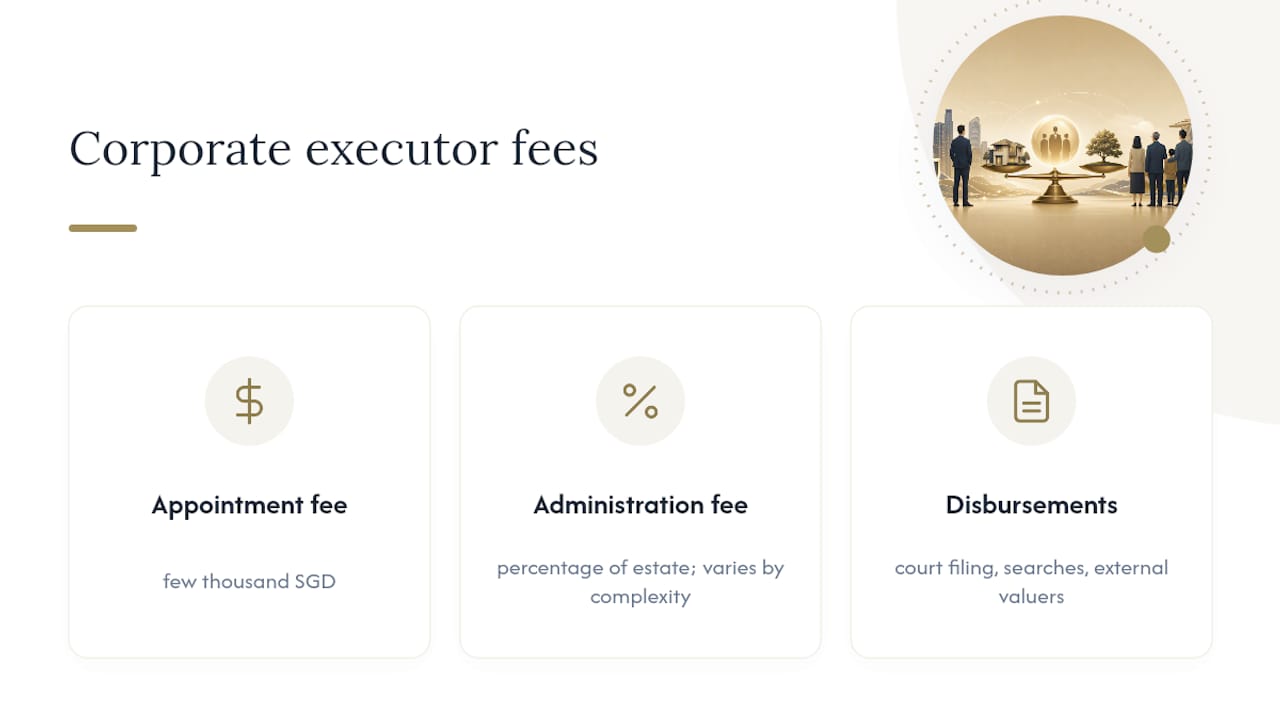
Beyond the executor’s own fee, expect standard probate disbursements: court filing fees, search fees, and charges from any external valuers or advisors brought in for specific assets.
The good news is that these costs are ordinarily paid from the estate itself, not out of the executor’s or a beneficiary’s own pocket. The exception is estates that are asset-rich but cash-poor at the start, where an executor may need to advance certain costs before liquid funds become available, then recover them once assets are sold or released.
How Do You Name a Corporate Executor in a Will?
Naming a corporate executor is a drafting exercise, not a formality to rush through. The will should identify the entity by its full legal name and registration details, avoid vague phrasing, and state clearly whether the corporate executor acts alone or jointly with a named family member.
Getting the wording right upfront avoids questions later, when nobody is around to clarify intent. Consider these steps when drafting or updating a will through a comprehensive will service:
Name the primary corporate executor and at least one backup or substitution clause in case the firm is unavailable
Specify whether a family member is appointed jointly, and how disagreements between joint executors get resolved
Confirm the corporate executor has given written consent to act before the will is finalized
Clarify how the appointment fee will be paid and whether it is triggered at death or at the start of administration
Pro Tip: Get written confirmation from the corporate executor before signing the will. A firm named without prior consent can decline to act when the time comes, leaving the court to appoint someone else entirely.
What Happens After Death? A Practical Timeline
Estate administration with a corporate executor moves through three broad phases, and knowing the order helps families set realistic expectations.
Immediate tasks (first few weeks): Secure the property, locate the original will and financial records, and notify banks and the CPF Board of the death.
Mid-stage tasks (weeks to several months): File the probate application, often through the Family Justice Courts’ probate e-service, value all assets, and give creditors time to make claims.
Final-stage tasks (final months): Settle debts and taxes, distribute assets according to the will, and prepare final accounts for beneficiaries to review.
Straightforward local estates can sometimes clear probate within a few months. Anything involving disputes, foreign property, or trust structures tends to stretch well beyond that, and a corporate executor’s job is largely managing that uncertainty without losing momentum.
How Do You Choose the Right Corporate Executor?
Not all providers operate the same way, and the differences show up most when an estate gets complicated. Focus the evaluation on a handful of concrete criteria rather than reputation alone.
Probate experience. Ask how many estates of similar size and complexity the firm has actually administered.
Indemnity and accountability. Confirm what professional indemnity coverage protects beneficiaries if something goes wrong.
Continuity planning. Find out what happens to your estate’s file if your named contact leaves the firm.
Fee transparency. Get the fee structure in writing before signing anything, not after administration begins.
Client servicing. Ask how often beneficiaries receive updates and in what format.
Good questions to raise in an initial meeting: How long did your last three probate cases take from filing to distribution? How do you handle disagreements between joint executors? Can you provide references from past engagements?
Red flags worth walking away from include vague answers about fee structure, reluctance to put indemnity arrangements in writing, or an inability to explain how they would handle a contested estate.
What Should a Service Agreement With a Corporate Executor Cover?
The relationship between a testator and a corporate executor is usually formalized well before death, through an engagement letter or service agreement rather than the will alone. This document does the practical work the will cannot: it sets expectations for both sides while the testator is still alive to negotiate terms.
A solid agreement typically covers the fee structure in full, distinguishing the appointment fee from the administration fee and stating whether either is refundable if plans change. It should specify what triggers the administration fee (death and instruction to proceed, typically) and how disbursements like court fees and third-party valuations get invoiced and reimbursed from the estate.
Indemnity and insurance arrangements deserve their own clause. Beneficiaries should be able to see, in writing, what recourse exists if the executor mishandles funds or misses a statutory deadline. Reporting cadence matters too: how often will beneficiaries receive updates, and in what form, once administration begins.
Continuity provisions round out a well-drafted agreement. Since these engagements can sit dormant for years or decades before they’re activated, the agreement should address what happens if the named professional leaves the firm, if the firm merges or is acquired, or if the testator wants to revoke the appointment later. None of this needs to be complicated, but it does need to be explicit, because vague language in a document nobody revisits for twenty years causes exactly the disputes a corporate executor was hired to avoid.
What Challenges Do Corporate Executors Face With Complex Estates?
Complex estates test a corporate executor’s systems in ways a simple, single-asset estate never does. Business succession is a common flashpoint: when the deceased owned a private company, the executor has to balance winding up or transferring the business against keeping it running for employees and creditors, often under time pressure and without the deceased’s institutional knowledge to draw on.
Cross-border assets create a separate layer of difficulty. A Singapore Grant of Probate does not automatically carry legal weight overseas, so a corporate executor administering an estate with property in Malaysia, the UK, or Australia usually has to coordinate parallel legal processes in each jurisdiction, each with its own timeline and documentation requirements.
Family disputes over asset division, contested wills, or accusations of unequal treatment among beneficiaries also surface more often in larger estates. A corporate executor’s response is typically procedural: documenting every decision, communicating reasoning in writing, and, where necessary, seeking directions from the court rather than making a unilateral call on a contested point.

Illiquid estates present a quieter but persistent problem. When most of the value sits in property or a business rather than cash, the executor may need to advance certain costs and time distributions around asset sales, which stretches the overall timeline even when there is no dispute at all.
Publisher Perspective: Elite Legacy Planning’s View
We see corporate executorship chosen most often by high-net-worth families, family offices, and households with assets or relatives spread across more than one country. These are estates where a well-meaning relative, however capable, would be administering something genuinely outside their depth.
Elite Legacy Planning structures engagements with written indemnity terms, a clear reporting cadence for beneficiaries, and nominated backups so continuity never depends on one individual staying available for decades. If your estate looks complicated enough that you’ve hesitated to name a single family member as sole executor, that hesitation is worth a proper conversation rather than a guess.
— Joseph
How Elite Legacy Planning Can Help You Plan Ahead
Elite Legacy Planning works with affluent families across Singapore on comprehensive wills, trust consultation, private trust company structures, and corporate executorship, all built around the same goal: making sure your estate is handled the way you actually intended, not however it happens to shake out.

An initial consultation focuses on your specific situation, business interests, family structure, cross-border assets, and where a corporate executor makes sense versus a joint appointment with a relative. Fee structures are laid out clearly before any engagement begins, covering both the appointment and administration components discussed earlier in this guide. For families exploring longer-term continuity, our private trust company service pairs well with executorship planning for multi-generational wealth.
If you’re ready to review your will or discuss appointing a corporate executor, book a consultation or check our pricing plans for details on engagement fees.
Where to Verify Singapore Probate Rules
For readers who want to confirm procedures directly, the Family Justice Courts publish forms and guidance for filing a Grant of Probate application, including e-service options for faster processing. MyLegacy@LifeSG offers step-by-step guidance for next of kin and executors navigating the process for the first time. For CPF-specific questions, the Public Trustee’s Office guidance on deceased CPF monies outlines how nominated and non-nominated funds are handled after death.
This article is general information, not a substitute for advice from a qualified lawyer. Consult a qualified legal professional about your own circumstances before acting on anything here.
Sources
Recommended
Comments