


Trust Letter of Wishes: A Practical Drafting Guide


A trust letter of wishes is a private, advisory document written by a settlor to guide trustees in exercising their discretionary powers. It is generally non-binding under U.S. trust practice, meaning trustees must consider it but retain full fiduciary discretion. Here is what to do right now:
Check your trust deed to see whether it references or requires a letter of wishes.
Draft or update a dated, signed advisory letter addressed to your trustees.
Store the letter with your trust papers and tell your trustees it exists.
Consult a trust attorney if you want any instruction to carry binding legal force, since that requires an amendment to the trust instrument itself.
Trustees who receive such a letter must treat it as a material consideration, but they are never automatically bound by it. Their fiduciary duties and the trust deed always take precedence.
Key Takeaways
A trust letter of wishes is advisory, not binding, but trustees must consider it and document their reasoning every time it influences a discretionary decision.
Point | Details |
Legal status | Letters of wishes are non-binding in U.S. trust practice; trustees must consider but retain fiduciary discretion. |
What to include | Date, signature, advisory statement, beneficiary background, distribution priorities, and special-purpose wishes. |
Tone discipline | Use “I hope” and “I would prefer” rather than “shall” or “must” to avoid creating apparent binding instructions. |
Storage and updates | Keep the original with trust papers, notify trustees, and issue a dated supersession note with every new version. |
Elitelegacyplanning | Offers trust consultation and lifetime advisory to align your letter of wishes with your formal trust structure. |
Table of Contents
What a trust letter of wishes actually is
Also called a memorandum of wishes, expression of wishes, or letter of guidance, this document sits alongside a trust or will and speaks directly to the people administering your estate. Wikipedia’s overview of letters of wishes describes it as a tool settlors use to pass non-binding guidance to trustees and executors.
The most common contexts are discretionary trusts, where trustees have wide powers over who gets what and when. A letter of wishes fills in the human detail the trust deed deliberately leaves open: why you want one child to receive more than another, which grandchild should get the family heirloom, or how you’d like funds used for education. It also appears alongside wills to guide executors on sentimental items, funeral preferences, or guardianship decisions.
One practical advantage over a will or trust deed: the letter stays private. It is not filed with probate courts and does not become part of the public record unless a dispute forces disclosure. Updating it costs nothing beyond your time, no attorney required, no deed amendment, no court filing.
When and why you would use one
A letter of wishes earns its place in several specific situations:
Guiding discretionary trustees on timing and size of distributions when the deed gives them broad latitude.
Explaining unequal treatment among beneficiaries so trustees understand the reasoning and can defend decisions if challenged.
Naming people to consult after your death, such as a surviving spouse or a trusted family advisor.
Recording education or values preferences, for example, that you want funds used for university before any lifestyle spending.
Capturing funeral and burial preferences that you do not want buried inside a formal legal document.
What a letter of wishes cannot do is equally important. It cannot change who legally inherits. It cannot create a new gift or override a trust term. Attempting either in a letter of wishes, rather than in the trust deed or will itself, is one of the most common drafting mistakes practitioners see, according to Culver Law’s drafting do’s and don’ts. If you want a specific outcome to be guaranteed, it belongs in the formal document, full stop.
The letter’s flexibility is its strength and its limit. You can rewrite it every year as family circumstances shift without paying for a deed amendment. But that flexibility comes with no enforcement mechanism.
Legal status in the United States: what trustees need to know
Letters of wishes are generally non-binding in U.S. trust practice. A trustee who ignores one entirely may still be acting within their fiduciary duty, provided they have considered all relevant factors. Conversely, a trustee who follows a letter mechanically, without independent judgment, risks breaching their duty to beneficiaries.
Kennedy’s Law’s analysis of discretionary trusts frames this precisely: a settlor’s letter of wishes is a material consideration that trustees should take into account, but trustees retain independent fiduciary judgment and are not automatically bound by the letter. Courts expect trustees to weigh the letter alongside the trust deed, the beneficiaries’ circumstances, and any other relevant factors.
Trustees should depart from a letter of wishes when:
Following it would conflict with the trust deed or applicable law.
Circumstances have changed so significantly that the letter no longer reflects what the settlor would have wanted.
The letter is ambiguous or contradictory.
Following it would harm a beneficiary’s best interests.
The table below maps the three categories of trustee guidance by legal weight.
Category | Legal weight | Trustee obligation |
Binding trust terms (in the deed) | Fully enforceable | Must follow; breach is actionable |
Legally significant guidance (letter of wishes) | Non-binding but material | Must consider; must document reasoning |
Informal wishes (verbal, undated notes) | Minimal | May consider; no formal obligation |
Overly prescriptive wording in a letter of wishes creates real risk. Language that reads like a command (“the trustees shall distribute…”) can invite a beneficiary to argue the letter was intended to be binding, triggering litigation. Keep the tone advisory throughout.
What to include: a practical content checklist
The Basel Governance sample letter of wishes and the Morgan Stanley sample letter both follow a consistent structure that wealth-management practitioners find useful. Use this checklist as your drafting framework.
Element | What to write | Why it matters |
Addressee | Name the trustee(s) or trust company | Confirms who the letter is for |
Advisory statement | “This letter is not legally binding and is intended as guidance only” | Prevents it from being read as a binding instruction |
Date and signature | Your full name, date, and wet signature | Establishes currency and authenticity |
Beneficiary background | Brief personal context for each beneficiary | Helps trustees understand your reasoning |
Distribution priorities | Ranked guidance on how and when to distribute | Gives trustees a clear starting point |
Special-purpose gifts | Sentimental items, specific funds for education or health | Captures intent that the deed leaves open |
Funeral preferences | Burial, cremation, service wishes | Keeps this out of the will, where it may be read too late |
Storage note | Where the original is kept | Trustees can locate it when needed |
Tone matters as much as content. Write in plain, factual sentences. Explain your reasoning rather than issuing instructions. “I hope the trustees will consider funding Sarah’s medical school tuition before any other distribution” lands very differently from “The trustees must fund Sarah’s medical school tuition.”
Pro Tip: Aim for specificity on the things that matter most, but leave room for trustee judgment on everything else. A letter that tries to script every scenario becomes a liability, not a guide.
How to draft, sign, store, and update the letter
Read the trust deed first. Check whether it references a letter of wishes, sets any format requirements, or limits trustee discretion in ways that affect what you need to say.
Identify your addressee. Name the current trustee(s) or the trust company. If trustees change, plan to reissue the letter.
Open with an explicit advisory statement. The first substantive paragraph should state clearly that the letter is not legally binding and is intended solely as guidance.
Write the substantive guidance. Cover beneficiary background, distribution priorities, and any special-purpose wishes. Keep each section short and factual.
Sign and date the letter. A wet signature and a clear date are the minimum. Some practitioners also have the letter witnessed, though this is not legally required for a non-binding document.
Store the original with your trust papers. Give a copy to your trustee or trust company and note its existence in a cover memo.
Update it when circumstances change. Marriage, divorce, a beneficiary’s death, or a significant change in assets are all triggers. Each new version should be dated and should state that it supersedes all prior letters.
Format guidance: one to two pages is the practical ceiling. Longer letters tend to introduce ambiguity and are harder for trustees to act on quickly. Plain language beats legal jargon here.
Pro Tip: Keep a simple version log, a one-page cover memo that lists each letter by date and confirms which is current. When a trustee is appointed years after you wrote the letter, that log removes any doubt about which version governs.
An editable example letter of wishes
The following sample, drawn from practitioner templates including the Morgan Stanley sample letter of wishes, illustrates the standard structure. Adapt the bracketed fields to your situation.
Letter of Wishes Date: To: [Name of Trustee(s) / Trust Company] Re: [Name of Trust] established [date of trust deed] This letter is written in a personal capacity and is not legally binding. It is intended solely as guidance to assist you in exercising your discretionary powers under the above trust. I understand that you retain full fiduciary discretion and that this letter does not fetter that discretion in any way. Background on beneficiaries: [Briefly describe each beneficiary’s circumstances, needs, and your relationship with them.] Distribution priorities: My preference is that distributions be made first for [health, education, maintenance — customize], with particular attention to [specific beneficiary or need]. I recognize that circumstances may change and trust your judgment accordingly. Special-purpose wishes: I would like [specific item or fund] to pass to [beneficiary] if practicable, as [brief reason]. Funeral preferences: [Optional — include only if not addressed elsewhere.] I ask that you treat this letter as confidential. Please retain it with the trust papers. I intend to review and update it periodically. Signed: _________________________ Date: _____________ [Full legal name]
When customizing, watch for two specific risks. First, avoid “shall” and “must” in your instructions; replace them with “I hope,” “I would prefer,” or “my wish is.” Second, cross-check every named beneficiary and asset against your trust deed and will to confirm there is no contradiction. A letter that conflicts with the deed creates exactly the dispute it was meant to prevent.
How trustees should use a letter of wishes in practice
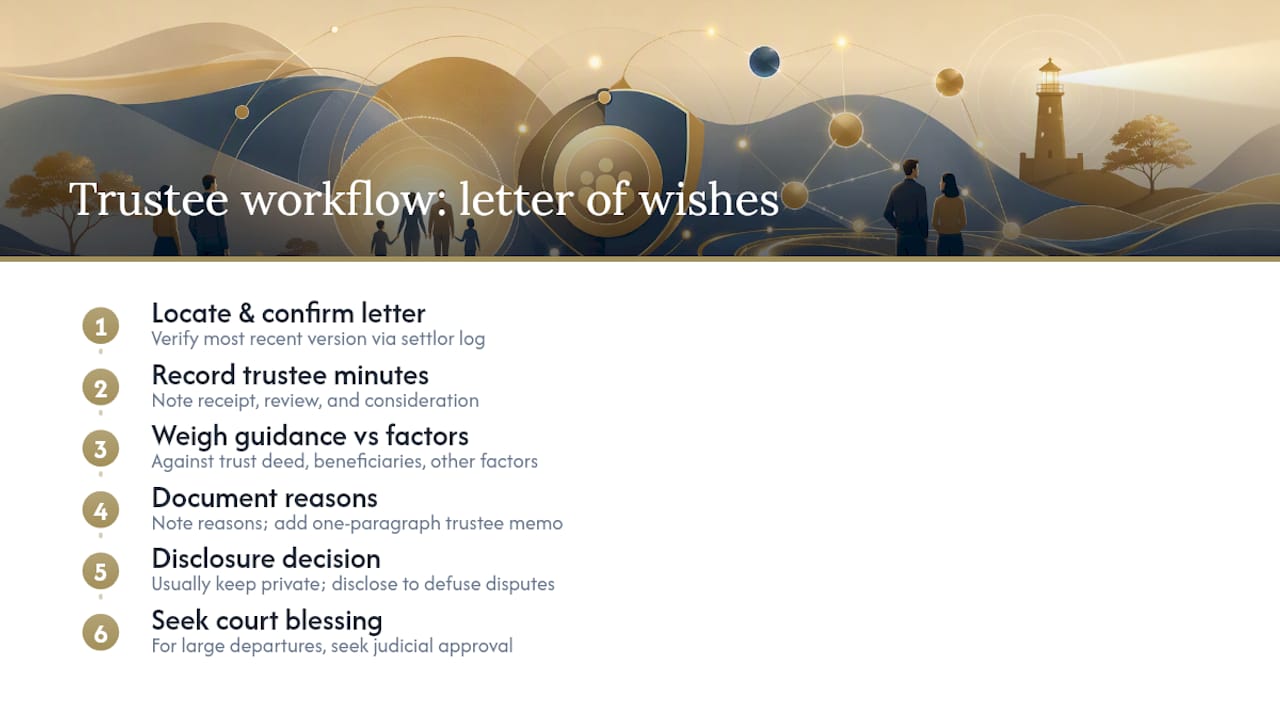
When a letter of wishes arrives, or when a trustee first takes office, the practical workflow matters. Locate the letter and confirm it is the most recent version using any version log the settlor kept. Record in trustee minutes that the letter was received, reviewed, and considered as part of the decision-making process.
From there, weigh the letter’s guidance against the trust deed, the beneficiaries’ current circumstances, and any other relevant factors. The FDIC’s guidance on fiduciary recordkeeping underscores that documented decision-making is the foundation of defensible trustee conduct. If you follow the letter, note why. If you depart from it, note why with equal care.
Disclosure to beneficiaries is a judgment call. In most U.S. discretionary trusts, trustees are not required to share the letter with beneficiaries, and doing so can sometimes create expectations that complicate future distributions. When a decision is contested, however, proactive disclosure often defuses disputes before they escalate.
For genuinely unusual decisions, such as a large distribution that departs significantly from the letter’s guidance, trustees may want to seek a court blessing order. This is a formal judicial approval that protects trustees from later challenge and is worth the cost when the stakes are high.
Pro Tip: Draft a short trustee memo each time you make a discretionary decision, noting the letter’s guidance and your reasoning. A one-paragraph note takes five minutes and can save years of litigation.
Storage, confidentiality, and who may see the letter
Keep the original letter with the trust deed and will, in a secure location your executor and trustees can access. A secure digital copy, stored in an encrypted file or with a trust company, provides a useful backup. Notify your trustee or trust company in writing that the letter exists and where it is held.
Privacy is one of the letter’s genuine advantages. As Elm Legal’s guidance on letters of wishes notes, letters of wishes are typically private and do not form part of the public probate record. That said, this principle applies most clearly in England and Wales; U.S. readers should confirm with state-specific counsel, since probate rules vary by jurisdiction.
Trustees may withhold the letter from beneficiaries in most circumstances, particularly where disclosure would breach the settlor’s expressed confidentiality preference or where legal advice privilege applies. If a beneficiary challenges a trustee decision in court, however, the letter may be produced as evidence. Plan accordingly: write nothing in the letter you would not want a judge to read.
Common pitfalls and when to get legal help
The most frequent drafting mistakes are also the most avoidable:
Attempting to change legal ownership in the letter rather than in the trust deed or will.
Using commanding language (“the trustees shall”) that could be read as a binding instruction.
Failing to date or sign the letter, which leaves its currency in doubt.
Not notifying trustees that the letter exists, so it is never found or considered.
Leaving multiple inconsistent versions without a clear supersession note.
Contradicting the trust deed or will, which creates ambiguity about which document governs.
Get legal help when your family situation is unusual, when there are potential tax consequences tied to distribution decisions, or when you anticipate a beneficiary dispute. Cross-border families, blended families, and estates with business interests all benefit from attorney review before the letter is finalized. For cross-border trust considerations, the governing law of the trust adds another layer of complexity that a letter of wishes alone cannot resolve.
If a dispute does arise after the settlor’s death, the first step is usually trustee-level mediation. If that fails, trustees can apply to a court for guidance on how to exercise their discretion. A well-drafted, clearly dated letter of wishes is the single best evidence of what the settlor actually wanted.
Why a clear letter of wishes matters more than most people realize
Most estate planning conversations focus on the formal documents: the will, the trust deed, the beneficiary designations. The letter of wishes gets treated as an afterthought, something to write “eventually.” That is a mistake.
Trustees making discretionary decisions years after a settlor’s death are working with incomplete information. They did not know the settlor personally. They cannot ask. A clear, factual, regularly updated letter of wishes is the closest thing to a direct conversation they will ever have with the person who created the trust. It does not bind them, but it orients them, and that orientation reduces the risk of decisions the settlor would have found baffling or unfair.
The letters that cause problems are not the ones that say too little. They are the ones that say too much in the wrong register: commanding language, contradictory instructions, outdated beneficiary descriptions that no longer match reality. A letter written once in 2010 and never updated is not guidance. It is a liability.
Write it plainly. Update it regularly. Store it where trustees can find it. Those three habits do more for your legacy than any elaborate trust structure.
Elitelegacyplanning: trust planning built for what matters

Drafting a letter of wishes is straightforward once you understand the legal framework. Pairing it with a properly structured trust is where the real complexity begins. Elitelegacyplanning works with affluent individuals and families to build trust structures that hold up, including living trusts, private trust company arrangements, and comprehensive will drafting that aligns with your letter of wishes rather than contradicting it. The firm’s trust consultation and lifetime advisory service covers exactly the gap this article describes: reviewing your trust deed, identifying where a letter of wishes adds value, and confirming that your formal documents say what you intend. Schedule a consultation at Elitelegacyplanning to get your trust documents and letter of wishes working together.
Sources
Trust law varies significantly by U.S. state. Consult a licensed trust attorney in your jurisdiction before finalizing any letter of wishes or trust document.
This article is general information, not a substitute for advice from a qualified lawyer. Consult a qualified legal professional about your own circumstances before acting on anything here.
Recommended
Comments