


ABSD Trust Singapore: When It Applies and How to Get It Back


Yes, transferring a residential property into a living trust triggers Additional Buyer’s Stamp Duty at an upfront rate of 65%), regardless of who the beneficiaries are or what property profile they’d otherwise qualify for. That’s the ABSD (Trust) rate, and it applies the moment the trust instrument is executed on or after May 9, 2022. The good news: a trustee can claw most of that back through a statutory remission, but only if the trust meets a narrow set of conditions.
Here’s the sequence that matters most for absd trust singapore planning:
Stamp and pay ABSD (Trust) at 65% within the standard payment window (don’t wait for remission approval first).
Apply for remission via myTax Portal within six months of the instrument’s execution.
If approved, IRAS refunds the difference between the 65% paid and the ABSD rate that applies to your highest-profile beneficiary.
It was set high enough that trust structures no longer offer a tax-avoidance shortcut compared to buying property directly in an individual’s name.
Key Takeaways
Point | Details |
Upfront rate is 65% | Every trust transfer of residential property pays ABSD (Trust) at 65% regardless of beneficiary profile. |
Remission depends on vesting | Refunds require identifiable beneficiaries with fixed, non-revocable shares at the time of transfer. |
Six-month deadline is firm | File the remission application through myTax Portal within six months of execution. |
HDB flats are excluded | HDB policy bars flats from any trust arrangement, so this only applies to private property. |
Elitelegacyplanning structures deeds for remission | Their property trust and living trust services are built to meet IRAS’s identifiable-beneficiary conditions from drafting onward. |
Table of Contents
What ABSD (Trust) Covers: Scope, Effective Date, and Who Pays It
ABSD (Trust) is the duty charged when residential property is transferred into a living trust, and it has applied to every such transfer executed on or after May 9, 2022. Before that date, trustees could often defer or avoid ABSD by naming beneficiaries later, sometimes leaving a trust “blank” until it suited them to allocate shares. The Ministry of Finance closed that gap-for-residential-properties-transferred-into-a-living-trust/) by introducing an upfront rate that applies regardless of the eventual beneficiary’s profile, then building in a remission path for arrangements that are genuinely structured for identifiable people.
The duty is payable by the trustee, acting in that capacity, at the point residential property is transferred into the trust. This applies whether the trust is created at the same time the property is purchased or whether an existing property is settled into a trust later.
A few carve outs matter here:
HDB flats cannot be held in trust at all. HDB policy excludes flats from private or statutory trust arrangements entirely, so this whole discussion only applies to private residential property.
Trustees acting for collective investment schemes and licensed housing developers fall under separate treatment and aren’t the focus of this guide.
Business trusts and other commercial trust vehicles are assessed differently from a personal living trust set up for family succession.
If you’re weighing whether a trust or a straightforward transfer makes sense for a private property, the Stamp Duties (Trusts for Identifiable Individual Beneficiary) (Remission of ABSD) Rules 2022 is the actual legal text governing remission, and it’s worth reading alongside IRAS’s plain-language guidance before you commit to a structure.
ABSD Rates for Trusts and How the Duty Is Computed
The upfront ABSD (Trust) rate sits at 65% of the higher of the purchase price or market value of the residential property, per IRAS’s published ABSD schedule. That’s dramatically higher than any individual buyer profile rate, including the rate a foreigner would pay outright. The logic is straightforward: since a trust can theoretically hide the real beneficiary’s profile, the law taxes it at the ceiling first and lets a genuine, transparent structure apply for a refund afterward.
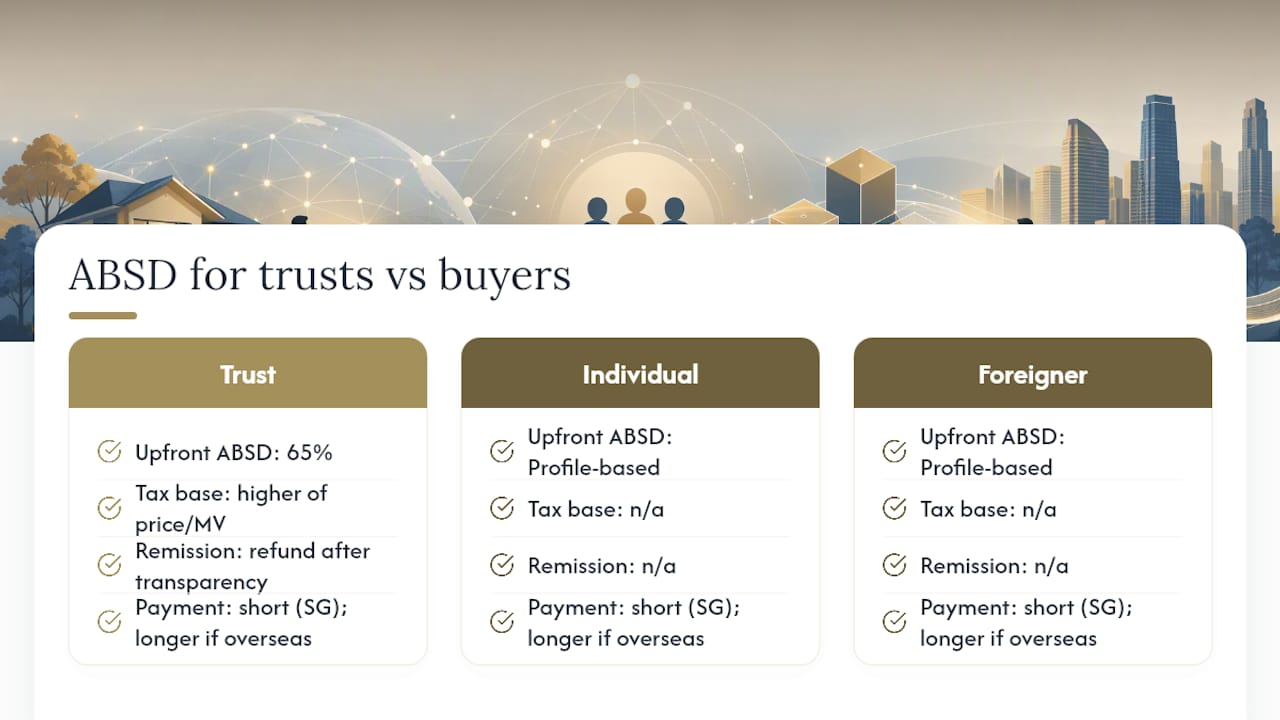
Payment timing follows the usual stamp duty rules: a short period if the instrument is executed in Singapore, or a slightly longer period if it’s executed overseas and then received in Singapore. Under pay or stamp incorrectly, and IRAS can assess additional duty plus penalties under the Stamp Duties Act separately from any remission decision.
Conditions for ABSD (Trust) Remission
Remission isn’t automatic, and it isn’t generous with ambiguity. The Remission Rules 2022 set out a specific checklist, and missing any one item usually means a rejected claim.
To qualify, the trust generally needs to satisfy all of the following:
The property is held on trust for one or more identifiable individual beneficiaries only, no companies, no unnamed classes of people.
Each beneficiary’s interest is vested at the time of transfer, meaning their share is fixed and not contingent on a future event.
The beneficial interest is non-revocable. The settlor can’t retain the power to change who benefits or how much they get later.
ABSD (Trust) at 65% has already been paid in full before the remission application is lodged.
The application reaches IRAS within a set deadline after the instrument’s execution date.
“Identifiable” is doing a lot of work in that list. It means beneficiaries are named or clearly determinable, and their beneficial ownership exists at the moment of transfer, not at some later milestone. A trust that says “my grandchildren, once they turn 21” typically fails this test, because the interest is deferred and conditional rather than vested now. Discretionary trusts, where a trustee decides later who gets what and how much, generally don’t qualify either, since no one is “identifiable” in the way the rules require.
The rules were written to reward trusts built for genuine succession planning, not trusts built to keep options open. If a settlor can still change their mind about who benefits, IRAS treats that flexibility as a reason to deny the refund, not a technicality to work around.
Special categories, like trustees for collective investment schemes or licensed housing developers, sit outside this remission framework and follow separate rules entirely.
Pro Tip: Draft the trust deed with an estate planning lawyer who names beneficiaries explicitly and vests their shares at signing, not at a future birthday, marriage, or other trigger event. Ambiguous vesting language is the single most common reason remission applications stall or get rejected.

How the ABSD Refund Is Actually Calculated
Here’s a worked example on a $3,000,000 private residential property held in trust for two named, vested beneficiaries: one Singapore Citizen owning her first property, and one Permanent Resident.
ABSD (Trust) paid upfront at 65%: $1,950,000.
Highest-profile beneficiary is the Permanent Resident, taxed at 5% if buying directly.
ABSD that would have applied at that rate: $150,000.
Remitted amount: $1,950,000 minus $150,000 = $1,800,000.
Net ABSD payable after remission: $150,000.
Change the beneficiary mix and the outcome shifts sharply, which is exactly why trustees should model this before executing the trust deed, not after.
Filing the Remission Claim With IRAS
Once ABSD (Trust) is stamped and paid, the clock starts on your six-month window. The remission application runs through myTax Portal, and the process is fairly linear if your documentation is in order.
Log in to myTax Portal using Singpass, then navigate to Stamp Duty services.
Select the option for remission applications relating to trust transfers.
Upload the trust instrument (the deed itself), showing the beneficiaries and their vested shares.
Attach the Option to Purchase or Sale & Purchase Agreement for the property.
Provide identification documents for each named beneficiary.
Submit proof that the 65% ABSD (Trust) has already been paid.
Where a trustee is acting under a power of attorney or corporate authorization, attach that authorization document.
Supporting documents IRAS commonly asks for beyond the basics include statutory declarations confirming vested beneficial interest and, in some cases, trustee minutes showing the decision-making process behind the trust’s structure. If you’re a foreign beneficiary who might separately qualify for relief under a Free Trade Agreement, that’s a separate remission route with its own document list worth checking in parallel.
Refunds, when approved, go back to whichever party actually paid the ABSD, usually the trustee or the settlor who funded the transfer. Processing isn’t instant, so factor in a few weeks to months of lead time, and if genuine circumstances delay your submission past six months, you can request an extension from the Commissioner of Stamp Duties, though approval isn’t guaranteed.
Why Remission Claims Get Rejected
Most rejected claims share a handful of root causes, and nearly all of them trace back to how the trust was drafted, not how the application was filed.
Contingent or conditional beneficiary interests. Anything phrased as “if” or “when” tends to break the vesting requirement.
Discretionary trust structures, where a trustee retains power to allocate shares later, almost never qualify because no beneficiary is fixed at transfer.
Incomplete documentation, missing statutory declarations or an unclear trust instrument that doesn’t specify shares precisely.
Late applications filed after the six-month deadline without a valid reason for an extension.
Incorrect stamping or underpayment at the outset, which complicates the entire refund calculation.
There’s a legal risk sitting behind all of this too. Where a settlor keeps effective control over the property, continuing to make decisions, collecting rental income, or retaining the right to unwind the trust, authorities can argue the arrangement is a sham. That undermines both the remission claim and potentially exposes the trustee to penalties under the Stamp Duties Act for what amounts to a misrepresented transaction. The Trustees Act 1967 also governs how trustees must exercise their powers, and a trustee who acts as a mere nominee for a settlor who never let go of control isn’t fulfilling that role in substance.
Clawback is the risk trustees underestimate most. If beneficial ownership changes later, say, a beneficiary’s share is varied or the trust is restructured, IRAS can revisit the original computation and recover part of the remitted amount, plus interest.
Pro Tip: Keep contemporaneous records: trustee meeting minutes, correspondence showing the settlor stepped back from control, and a deed that reads as final rather than adjustable. These are exactly what IRAS asks for if your claim is ever queried.
A Readiness Checklist Before You Execute the Trust
Before any documents are signed or duty is paid, run through this list with whoever is drafting the trust:
Confirm every beneficiary is named and their share is fixed, not conditional on age, marriage, or any future event.
Check the trust deed contains no revocation or variation clause that lets the settlor change beneficiaries later.
Confirm who is paying the 65% ABSD (Trust) upfront and how that payment will be funded, since bank financing for trust-held property is often unavailable.
Gather supporting documents in advance: trust instrument, Option to Purchase or S&P Agreement, beneficiary IDs.
Decide who will file the myTax Portal remission application and diarize the six-month deadline the moment the instrument is executed.
Pro Tip: Avoid deed language that gives the settlor any residual power, phrases like “at the trustee’s discretion” or “subject to further instruction from the settlor” are red flags that routinely sink otherwise solid remission claims.
If your family situation involves beneficiaries overseas, a blended family, or a property that’s also earmarked for a business purpose, pause before executing anything and get tailored legal and tax advice specific to your structure.
A Practitioner’s View on Trusts Versus Wills
A living trust earns its complexity when a family has cross-jurisdiction beneficiaries, a wish to control property use across generations, or succession needs a simple will can’t address cleanly. For a straightforward estate with one property and clear heirs, a well-drafted will is often faster, cheaper, and entirely sufficient. What we see most often is people reaching for a trust before checking the ABSD math, when the smarter order is: confirm your statutory exposure first, then structure the deed to meet remission conditions from day one rather than fixing it after the fact. Financing is the other constraint people miss. Banks are often reluctant to lend against property held by an individual trustee, which pushes many transfers toward cash funding.
How Elite Legacy Planning Supports ABSD and Trust Decisions
Getting the trust deed right the first time is cheaper than fixing a rejected remission claim later, and that’s the gap Elitelegacyplanning closes for Singapore property owners weighing a trust transfer. Rather than a one-size template, we walk through your specific beneficiary structure, property profile, and financing plan before a single document is drafted, so the deed is built to satisfy IRAS’s identifiable-beneficiary and vesting requirements from the outset.

Our trust consultation and lifetime advisory service is where most clients start, especially when a property transfer is part of a wider succession plan. If you’re specifically looking at moving residential property into a trust, our property trust and standby/living trust services are built around exactly this scenario, and for high-net-worth families with more complex holdings, our private trust company structures offer a bespoke alternative. Every consultation is confidential and grounded in Singapore’s current rules, not generic templates.
Run through the readiness checklist above, then book a consultation to review your specific beneficiary structure before you execute anything.
Where to Verify the Rules Yourself
Every figure and condition in this guide traces back to official Singapore sources, and it’s worth bookmarking these before you sign anything:
IRAS: Remission of ABSD (Trust) for the remission application process.
Stamp Duties (Trusts for Identifiable Individual Beneficiary) (Remission of ABSD) Rules 2022 for the full legal text.
HDB to confirm flats remain excluded from trust arrangements.
If you’re also comparing property restructuring options more broadly, this guide to property decoupling in Singapore covers a related tax angle worth understanding alongside trust transfers.
Frequently Asked Questions
Yes, for any transfer executed on or after May 9, 2022.
Can I get ABSD back if my trust has discretionary beneficiaries? Generally, no. Remission requires identifiable individual beneficiaries with vested, non-revocable interests. A discretionary trust where the trustee decides allocations later typically fails this test.
What happens if I miss the six-month remission deadline? Your remission application will likely be rejected unless you have valid grounds to request an extension from the Commissioner of Stamp Duties, and approval for extensions isn’t automatic.
Can HDB flats be transferred into a living trust to reduce ABSD exposure? No. HDB policy excludes flats from any trust arrangement entirely, so this strategy only applies to private residential property.
Will a bank finance a property held by a trustee? Often not. Many banks are reluctant to lend against property where legal title sits with an individual trustee, so many trust transfers require cash funding or pre-arranged financing solutions.
Is a will simpler than a trust for passing on a single property? For straightforward estates with clear heirs, yes, a well-drafted will is usually faster and less costly. Trusts earn their complexity when families face cross-jurisdiction beneficiaries or want ongoing control over how property is used across generations.
This article is general information, not a substitute for advice from a qualified financial advisor. Consult a qualified financial professional about your own circumstances before acting on anything here.
Sources
Recommended
Comments