


Estate Duty Singapore: What Executors Need to Know


There is no estate duty in Singapore today. Estate duty (Singapore’s version of inheritance tax) was abolished for every death occurring on or after 15 February 2008, under the Estate Duty (Abolition) Act 2008. The Inland Revenue Authority of Singapore (IRAS) confirms this applies regardless of whether the deceased left a valid will.
Covered (no duty owed): anyone who died on or after 15 February 2008
Not covered (older rules may still apply): deaths before 15 February 2008, plus a few transitional edge cases
First action for executors: confirm the exact date of death, then check with IRAS whether any clearance or form filing is still required
Key Takeaways
Estate duty no longer applies to any death in Singapore on or after 15 February 2008, and the real planning work now centers on probate efficiency and trust structuring, not tax avoidance.
Point | Details |
No duty since 2008 | Estate duty was abolished for all deaths on or after 15 February 2008 under the Estate Duty (Abolition) Act 2008. |
Pre-2008 deaths differ | Older estates may still need IRAS clearance, Form SC, Form ED, or the Observations Form. |
Historical rates | Between 1996 and 2008, rates were 5% up to S$12 million and 10% above that threshold. |
Estate income still taxable | Trustees and executors must still report income earned by the estate after death. |
Professional support helps | Elitelegacyplanning assists with wills, trusts, and executorship so probate moves faster and disputes stay minimal. |
This article is general information, not a substitute for advice from a qualified financial advisor. Consult a qualified financial professional about your own circumstances before acting on anything here.
Table of Contents
Does Singapore Have Estate Duty Today?
No. Singapore has not collected estate duty on any death since the cutoff in February 2008, and there is no separate inheritance tax that replaced it. To understand why the date matters so much, it helps to know what estate duty actually was and how it worked before lawmakers scrapped it.
Estate duty was a tax charged on the total market value of a deceased person’s assets, assessed as of the date of death. It covered everything from property and bank balances to shares and insurance payouts, all rolled into one dutiable estate. The tax traced back to the Estate Duty Act 1929, a piece of colonial-era legislation that shaped Singapore’s approach to wealth transfer for nearly eight decades.
The rates that mattered most were the ones in force just before abolition. For deaths between 28 February 1996 and 14 February 2008, the rate structure was 5% on the first S$12 million of the estate’s value, and 10% on anything above that.
Full market value at date of death, not purchase price or book value
5% up to S$12 million
10% on the excess
Pro Tip: If you’re handling an estate from that era, get an independent, dated valuation for property and shares. IRAS assessed duty on value at the exact date of death, and a sloppy valuation can trigger disputes with beneficiaries or delays in getting clearance.
What Did the Estate Duty (Abolition) Act 2008 Actually Change?
The Estate Duty (Abolition) Act 2008 did exactly what its name says: it removed estate duty from Singapore’s tax system going forward. Parliament passed the Act to amend the original Estate Duty Act 1929, and the new law was deemed to have come into operation on 15 February 2008.
The mechanism is simple. Rather than repealing the old Act outright, the 2008 legislation restricts its application to deaths that occurred before the commencement date. That is why the cutoff functions as a hard legal line rather than a general guideline.
Estate duty shall not be chargeable in respect of the estate of any person dying on or after 15 February 2008.
Everything downstream, clearance requirements, forms, exemptions, hinges on which side of that date a death falls.
Which Deaths Still Fall Under the Old Estate Duty Rules?
The dividing line is absolute: die on or after 15 February 2008, and your estate owes no estate duty, full stop. Die before that date, and the older rules may still apply, sometimes decades later if an estate was never formally settled.
A handful of categories still trigger old-rules scrutiny:
Deaths before 15 February 2008 that were never fully administered or cleared with IRAS
Gifts made shortly before death under the old lookback provisions, where a deceased person transferred assets to reduce the dutiable estate
Unresolved joint accounts or jointly held property tied to a pre-2008 death, where ownership shares were never formally settled
Pro Tip: If you’re settling a decades-old estate that was left in limbo, don’t assume the abolition wipes the slate clean. Domicile status at the time of death and the exact date matter more than how long ago it happened.
Which Assets Attracted Estate Duty, and What Was Exempt?
Before 2008, estate duty applied broadly across a deceased person’s holdings. Immovable property, bank deposits, publicly listed shares, private company shares, insurance proceeds payable to the estate, and Central Provident Fund (CPF) balances could all be pulled into the dutiable pool depending on how they were held.
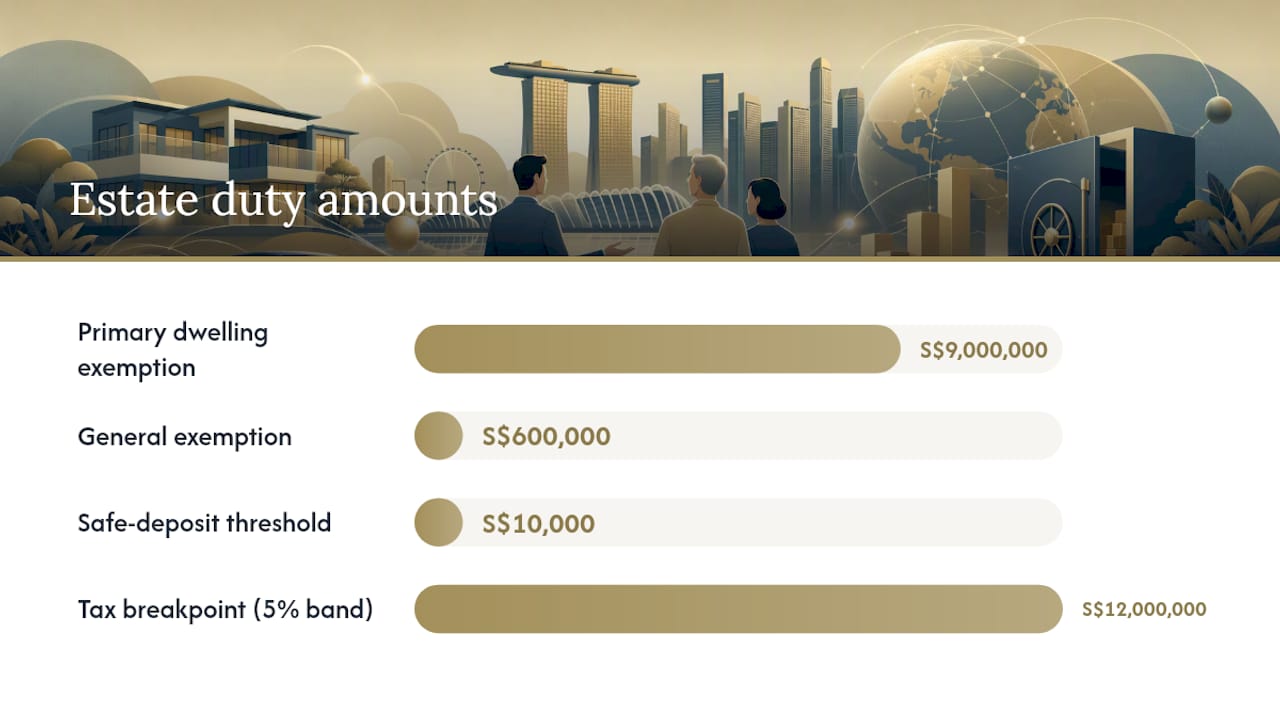
Exemptions softened the blow considerably, and IRAS built in specific thresholds:
A S$9 million exemption for the deceased’s primary dwelling house
A S$600,000 general exemption applied to the remainder of the estate
Safe-deposit box contents under S$10,000 generally escaped separate assessment
CPF savings received specific exemption treatment rather than being taxed as ordinary estate assets
Between 28 February 1996 and 14 February 2008, the applicable rate stayed at 5% on the first S$12 million and 10% on anything above it, calculated against total market value at date of death.
Pro Tip: For jointly held bank accounts or property from that era, document each party’s actual financial contribution at the time of purchase. IRAS looked past the account name to who actually put the money in, and unclear records are one of the most common reasons old estate files stall.
When Do You Still Need IRAS Estate Duty Clearance?
Clearance is not required for deaths on or after 15 February 2008. That single fact removes most executors from the process entirely. But IRAS still requires clearance or specific forms for a defined set of pre-2008 scenarios, including large safe-deposit box holdings, sizable joint-account balances, and certain gift transfers that fall within the old lookback rules.
For estates that do fall under the pre-2008 regime, the process generally runs like this:
Apply for a Grant of Representation (Probate or Letters of Administration) through the Family Justice Courts.
Submit the relevant IRAS forms. IRAS lists Form SC, Form ED, and an Observations Form for specific circumstances, with some requiring submission within six months of the grant.
Pay any assessed duty based on the historical rate structure, if the estate is confirmed dutiable.
Obtain clearance from the Commissioner of Estate Duties before final distribution to beneficiaries.
Confirm the exact date of death before assuming which rules apply
Gather valuations dated as close to the date of death as possible
Contact the Commissioner of Estate Duties office directly for anything unresolved from before 2008
What Should Executors Do First After a Death in Singapore?
Handling an estate well starts with a short list of immediate, unglamorous tasks. Get the death certificate, locate the original will, and secure the physical and financial assets before anyone else touches them.
Obtain the death certificate and locate the original will (or confirm there isn’t one)
Notify the CPF Board, banks, and insurers, and gather statements as close to the date of death as possible
Check documentation on any jointly owned property or accounts
Apply for a Grant of Probate or Letters of Administration through the Family Justice Courts where the estate requires it
Confirm with IRAS whether estate duty clearance applies, and if so, assemble supporting valuations early
Pro Tip: Even though most estates today owe zero estate duty, banks and CPF still expect a Grant of Representation before releasing funds. Start that court application early. It’s usually the longest step in the whole process, not the tax question.
How Does Abolition Change Estate Planning in Singapore?
Removing estate duty took away the old incentive to split assets awkwardly across family members just to dodge a tax bill. That shift moved the real planning priorities toward probate speed, clear instructions, and avoiding family disputes rather than tax avoidance.
One thing hasn’t changed: income generated by an estate or trust after death still counts as taxable income, and executors or trustees must report it to IRAS. Rental income, dividends, or interest earned by estate assets before final distribution doesn’t get a free pass just because estate duty is gone.
A well-drafted will still avoids Family Justice Courts default rules that may not reflect your wishes
A living trust can bypass probate delays entirely for specific assets
A private trust company structure suits families with complex, multigenerational holdings
Pro Tip: Don’t confuse “no estate duty” with “no tax planning needed.” Trustees still file income tax on estate earnings, and getting that wrong creates its own penalties long after probate closes.
A Note From the Firm
Elitelegacyplanning works with executors and families navigating exactly these questions, from confirming whether a pre-2008 estate still owes duty to structuring trusts that keep probate simple for the next generation. [Author credentials and case examples to be added.] We’ve seen firsthand how much smoother distribution goes when the paperwork and valuations are handled early rather than reconstructed under pressure.
Get Clear Estate Planning Support in Singapore
Knowing that estate duty no longer applies is only half the picture. The harder half is making sure your will, CPF nominations, and any trust structures actually work together so your family isn’t stuck untangling joint accounts or waiting on a Grant of Representation for months.

Elitelegacyplanning handles the parts that trip up most families: drafting a Comprehensive Will that reflects Singapore’s current rules, setting up a Trust Consultation for ongoing wealth structuring, or establishing a Private Trust Company for families with more complex holdings. If you’re an executor dealing with a pre-2008 estate, or simply want your own affairs settled properly, book a consultation and get a clear plan in place before it becomes someone else’s problem to solve.
Sources
Recommended
Comments