


65% ABSD: What Trust Deeds in Singapore Mean for Your Property Tax
A trust deed is the written legal instrument that creates an express trust under Singapore law, setting out who holds property (the trustee), for whose benefit (the beneficiaries), and on what terms. Most people reach for one to manage estate succession or protect family assets. The single biggest trap is transferring residential property into a living trust, which triggers Additional Buyer’s Stamp Duty upfront, often at 65%), before any remission is even considered.
TL;DR:
Transferring residential property into a living trust triggers a 65% upfront stamp duty, making it mostly cost-prohibitive compared to other trust types.
Trust deeds typically include detailed clauses on assets, distribution terms, trustee powers, and legal provisions, which must be carefully reviewed to avoid disputes.
Stamp duty rules vary depending on whether beneficial interest changes hands or just formalizes arrangements, with strict deadlines for remission eligibility and hefty penalties for delays.
Using a licensed trust company for multi-generational or cross-border estates offers more continuity and security than individual trustees, especially when future succession is uncertain.
Setting up a trust generally does not require registration, but asset transfers to the trustee must be properly documented and lodged with relevant authorities to be legally effective.
Table of Contents
What Is a Trust Deed and Why Singapore Residents Use One
An express trust splits ownership into two layers: the trustee holds legal title, while the beneficiary holds equitable interest and the actual economic benefit. The Ministry of Law confirms that an express trust can technically be created orally, but a written trust deed records the terms and gives everyone something enforceable to point to when a dispute arises.
That distinction between legal and equitable ownership matters most with property, businesses, and investment portfolios, where ambiguity gets expensive fast. In Singapore, people set up trust deeds for a handful of recurring reasons:
Passing wealth to children or grandchildren while controlling timing and conditions
Protecting assets from a beneficiary’s creditors, divorce settlement, or poor financial judgment
Structuring succession for a family business without forcing a sale
Providing for a beneficiary with special needs over their lifetime
Separating a testamentary trust (created through a will, taking effect at death) from a living trust (created and funded while you’re alive)
Property and high-net-worth planning almost always call for a formal deed rather than an informal arrangement, mainly because banks, IRAS, and the Land Titles Registry all expect a document they can rely on.
What a Trust Deed Actually Contains
A trust deed lawyer in Singapore typically structures the document around a consistent set of clauses, even though the substance varies by family situation.
Parties and recitals — names the settlor (who creates the trust), the trustee (who administers it), and the beneficiaries, plus a background narrative explaining intent.
Trust fund identification — a schedule listing exactly which assets sit inside the trust, whether that’s a property, shares, or cash.
Distribution provisions — spells out whether beneficiaries receive fixed, predetermined shares or whether the trustee has discretion to decide who gets what and when.
Trustee powers — investment authority, power to sell or mortgage trust assets, and power to appoint a successor trustee.
Reporting and accounting obligations — how often the trustee must account to beneficiaries or protectors.
Governing law, amendment, and termination clauses — almost always Singapore law, plus the mechanism for changing or winding up the trust.
Pro Tip: Ask your drafting lawyer to walk through the discretionary distribution clause line by line before signing. This is the section families argue over decades later, and vague wording here causes more disputes than any other part of the deed.
How to Create and Execute a Trust Deed in Singapore
Creating a trust deed follows a fairly linear sequence, though each step has consequences that compound if rushed.
Define the purpose. Decide whether you want a living trust (active now) or a testamentary trust (activated by your will at death), since this single choice changes tax exposure dramatically.
Identify trust assets and beneficiaries. Property, shares, cash, or business interests all need a clean paper trail showing current ownership.
Instruct a trust deed lawyer to draft the document. Templates found online rarely account for Singapore-specific stamp duty triggers or the Trustees Act’s default provisions.
Execute the deed. Signatures are typically witnessed, and for property transfers, the deed must be properly executed before assets can legally move to the trustee.
Transfer the assets. For real estate, this means lodging a transfer with the Singapore Land Authority; for shares, updating the register of members.
Stamp the document. IRAS requires stamping within 14 days if the deed is executed in Singapore, or 30 days if executed and first received in Singapore from abroad. Miss this window and penalties apply on top of the duty owed.
Choosing who administers the trust is its own decision point. An individual trustee, often a trusted family member, works for simple arrangements. For multi-generational or multi-jurisdictional estates, a licensed trust company regulated by the Monetary Authority of Singapore offers continuity that an individual trustee simply cannot guarantee, particularly when that individual eventually passes away or emigrates.
Stamp Duty and Tax Rules That Change the Math
This is where trust planning gets expensive if nobody flags it early. Since April 27, 2023, transferring residential property into a living trust attracts ABSD (Trust) at 65%, and the trustee must pay it upfront at the time of transfer, not after the fact.
That single change reshaped how Singapore families approach property trusts. Before 2023, ABSD on trust transfers was assessed at a flat lower rate regardless of beneficiary profile. The 65% rate now applies broadly, which is why more families are routing property through testamentary trusts (activated only at death, when ABSD treatment differs) rather than living trusts.
Beyond ABSD, a few other duty rules apply depending on what the deed actually changes:
A Declaration of Trust that doesn’t shift beneficial ownership, just formalizes an existing arrangement, attracts a fixed $10 duty.
Where beneficial interest genuinely changes hands, ad valorem duty applies based on the property’s market value, calculated the same way as a normal sale.
Buyer’s Stamp Duty (BSD) still applies on top of ABSD when the trust is acquiring the property rather than simply holding an asset the settlor already owned.
Remission offers a way back for some families, but the conditions are specific. Under the Stamp Duties (Trusts for Identifiable Individual Beneficiary) (Remission of ABSD) Rules 2022, remission requires that the property be held for an identifiable individual beneficiary and that the beneficial interest vests irrevocably. Even then, ABSD must be paid in full first, and the refund application must land within six months of the trust instrument’s execution. Miss that window and the money is gone.
Trustees’ Powers and Legal Duties
Once assets sit inside a trust, the trustee isn’t just a passive title holder. The Trustees Act supplies default statutory powers covering investment, delegation, and administration, and these apply automatically unless the trust deed says otherwise.
Fiduciary duty sits on top of that statutory framework and it’s non-negotiable:
Trustees must act with the same prudence they’d apply to their own affairs when investing trust assets.
They owe undivided loyalty to beneficiaries and cannot let personal interests conflict with trust decisions.
Proper records and periodic accounting to beneficiaries are expected, not optional.
Well-drafted deeds often appoint a protector, a person with power to approve major decisions or remove an underperforming trustee.
If disputes escalate, trustees or beneficiaries can apply to the Singapore courts for directions on how to proceed.
Choosing a trustee, individual or corporate, is really a decision about who you trust to carry these obligations for decades.
Duration, Amendment, and Revocation
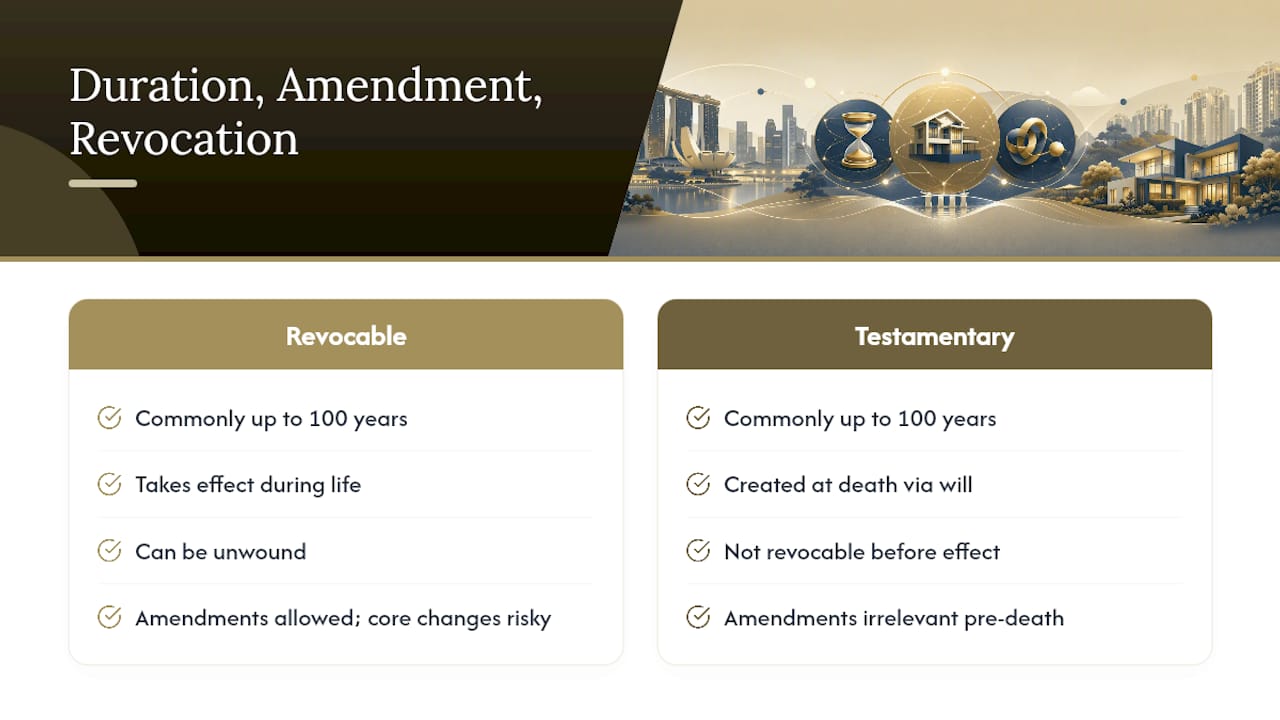
Singapore trusts commonly run for up to 100 years, so drafting for a multi-generational horizon matters more than it might first seem. Amendment clauses give the settlor or trustee power to tweak administrative details, but changes that alter the trust’s core purpose risk being treated as a resettlement, potentially triggering fresh stamp duty.
Revocable living trusts can be unwound if circumstances change, while testamentary trusts, only created at death through a will, can’t be revoked because they haven’t taken effect yet. That distinction directly affects whether ABSD applies at all, which is exactly why the choice between trust deed vs will structures deserves real thought before any deed gets drafted.
Your Practical Checklist Before Meeting a Trust Lawyer
Walking into a first consultation prepared saves time and, often, money. Bring these:
Identification documents for the settlor, proposed trustees, and beneficiaries
A schedule of assets you intend to place in trust, including property titles and share certificates
Any existing will, since testamentary and living trust structures need to work together, not against each other
A rough outline of distribution wishes, fixed shares or discretionary
Expect drafting to take two to four weeks depending on complexity, with execution, asset transfer, and stamping following shortly after. If ABSD applies, budget for the upfront payment and the six-month remission window if you qualify.
Fees typically break into legal drafting costs, ongoing trustee fees or commissions if you appoint a corporate trustee, and the stamp duties themselves.
Pro Tip: Ask for a fixed quote covering drafting through execution before committing. Trust deed work with property and ABSD exposure has enough variables that hourly billing can run up fast.
Does a Trust Deed Need to Be Registered in Singapore?
Unlike a company or a piece of land, a trust deed itself generally doesn’t require registration with a central trust registry to be valid between the parties. What creates the trust is proper execution and, where relevant, the actual transfer of assets into the trustee’s name. That said, “no registration required” doesn’t mean “no paperwork matters.”
If the trust holds Singapore real estate, the transfer of legal title must be lodged with the Singapore Land Authority, because that’s what makes the trustee’s ownership legally recognized against third parties. If the trust holds company shares, the transfer needs to appear on the company’s register of members. Stamping with IRAS, separately, is a tax compliance step rather than a registration of the trust’s existence, but skipping it exposes the document to penalties and makes it harder to rely on the deed in a dispute or when refinancing.
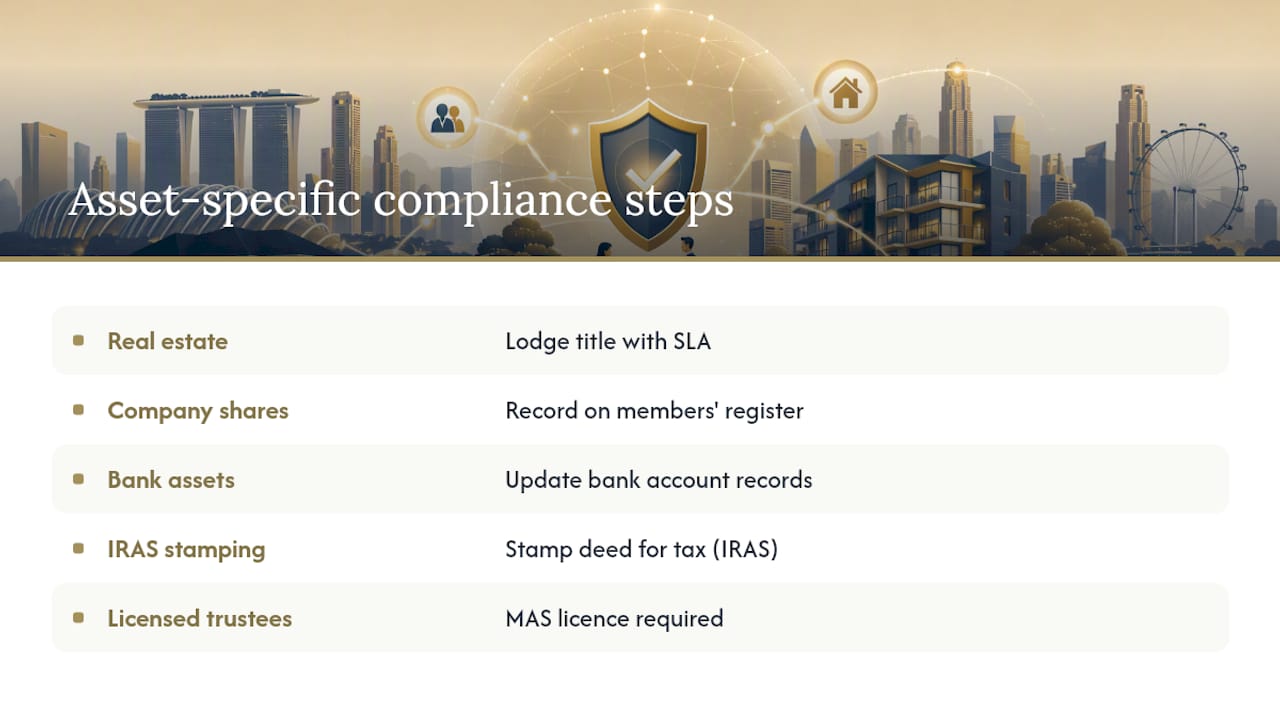
Where things get more formal is licensed trust business. A trust company acting as trustee for fee-paying clients generally needs to be licensed by the Monetary Authority of Singapore, and that licensing sits at the institutional level rather than requiring each individual trust deed to be filed anywhere. For most family trusts, the practical registration steps are asset-specific: land title updates, share register entries, and bank account changes, not a filing of the deed itself with a government trust registry.
How Elite Legacy Planning Approaches Trust-Deed Work
We build every trust deed clause around the family’s actual governance needs, not a template. That means asking early whether a living trust, testamentary trust, or private trust company structure fits the ABSD exposure and succession goals better, before drafting starts. For clients holding property, multiple entities, or cross-border assets, we often recommend a private trust company for the continuity a single individual trustee can’t match. Before the first meeting, we review existing wills, asset schedules, and any prior trust documents so the conversation starts from where you actually stand.
— Joseph
Book a Trust Consultation With Elite Legacy Planning
Elite Legacy Planning gives you what a generic template or DIY deed can’t: a Singapore-based team that drafts around ABSD exposure from day one instead of discovering the tax bill after the deed is signed. Our Trust Consultation & Lifetime Advisory service covers living trust drafting, private trust company setup, and ongoing advisory as your family’s circumstances change.
Bring your asset schedule, existing will, and a rough idea of how you want distributions structured, and we’ll map out whether a living trust, testamentary trust, or corporate trustee structure fits best. You can book a consultation online and get a fixed-scope quote before any drafting begins, so there are no surprises on cost or on the ABSD math.
Sources
For primary rules, check IRAS on stamp duty, the Ministry of Law’s express trusts overview, and the Trustees Act. For ABSD refund mechanics specifically, see our guide on ABSD Trust Singapore.
This article is general information, not a substitute for advice from a qualified lawyer. Consult a qualified legal professional about your own circumstances before acting on anything here.
Recommended
Comments