


Avoid Probate in Singapore: Start With CPF, Insurance and S$50,000 Rule


Yes, in many cases you can. CPF savings and insurance proceeds with a valid nomination bypass probate entirely, jointly held assets pass to the survivor automatically, and assets moved into a living trust during your lifetime skip the court process altogether. Small estates under S$50,000 may also qualify for Public Trustee administration instead. A Will alone won’t get you there, and business interests, disputes, or solely owned property still usually need a Grant of Probate or Letters of Administration. When your situation looks even slightly complicated, get advice before you assume you’re covered.
TL;DR:
Making or checking CPF and insurance nominations is the most straightforward and cost-effective way to keep assets outside probate, especially for large savings.
Joint ownership of assets like bank accounts or property can pass directly to the survivor if survivorship applies, but the exact wording and potential creditor risks should be confirmed in advance.
Living trusts hold assets retitled during your lifetime, allowing them to bypass probate, but only for assets actually transferred into the trust; regular audits are necessary to include new acquisitions.
Small estates under S$50,000 may qualify for Public Trustee administration, but certain exclusions like disputed claims or business interests can disqualify estates from this shortcut.
Lasting Power of Attorney addresses incapacity issues before death, enabling trusted individuals to manage finances without court involvement, and complements other estate planning tools.
Table of Contents
Quick Checklist: The Practical Ways Your Estate Can Bypass Probate
CPF and Insurance Nominations: Direct Payouts That Skip Probate
Living Trusts vs Testamentary Trusts: Which One Actually Avoids Probate
Small Estates and the Public Trustee: Does the S$50,000 Rule Apply to You?
Lasting Power of Attorney: Handling Incapacity Before It Becomes a Court Problem
How Elite Legacy Planning Advises Clients on Avoiding Probate
Quick Checklist: The Practical Ways Your Estate Can Bypass Probate
Before you dig into the details, here’s where to look first.
CPF nomination: Make or check yours online through Singpass. It covers CPF savings only, not your other assets.
Insurance nomination: Choose revocable or trust nomination depending on how much control and privacy you want.
Joint ownership: Retitle bank accounts or property where it makes sense, but watch for unintended gifting or creditor exposure.
Living trust: Move assets into a trust while you’re alive to skip probate. A testamentary trust, created by a will, does not do this.
Public Trustee: An option for smaller estates, with thresholds and exclusions that catch people out.
Bank discretion: Some banks release small sums against an indemnity form. Confirm this with your specific bank rather than planning around it.
Joint Ownership and Right of Survivorship
When two people hold an asset jointly, the right of survivorship means the asset passes directly to the surviving owner the moment the other dies. No court, no waiting, no Grant of Probate. This is why joint bank accounts and matrimonial property held under joint title are two of the most common probate workarounds in Singapore.

The mechanics matter, though. The exact wording on a bank mandate or a property title determines whether survivorship actually applies, so it’s worth checking rather than assuming. Joint ownership also carries real risk: adding a name to a bank account can be treated as an unintended gift, and jointly held assets can become exposed to a co owner’s creditors if that person runs into financial trouble. Assets you own solely still go through probate regardless of what else is jointly titled, and some HDB flats carry ownership rules that complicate a straightforward survivorship transfer.
Pro Tip: Ask your bank to confirm in writing whether an account is held as “joint tenants” (survivorship applies) or “tenants in common” (it does not) before you assume either way.
CPF and Insurance Nominations: Direct Payouts That Skip Probate
CPF nominations, made through the CPF Board, pay your CPF savings directly to the people you name. That money never becomes part of your estate, which means it never touches the probate process. You set this up in minutes through Singpass, and it’s arguably the single most effective, lowest cost move most Singapore residents can make to protect one of their largest assets from delay.
Insurance nominations work on a similar principle but come in two flavors. A revocable nomination lets you change your mind later; a trust nomination locks the payout in for your spouse or children and keeps it outside both probate and any later will dispute. MoneySense lists nominations, alongside joint ownership and trusts, as the standard ways Singaporeans move assets outside the estate.
The mistakes here are predictable:
Assuming a will automatically covers CPF savings or insurance payouts (it doesn’t).
Never revisiting nominations after marriage, divorce, or the birth of a child.
Losing track of policy numbers and nomination receipts, leaving an executor guessing.
Review both nominations at least once a year, and keep the paperwork somewhere your next of kin can actually find it.
Living Trusts vs Testamentary Trusts: Which One Actually Avoids Probate
Only one type of trust skips probate, and it’s not the one most wills create. A living trust, also called an inter vivos trust, holds assets that you’ve formally retitled into the trust while you’re still alive. Because the trust, not you personally, owns those assets at the time of death, they pass to beneficiaries without a Grant of Probate. A testamentary trust, by contrast, is written into a will and only takes effect after probate is granted, so it doesn’t avoid the process at all.
The catch with living trusts is retitling. Global Law Experts points out that a living trust only works for the specific assets actually transferred into it; forget to retitle one property or one brokerage account, and that asset still needs probate on its own.
A living trust is worth considering when:
You want privacy, since trusts don’t go through the public probate record the way court applications do.
Your family situation calls for detailed, staged provisions rather than a simple lump sum.
You hold assets across more than one jurisdiction and want to avoid multiple probate proceedings.
The estate is large enough that even a modest probate delay carries a real cost.
Pro Tip: If you set up a living trust, calendar an annual “retitling audit.” New assets you buy after the trust is formed don’t automatically belong to it.
Setting one up involves a trust deed, a named trustee, and ongoing administration, so factor in both setup costs and the trustee’s ongoing responsibilities before you commit.
Small Estates and the Public Trustee: Does the S$50,000 Rule Apply to You?
The Public Trustee’s Office can administer qualifying estates without a private Grant of Probate, which is a genuine shortcut for smaller estates. But “qualifying” carries real limits.
Estates with any of these are typically excluded: pending court applications, disputed claims among beneficiaries, outstanding debts, unlisted shares, or business interests.
Some HDB flat scenarios fall outside the scheme too, depending on ownership structure.
If your estate sits anywhere near the threshold or includes any excluded item, check eligibility with a lawyer before assuming the Public Trustee route applies. Families who assume coverage and later discover an exclusion lose the time advantage they had been counting on.
Bank Discretion: A Stopgap, Not a Strategy
Some banks will release a modest sum from a deceased person’s account if next of kin sign an indemnity form and produce identification and a death certificate. Reporting on banking practices for seniors in Singapore notes these payouts are discretionary, often capped around a few thousand dollars, and vary by institution. A bank can also simply refuse, particularly where account ownership is unclear or a claim looks disputed. Treat this as a way to cover funeral costs in the short term, never as a substitute for actual estate planning.
Lasting Power of Attorney: Handling Incapacity Before It Becomes a Court Problem
An LPA doesn’t avoid probate. It solves a different but related problem: if you lose mental capacity while still alive, an LPA lets your chosen donees manage your finances and welfare without anyone needing to apply to court for deputyship. Setting one up while you’re still capable coordinates neatly with your other nominations and trust arrangements.
Appoint one or more donees you trust, and specify exactly what powers they hold over finances versus personal welfare.
File the LPA through the Office of the Public Guardian while you have full mental capacity.
Review it alongside your CPF nomination, insurance nomination, and will whenever any of those change.
Plan Your Legacy frames the LPA as a cost avoidance tool for families, since deputyship applications are slower and more expensive than an LPA set up in advance. Most people focus entirely on what happens after death and skip this step, which is exactly backwards.
When Probate Is Still Required
None of the above works universally. You’ll still need a Grant of Probate or Letters of Administration when:
Property or bank accounts are solely owned, with no nomination or joint title in place.
The estate includes a business, unlisted shares, or other complex corporate holdings.
Family members dispute the estate, creditors make claims, or HDB or trust nomination rules impose legal restrictions.
A will by itself typically triggers a probate application rather than avoiding one. The Singapore Judiciary’s probate guidance confirms that a grant is the default requirement once an estate falls outside the narrow exceptions above.
How to Implement These Measures: A Practical Checklist
Work through this roughly in order of speed and cost.
Update your CPF nomination through Singpass.
Check and, if needed, correct your insurance nomination.
Review joint titles on bank accounts and property.
Write or update your will to cover everything nominations and joint ownership don’t.
Consider a living trust if your estate is complex, cross-border, or simply large.
Set up an LPA to cover incapacity, not just death.
Prepare identification documents, existing policy numbers, and a rough asset list before any of this, and MoneySense recommends revisiting the whole set annually or after marriage, divorce, a new child, or a major property purchase.
Pro Tip: Ask any adviser you consult exactly how retitling works for each asset class, who will act as trustee, what it costs, and how CPF or insurance nominations interact with a trust you’re setting up. If overseas assets are involved, cross-border succession rules add another layer worth flagging early.
How Elite Legacy Planning Advises Clients on Avoiding Probate
Elite Legacy Planning sees that pattern constantly: a client updates their CPF and insurance nominations, confirms joint ownership on the family home, and their exposure to probate delay drops sharply within a single afternoon.
Where it gets harder is complex families, cross-border assets, or estates large enough that privacy and control start to matter more than speed. That’s where a Comprehensive Will, a living trust, or a private trust company structure earns its cost. A first consultation typically reviews your existing nominations, current asset titling, and any business interests before recommending which of these tools you actually need, rather than selling you all of them.
What the Conventional Advice on Probate Gets Wrong
Most articles on this topic treat probate avoidance as an all or nothing decision: either you build an elaborate trust structure, or you do nothing and hope. That framing wastes people’s time and money.
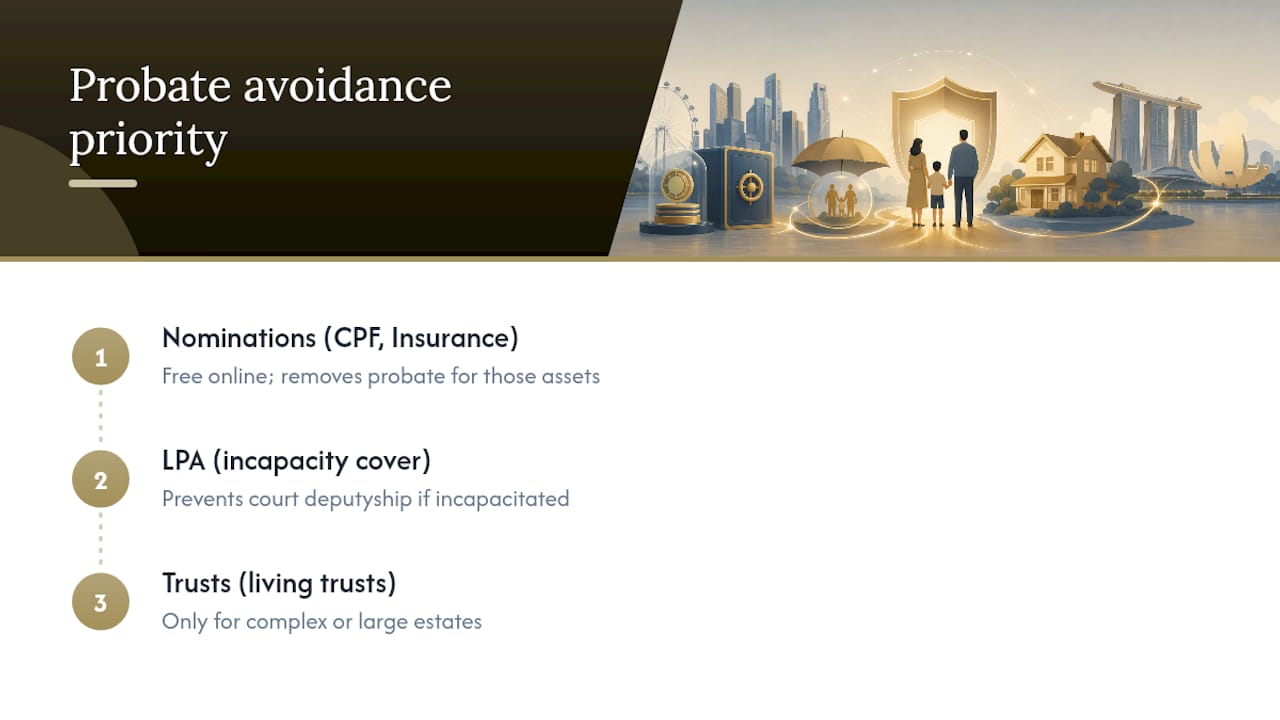
The research is clear that CPF and insurance nominations, both free and both doable online in under an hour, eliminate probate risk for two of the largest assets most Singaporeans hold. That should be step one for everyone, not a footnote buried under trust marketing. Living trusts genuinely earn their setup cost, but only for estates complex or large enough to justify ongoing trustee administration. Recommending one to a family with a HDB flat, a CPF account, and a straightforward insurance policy is overkill.
The bigger blind spot is incapacity. Families spend years worrying about probate after death while skipping the LPA that would save them a court deputyship application while someone is still alive. If you take one thing from this article, prioritize nominations first, an LPA second, and only escalate to trusts once your situation actually calls for that level of structure.
— Joseph
How Elite Legacy Planning Can Help
If you’ve read this far and realized your nominations are outdated, your title deeds are unclear, or your estate is complex enough that a trust makes sense, that’s exactly the gap Elite Legacy Planning closes. Rather than a generic will template, you get a plan built around what you actually own, from a straightforward Comprehensive Will to a fully structured Standby or Living Trust for families who need more privacy or control.

A first review looks at your current nominations, asset titles, and any business interests, then tells you plainly which tools you need and which you don’t. Bring your CPF and insurance nomination records, a rough list of assets, and any existing will. You can book a consultation online or start with a trust consultation if you already know a trust is on the table.
This article is general information, not a substitute for advice from a qualified lawyer. Consult a qualified legal professional about your own circumstances before acting on anything here.
Sources
FAQ
How Long Does Probate Take in Singapore?
Timelines vary with how contested and complex the estate is, but straightforward, uncontested applications generally move faster than ones involving disputes, business interests, or unclear ownership. The Singapore Judiciary notes that delays typically stem from incomplete documentation or family disagreement rather than the court process itself.
Why Would Someone Want to Avoid Probate?
Probate takes time, costs money, and becomes a matter of public record once a grant is issued, none of which suits families who want a fast, private transfer of assets. Nominations, joint ownership, and living trusts each sidestep that process for the specific assets they cover.
Do Bank Accounts Go Through Probate?
Solely owned bank accounts generally do, unless the bank exercises discretion to release a small sum against an indemnity form. Jointly held accounts with survivorship typically pass directly to the surviving holder without probate, which is why checking your account’s exact ownership structure matters.
Does an HDB Flat Need a Grant of Probate?
It depends entirely on how the flat is held. A flat under joint tenancy usually passes to the surviving owner through survivorship, while a solely owned flat, or one with more complex co-ownership arrangements, typically requires a Grant of Probate or Letters of Administration before it can be transferred.
Recommended
Comments