


Avoid Resettlement: 6 Steps for Singapore Practitioners to Amend a Trust


Yes, you can amend a trust in Singapore, but only if the deed itself allows it. There is no general statute that lets a settlor or trustee rewrite beneficial interests at will. The Trustees Act 1967 governs trustee powers, not variation rights, so the lawful routes are usually a deed of variation, a supplemental deed, or an amended-and-restated deed. Court relief exists but is exceptional, especially where minors or unborn beneficiaries are involved, which is exactly when you need specialist legal advice before touching the paperwork.
TL;DR:
Trusts in Singapore can only be amended if the original deed explicitly grants the power, often through a variation or supplemental deed, while court relief is rare.
The most common reasons for amendments include family changes, trustee restructuring, tax shifts, or consolidating multiple variations into a single document.
Changes affecting beneficiaries’ interests—such as new beneficiaries or altered distributions—typically require beneficiary consent or court approval, especially when minors or unborn persons are involved.
Proper implementation involves notifying asset institutions, updating property records, and maintaining meticulous documentation to avoid risks like resettlement or non-compliance.
Building flexibility into the initial trust deed, including clear amendment powers, minimizes future complications versus fixing restrictive deeds later.
Table of Contents
How Do You Check If Your Trust Can Be Amended?
Before drafting anything, pull out the original deed and read it clause by clause. Most disputes over trust amendments in Singapore trace back to someone skipping this step and assuming a power exists that was never actually granted.
Start with the amendment clause itself, if there is one. Some deeds spell out an express power of amendment, naming who can exercise it (settlor, trustee, or a protector) and how (unilateral deed, trustee resolution, or with beneficiary consent). Others say nothing at all, which is a real problem because the Trustees Act gives trustees administrative powers subject to the trust instrument. It does not hand them a blank check to alter who gets what.
Work through these clauses in order:
Amendment or variation clause — does it exist, and what does it actually permit?
Revocation clause — for revocable trusts, this often sits next to (or doubles as) the amendment power.
Protector clause — does a protector need to consent, or can they veto changes outright?
Trustee powers clause — separates administrative discretion (investment, distribution timing) from anything touching beneficial entitlements.
Governing law clause — confirms the trust is actually governed by Singapore law, which matters if assets or parties sit offshore.
Beyond the main deed, check whether the settlor retained specific powers, such as the right to add or remove beneficiaries or redirect income. If so, confirm the exact mode required to exercise them. Some deeds insist on a formal written instrument; others accept a signed letter. Getting this wrong can mean the “amendment” never legally took effect.
Then go hunting through the file for prior variations, appointment or retirement deeds, letters of wishes, and asset schedules. These documents often carry constraints nobody remembers exist, like a prior variation that already narrowed the amendment power, or a letter of wishes referencing an arrangement that never made it into the deed itself. Letters of wishes are not binding and cannot substitute for a deed amendment where a dispositive change is intended, but they can reveal intent that shapes how you draft the fix.
Pro Tip: Photocopy or scan every page of every prior variation before your first meeting with a lawyer. Missing pages in the document chain are the single most common reason amendment drafting stalls halfway through.
Step-By-Step Guide To Amending A Trust Deed In Singapore
Once you’ve confirmed the power exists, the question becomes which instrument to use. Singapore practice generally recognizes three routes, and picking the wrong one creates paperwork headaches down the line.
A deed of variation works for a single, discrete change, such as swapping a successor trustee or adjusting an investment power. It’s quick, targeted, and doesn’t require restating the whole trust.
A supplemental deed is better when you’re adding new provisions without disturbing the bulk of the original text, like inserting a new protector mechanism or clarifying an ambiguous distribution clause.
An amended-and-restated deed makes sense once a trust has accumulated several variations over the years. Rather than asking anyone (a bank, a beneficiary, a future trustee) to piece together five separate documents to understand the current terms, you consolidate everything into one clean, current instrument. The Ministry of Law’s guidance on express trusts treats this as the standard toolkit for lawful amendment once a deed grants the power.
Here’s the drafting sequence that keeps amendments clean and enforceable:
Identify the original deed by full title and date, and list every prior variation by date and instrument type.
State precisely which clauses are being changed, quoting the old wording and the new wording side by side where practical.
Preserve everything else expressly, with a clause confirming all unaffected terms of the original deed continue in full force.
Record who approved the change and when, including any protector consent or beneficiary sign-off obtained.
Set an explicit effective date, distinct from the execution date if the change is meant to apply retroactively or from a future point.
Execute according to the deed’s own formalities, which may require witnesses, and in some cases notarization if the deed or a receiving institution demands it.
Settlors, trustees, and protectors each sign in the capacity the deed requires, not just as a matter of form. If the deed says the settlor must execute personally to exercise a retained power, a trustee signing on their behalf doesn’t satisfy that requirement, even with the best intentions.
The distinction between administrative and dispositive changes matters more than most people realize. Changing who manages the trust’s bank account is administrative. Changing who eventually inherits the trust fund is dispositive. Blurring that line in your drafting is how amendments accidentally trigger resettlement, where the changes are so extensive that the law treats the “amended” trust as an entirely new trust for tax and legal purposes. That has real consequences, particularly around stamp duty and continuity of trustee obligations.
Pro Tip: Draft narrowly. If you can achieve the client’s goal by amending one administrative clause instead of rewriting the beneficial schedule, do that instead. It’s faster, cheaper, and avoids resettlement risk entirely.
Trustee Retirement, Appointment, And Replacement Rules
Trustee changes are procedurally distinct from beneficial amendments, but they trip people up just as often, usually because someone assumes a trustee can simply walk away.
There are two separate pathways here. Statutory retirement under the Trustees Act allows a trustee to retire under specific conditions, generally requiring the consent of the remaining trustees or a co-trustee to be appointed simultaneously. Express retirement powers written into the deed itself might set different, sometimes looser, conditions. The deed’s mechanism controls first; the statute fills gaps where the deed is silent.
Trustee consent becomes critical when the amendment itself depends on unanimous trustee agreement, which many deeds require for anything touching beneficial interests. A trustee who tries to retire specifically to avoid giving that consent, or whose retirement is executed defectively, can leave the whole amendment vulnerable to challenge later. This is precisely the kind of problem illustrated in Chan Yun Cheong v Chan Chi Cheong, where the Court of Appeal examined how retirement and consent mechanics interact and what happens when the formalities aren’t properly observed.
Before you touch trustee arrangements, run through this checklist:
Confirm whether the deed or the statute governs the specific retirement or appointment you’re planning.
Prepare the deed of retirement and the deed of appointment as separate, properly dated instruments.
Identify every consent required, including from co-trustees, protectors, or (in rarer cases) beneficiaries.
If a corporate trustee is involved, check its own internal governance requirements alongside the trust deed.
Update every bank, custodian, and registry signatory list once the new trustee is validly in place.
Trustees also carry a statutory duty of care that follows them into any amendment decision. A trustee who rubber-stamps a change without genuinely considering whether it serves the trust’s purpose is exposed to challenge later, regardless of whether the paperwork looks tidy.
When Do You Need Beneficiary Consent Or Court Approval?
Anything that shifts who gets what, and how much, sits in a different risk category than administrative housekeeping. Redirecting income to a different beneficiary, changing the proportions of a distribution, or adding or removing someone from the class of beneficiaries almost always counts as a dispositive change, especially where minors or unborn beneficiaries are affected.
Singapore does not have a broad statutory variation mechanism comparable to the UK’s Variation of Trusts Act. That absence matters practically: there’s no simple statutory shortcut to get a court to approve a variation on behalf of people who can’t consent for themselves. Court relief exists, but it’s used sparingly, and applications involving minors or unborn beneficiaries carry a genuinely higher bar than in jurisdictions with dedicated variation statutes.
A useful test: ask whether the change alters who benefits or how much they benefit, versus merely how the trust is managed day to day.
Likely dispositive (needs consent or court input): adding a beneficiary, changing distribution percentages, extending the trust period.
Likely administrative (usually doesn’t): changing the investment manager, updating reporting frequency, replacing a retiring trustee.
Where full consent genuinely isn’t obtainable, whether because a beneficiary is a minor, incapacitated, or simply unreachable, your options narrow to negotiating a workaround with the settlor if they’re still living, restructuring the change to stay on the administrative side of the line, or applying to the court for directions. None of these are quick fixes, which is exactly why this is the point where a general practitioner should hand off to someone who specializes in Singapore trust variation work.
What Happens After The Deed Is Signed?
A signed amendment deed is not the finish line. It’s the start of an implementation project that touches every institution holding the trust’s assets, and this is where amendments quietly fail in practice.
Work through this sequence methodically:
Assemble the full document chain — the original deed, every prior variation, all appointment and retirement deeds, current asset schedules, and any letters of wishes on file.
Notify each institution holding trust assets, including banks, custodians, insurers, and share registrars, and expect each to require its own internal form alongside a certified copy of the deed.
Update land title or property records where real estate sits inside the trust, since a signed deed doesn’t automatically amend a title register.
Refresh trustee internal compliance files, including controlling-person records, given the enhanced record-keeping obligations that took effect for licensed trust structures in 2025.
Keep a running audit trail documenting who approved what and when, alongside a distribution or implementation schedule showing exactly when each asset-level change was actioned.
Send notices to affected beneficiaries where the deed or good practice calls for it, particularly when the amendment changes their entitlement in any way.
Pro Tip: A signed deed sitting in a lawyer’s file while the bank mandate still shows the old trustee is a liability, not a formality still in progress. Treat asset-level updates as a project with a deadline, not an afterthought.
None of this is optional paperwork. A property still titled in a retired trustee’s name, or a bank mandate that never reflects a beneficiary change, creates exactly the kind of gap that surfaces at the worst possible moment, usually when someone is trying to access funds urgently.

Does Amending A Trust Trigger Stamp Duty In Singapore?
Sometimes, yes, and this catches people off guard because not every trust amendment is stamp-duty-neutral. IRAS guidance draws a line between administrative variations, which generally don’t attract duty, and instruments that effect an actual transfer of beneficial ownership, which can attract ad valorem duty calculated on the value transferred.
Property is where this shows up most often. If an amendment changes who beneficially owns a residential property held in trust, that can be treated the same way a transfer of that property would be, with duty assessed accordingly. Share-related changes carry similar exposure. A renunciation of interest in trust property under section 22C is a clear example of a variation that IRAS treats as a dutiable event, not a paperwork formality.
Key checks before you execute:
Does the amendment change who beneficially owns an asset, or just who manages it?
Does the trust hold Singapore property or shares that could fall within IRAS’s dutiable categories?
Has the trustee updated its own record-keeping obligations to reflect the new arrangement for future reporting purposes?
There’s no universal statistic on how many amendments trigger duty, because it depends entirely on the specific clause and asset involved, but IRAS treats declaration-of-trust instruments that shift beneficial ownership as presumptively dutiable unless an exemption applies. Getting tax input before execution, not after, is the difference between a clean amendment and an unexpected assessment months later.
Practitioner Checklist For Getting Trust Amendments Right
An effective approach to amendment work starts with the same principle every experienced practitioner eventually learns the hard way: the document chain is everything. Missing a single prior variation or an outdated asset schedule is the most common reason a drafted amendment doesn’t hold up the way clients expect.
The next step is mapping the requested change against every affected asset and beneficiary individually, not assuming one clause fix covers everything. A change that looks simple on paper, like adding a grandchild as a beneficiary, can ripple across insurance nominations, CPF trust arrangements, and property titling in ways that aren’t obvious until someone checks each one.
Drafting narrowly matters just as much as drafting correctly. Separating the client’s actual goal from the mechanism used to achieve it often reveals a smaller, safer amendment that gets the same result without touching beneficial entitlements at all.
Before execution, coordination with banks, registries, and tax advisors isn’t a nice-to-have step, it’s what prevents the deed from sitting unimplemented for months. A trustee-administered implementation stage, with sign-off at each asset touchpoint, closes that gap.
Revocable Vs. Irrevocable Trusts: Why Amendment Works Differently
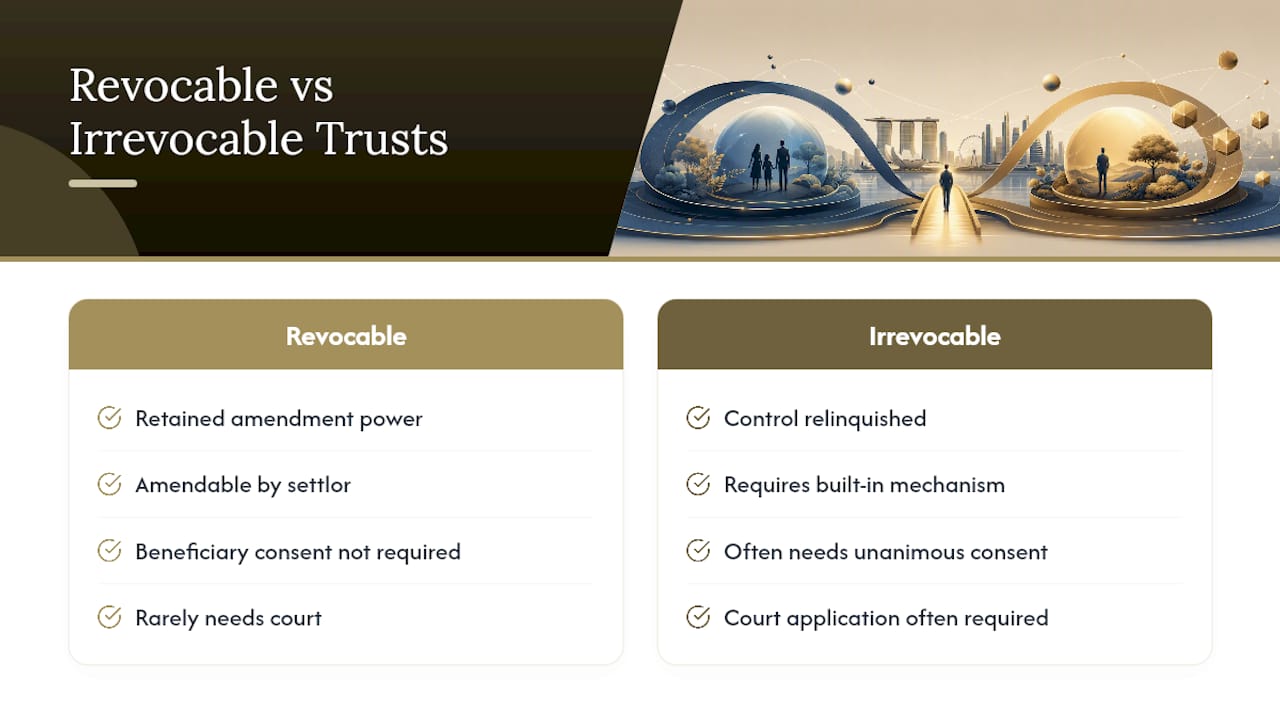
A revocable trust generally gives the settlor retained power to amend or revoke terms during their lifetime, since they haven’t fully given up control over the assets. That flexibility is the whole point of choosing a revocable structure, often for privacy and probate planning rather than asset protection.
An irrevocable trust is a different animal entirely. The settlor has deliberately relinquished control, usually to achieve estate or tax planning goals, or to protect assets from future claims. Amending an irrevocable trust depends entirely on whether the original deed built in a specific amendment mechanism, such as a protector’s power or a limited power of appointment. Without one, changes require either unanimous beneficiary consent (rarely feasible where minors are involved) or a court application, and both carry a genuinely higher bar than simply asking a settlor to sign a variation.
This is why practitioners increasingly advise settlors to think through amendment flexibility at the drafting stage rather than treating irrevocability as an all-or-nothing choice. A discretionary trust with a carefully scoped amendment power can offer most of the protective benefits of irrevocability while still leaving room to adjust for circumstances nobody could have predicted at signing.
Why Do People Amend Trusts In Singapore?
Amendments rarely come from nowhere. They tend to follow specific life events or planning realizations, and recognizing the pattern helps you anticipate what documentation you’ll need.
Family changes drive a large share of amendment requests: a new grandchild, a divorce, a beneficiary who’s matured and no longer needs the protective restrictions built into the original deed. Trustee-related changes are equally common, particularly when a corporate trustee is acquired or restructured, or when an individual trustee wants to retire due to age or relocation.
Tax and regulatory shifts also prompt amendments. A change in how CPF nominations interact with an insurance trust, or updated stamp duty treatment for property held in trust, can make a previously efficient structure worth revisiting. Business succession is another frequent trigger, especially where a buy-sell arrangement needs updating as a company’s ownership or valuation changes.
Sometimes the reason is simpler: the original deed was drafted broadly, and the family now wants to tighten distribution terms, add a protector role for oversight, or consolidate several years of ad hoc variations into one clean, current document. None of these scenarios require the same fix, which is exactly why the clause-by-clause review comes first, every time.
What Limits Can Block A Trust Amendment?
The trust deed itself is usually the biggest constraint, not Singapore law. If the original drafting never included an amendment power, no amount of goodwill among the parties creates one after the fact. That’s the harsh reality settlors sometimes discover only when they try to make a change years later.
Where the deed does grant a power, it often comes with built-in restrictions: a requirement for unanimous trustee consent, a protector’s veto right, or a limitation that the power can only be used for administrative matters, not dispositive ones. Some deeds also set a time limit or trigger event after which the amendment power lapses entirely.
Beyond the deed, Singapore’s legal framework adds its own ceiling. Because there’s no broad statutory variation mechanism, trustees and settlors can’t lean on legislation to bypass a deed that’s silent or restrictive on amendment. Court relief remains available, but as noted earlier, it’s exceptional rather than routine, particularly where the proposed change affects beneficiaries who can’t give informed consent themselves.
The practical takeaway is straightforward: the deed’s own wording is almost always the first and last word on what’s possible, which is exactly why the initial clause review matters more than any procedural shortcut.
How Do Amendments Affect Beneficiaries’ Rights?
Every amendment that touches beneficial entitlements changes someone’s expectations, and beneficiaries are entitled to understand how. A change that redirects income, alters a distribution schedule, or adds a new class of beneficiary directly affects existing beneficiaries’ interests, sometimes by dilution, sometimes by outright removal.
This is why consent requirements exist in the first place. A beneficiary with a vested interest generally has standing to object if an amendment diminishes their position without proper authority or process. Even where consent isn’t strictly required under the deed’s terms, trustees who proceed without notifying affected beneficiaries expose themselves to later disputes, particularly if the change looks favorable to one branch of the family over another.
Minors and unborn beneficiaries deserve particular care here, since they cannot consent for themselves and Singapore’s courts apply real scrutiny before approving anything on their behalf. An amendment that seems reasonable to the adults involved can still fail if it isn’t demonstrably in the interests of those who can’t speak for themselves.
Good practice means documenting exactly how each amendment affects each beneficiary’s position, not just the trustee’s or settlor’s intent. That record becomes essential if a beneficiary later questions whether the change was properly authorized.
What Are The Risks Of Getting A Trust Amendment Wrong?
The biggest risk is resettlement, where changes are extensive enough that the amended trust is treated as a brand new trust rather than a continuation of the old one. That reclassification can trigger fresh tax consequences and disrupt the continuity trustees and beneficiaries were relying on.
Defective execution is another real exposure. An amendment signed by the wrong party, missing a required witness, or exercised in a way the deed doesn’t actually permit can be challenged and potentially unwound years after everyone assumed it was settled. That’s a particularly ugly outcome when asset transfers or distributions have already happened based on the “amended” terms.
Beneficiary disputes follow naturally from any change that shifts entitlements, especially within families where the amendment wasn’t communicated clearly beforehand. And regulatory exposure, unexpected stamp duty, incomplete compliance updates, or missed reporting obligations, tends to surface months later, often when a bank or IRAS review flags a discrepancy nobody caught at execution.
None of these risks are exotic. They’re the predictable result of skipping the clause review, rushing the drafting, or treating asset-level implementation as an afterthought.
Why Legal And Tax Advice Matters Before You Amend
Amending a trust touches property law, tax law, and family dynamics simultaneously, which is precisely why doing it without specialist input is a false economy. A lawyer reviewing the deed catches restrictions a layperson would miss entirely, while a tax advisor flags stamp duty or CPF nomination consequences before they become expensive surprises.
The stakes rise sharply wherever minors, unborn beneficiaries, or irrevocable structures are involved, since these are exactly the situations where Singapore’s absence of a broad variation statute makes court relief harder to obtain. Getting the drafting wrong here isn’t a minor inconvenience, it can mean years of delay or an amendment that never takes lawful effect.
Early legal and tax input also tends to reveal a simpler path than the one a family initially imagined, often a narrow administrative fix instead of a broad dispositive rewrite. That’s advice worth having before a single deed gets drafted, not after.
Why Building Amendment Flexibility Into The Trust Beats Fixing It Later
The trusts that cause the fewest headaches later are the ones drafted with change in mind from day one. A discretionary trust paired with a genuine, well-scoped power of amendment gives a family room to adapt as circumstances shift, without needing a court application or a beneficiary consent scramble years down the line.
That flexibility isn’t free, though. A broad amendment power without checks invites its own risks, which is why pairing it with a protector role, or limiting who can exercise it and for what purpose, tends to work better than leaving it wide open. The right balance depends on the family, but the principle holds everywhere: build the flexibility in now, because retrofitting it into a deed that never anticipated change is far harder than getting it right at settlement.
If your existing trust was drafted years ago without this kind of provision, it’s worth reviewing before the next life event forces the question.
— Joseph
How Elite Legacy Planning Supports Trust Amendment Projects
Working through a trust amendment on your own means juggling deed interpretation, trustee mechanics, and tax exposure all at once, usually while also managing the family conversation that triggered the change in the first place. Elite Legacy Planning’s Trust Consultation & Lifetime Advisory service exists specifically to take that coordination off your plate, walking through the deed, the document chain, and the tax implications in one sitting rather than leaving you to piece it together from separate advisors.

For families holding trust structures like AssureTrust or a testamentary trust set up as part of a comprehensive will, an amendment rarely happens in isolation. It usually intersects with insurance nominations, CPF arrangements, or property held under a related structure, which is why Elite Legacy Planning reviews the full picture rather than treating the deed as a standalone document.
The practical next step is straightforward: bring your original deed, every prior variation, and current asset schedules to a consultation, and expect the legal and tax coordination to happen alongside the drafting, not after it. You can book a consultation online or review the full range of services on the Elite Legacy Planning services page before your first meeting.
Sources
Readers wanting to go deeper into the legal framework behind trust amendments should start with these primary sources rather than secondhand summaries.
This article is general information, not a substitute for advice from a qualified lawyer. Consult a qualified legal professional about your own circumstances before acting on anything here.
FAQ
How Do I Amend An Existing Trust In Singapore?
Start by reviewing the trust deed for an express amendment power, then execute the appropriate instrument, typically a deed of variation, supplemental deed, or amended-and-restated deed. Whether you need beneficiary consent or court approval depends on whether the change affects beneficial entitlements.
How Much Does It Usually Cost To Amend A Trust In Singapore?
Costs vary depending on the complexity of the change and whether tax or court input is needed, so there’s no single fixed figure across the market. Elite Legacy Planning’s Trust Consultation & Lifetime Advisory service doesn’t list a published flat rate for amendments; current pricing is available directly on the services page.
What Is The Procedure To Amend A Trust Deed?
The procedure runs from clause review to execution: confirm the amendment power exists, draft the correct instrument identifying the original deed and the specific clauses changing, obtain required consents, and execute according to the deed’s formalities. After signing, you still need to update banks, registries, and trustee records for the change to take effect across all the trust’s assets.
How Difficult Is It To Change A Trustee In Singapore?
Changing a trustee is usually more straightforward than changing beneficial entitlements, but it still requires following either the deed’s express retirement power or the statutory conditions in the Trustees Act. Defective execution, such as a retirement completed without required co-trustee consent, can leave the change vulnerable to challenge, as case law like Chan Yun Cheong v Chan Chi Cheong illustrates.
Recommended
Comments