


Trust Bank Account Singapore: What HNW Advisers Need to Know


A trust bank account in Singapore is a bank account held in the trustee’s name to receive, hold, and disburse trust assets for estate and succession planning purposes. It is not a retail product. The account title reflects the legal trust relationship, and the bank treats the trustee as the account holder acting in a fiduciary capacity.
Before your first call with a relationship manager, assemble these documents:
Executed trust deed (certified true copy)
Trustee resolution authorizing account opening
Incumbency certificate confirming current trustees and officers
Certified passports and proof of address for all trustees, signatories, and ultimate beneficial owners (UBOs)
UBO ownership chart showing control structure
ACRA BizFile+ extract (for corporate trustees)
Pro Tip: Private banks typically expect assets under management in the USD 5–10 million range, though relationship managers can consider lower amounts case-by-case. Presenting a credible asset history and an adviser-managed implementation plan before the first meeting materially improves your negotiating position.
Key Takeaways
Opening a trust bank account in Singapore requires a correctly structured trust deed, a compliant trustee entity, and a clear commercial narrative that satisfies bank KYC and MAS/TCA obligations.
Point | Details |
Document pack first | Prepare trust deed, trustee resolution, incumbency, certified IDs, UBO chart, and ACRA extract before contacting any bank. |
AUM expectations | Private banks typically expect USD 5–10 million; relationship managers can consider lower amounts with a credible asset history. |
Timeline | Allow one to two weeks for existing relationships; four to six weeks for new corporate trustees with complex structures. |
MAS licence fees | TCA application fee is S$1,000 (non-refundable); annual licence fee is S$4,000 where a licence is required. |
Elitelegacyplanning | Provides end-to-end trust setup and bank onboarding support, from document preparation to RM briefing and compliance handover. |
Table of Contents
Who can open a trust bank account in Singapore?
Three categories of trustee can hold a Singapore trust bank account: an individual trustee, a licensed corporate trustee, and a Private Trust Company (PTC).
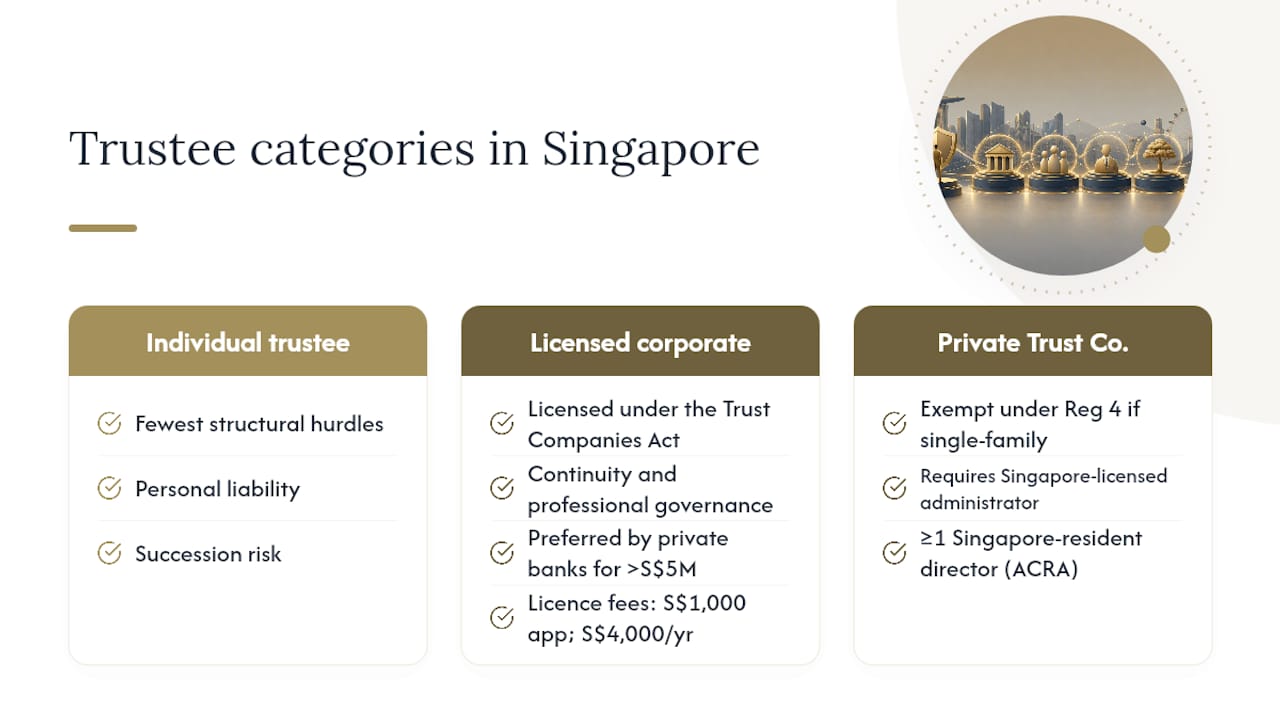
Individual trustees face the fewest structural hurdles but carry personal liability and succession risk. A corporate trustee licensed under the Trust Companies Act (TCA) offers continuity and professional governance, which most private banks prefer for accounts above S$5 million.
PTCs occupy a distinct position. Under regulation 4 of the Trust Companies (Exemption) Regulations, a PTC serving a single family is exempt from holding a trust business licence, provided it uses a Singapore-licensed trust company as administrator and maintains at least one Singapore-resident director under ACRA rules. Banks and merchant banks, holders of certain Capital Markets Services licences, and lawyers are also among the exempt persons listed by MAS. For entities that do require a licence, MAS weighs physical presence in Singapore, management expertise, financial soundness, and internal compliance systems. The non-refundable application fee is S$1,000; the annual licence fee is S$4,000.
Elitelegacyplanning’s Private Trust Company setup service is specifically designed to navigate these structural choices for HNW families.
What do banks actually check during KYC?
Banks treat account opening as a long-term risk assessment, not a form-filling exercise. GoBusiness guidance confirms that corporate accounts require a certified ACRA BizFile+ extract, certificate of incorporation, company constitution, board resolution authorizing the account, and certified IDs and proof of address for all directors and signatories.
For trust accounts, banks add layers: the trust deed, a trustee resolution, source-of-funds documentation, and a clear UBO chart. Foreign-incorporated trustees face an additional requirement: a legal counsel’s opinion confirming the entity’s authority to open accounts overseas.
Most major Singapore banks require at least one signatory to attend in person. Where that is not possible, notarized alternatives are accepted, but they add time. Appoint signatories early and confirm their availability before scheduling the bank meeting.
How long does the account opening process take?
For an existing banking relationship, onboarding can move in one to two weeks. A new corporate trustee with no prior bank relationship typically takes four to six weeks, and complex structures with foreign-incorporated entities or multiple UBOs can run longer if document rounds are needed.
The practical sequence: finalize the trust deed and trustee structure, incorporate the corporate trustee and obtain ACRA registration, prepare the full document pack, brief the relationship manager before submission, attend the in-person signing, and await compliance sign-off.
What costs should you budget for?
Trust setup costs vary by structure. A Standby or Living Trust or Property Trust carries professional drafting fees. A PTC adds ACRA incorporation costs and ongoing registered-address and director fees. Where a full TCA licence is required, budget S$1,000 for the application and S$4,000 annually for the licence. Banks may also impose account maintenance fees and minimum balance requirements that vary by institution and AUM tier.
What compliance risks apply to trust bank accounts?
The primary risks are KYC/AML failures, inconsistent UBO records, and inadequate source-of-funds documentation. Banks screen all directors, trustees, and UBOs against sanctions lists, PEP databases, and adverse media. A mismatch between your ACRA records and the trust deed is one of the fastest ways to trigger a supplementary document round or an outright rejection.
Trustees also carry ongoing obligations: updating the bank when trustees change, maintaining accurate transaction records, and notifying MAS within prescribed timeframes under the TCA when trust business commences or ceases.
How are trust bank accounts taxed in Singapore?
Singapore does not impose a separate trust tax regime in most cases. Trust income distributed to Singapore-resident beneficiaries is generally taxable in their hands at their personal income tax rate. Undistributed income retained by the trustee is taxable at the trustee level at the prevailing corporate or individual rate, depending on the trustee’s legal form.
Foreign-sourced income remitted into Singapore by a trust may qualify for exemption under certain conditions, but the analysis is fact-specific. Trustees should maintain clear records of income source, distribution decisions, and beneficiary residency status to support annual tax filings with the Inland Revenue Authority of Singapore (IRAS).
Trust accounts vs. nominee and escrow accounts
These three account types serve different legal purposes and carry different risk profiles.
A trust bank account is held by a trustee under a binding trust deed. The trustee has fiduciary duties to beneficiaries, and the assets are legally separated from the trustee’s personal estate. A nominee account, by contrast, holds assets in one person’s name on behalf of another, but without the formal legal structure of a trust. Nominee arrangements offer less protection and have come under increased scrutiny following recent company law updates requiring Corporate Service Provider registration evidence for nominee directors.

An escrow account is a transactional tool: a neutral third party holds funds pending fulfillment of a contractual condition, then releases them. It has no ongoing fiduciary relationship and is not suited to long-term estate planning.
For succession planning, only a properly structured trust account provides the legal separation, beneficiary protection, and continuity that HNW families require.
What advisers consistently underestimate about this process
The document checklist is not the hard part. Banks have seen thousands of trust deed formats. What actually slows onboarding is a vague commercial narrative. When a relationship manager asks “what is the purpose of this trust and what transactions do you expect?” and the answer is generic, the compliance team flags it for enhanced due diligence.
The substance narrative matters more than most advisers realize. A well-prepared brief covering the trust’s business purpose, expected transaction patterns, source-of-funds evidence, and UBO clarity reduces supplementary document rounds significantly. Pre-meeting RM briefings, notarized documents prepared in advance, and a multi-bank application strategy when one bank’s AUM threshold is uncertain: these are the practical levers that move timelines.
PTCs in particular benefit from a clean ACRA record from day one. Inconsistent director details between BizFile+ and the trust deed are a common and avoidable delay.
How Elitelegacyplanning supports trust bank account onboarding

Elitelegacyplanning handles the full document-to-account sequence for HNW clients and their advisers in Singapore. The engagement runs from discovery and structure selection through document pack preparation, trustee resolution drafting, RM briefing, in-person signing coordination, and post-onboarding compliance handover.
Services relevant to trust bank account setup include Trust Consultation and Lifetime Advisory, Private Trust Company setup, AssureTrust, Standby/Living Trust, and Property Trust. All work is conducted with awareness of MAS/TCA requirements and ACRA obligations, and client information is handled with strict confidentiality.
To start the process, book a consultation online or contact the team directly to discuss your trust structure and banking requirements.
Primary sources and references for advisers
The following sources cover MAS forms, statutory provisions, bank checklists, and AUM guidance relevant to opening and operating a trust bank account in Singapore.
MAS FAQs on the Trust Companies Act: Covers TCA exemptions, MAS licensing criteria, and fee amounts (S$1,000 application; S$4,000 annual).
Trust Companies Act 2005 (Singapore Statutes Online): Statutory text including notification forms, timelines, and prescribed obligations.
MAS Compliance Toolkit for the Trust Industry: Practical forms (Form 1, Forms 6–10) and submission instructions for licence applications and notifications.
GoBusiness: Open a Corporate Bank Account: Government checklist of standard corporate account documents and in-person signing requirements.
Bordier Singapore: Trust Account Minimum Requirements: Private-bank AUM expectations for trust accounts.
Item | Figure | Source |
TCA application fee | S$1,000 (non-refundable) | MAS TCA FAQs |
TCA annual licence fee | S$4,000 | MAS TCA FAQs |
Typical private-bank AUM expectation | USD 5–10 million (case-by-case consideration possible) | Bordier Singapore FAQ |
This article is general information, not a substitute for advice from a qualified financial advisor. Consult a qualified financial professional about your own circumstances before acting on anything here.
Sources
Recommended
Comments