


No, Usually Not: Stamp Duty on Inherited Homes for Heirs in Singapore


If you inherit a residential property in Singapore under a valid will or succession law, you generally do not pay stamp duty on the transfer. IRAS treats that transfer as non-chargeable. The catch: the property still counts toward your total property count, which shapes what you owe later under ABSD if you buy again, or SSD if you sell. Check the details with IRAS or HDB before you act.
TL;DR:
Inheritance through lawful succession does not trigger stamp duty, but the property still counts toward your total property holdings, affecting future ABSD and SSD liabilities.
An inherited property can push your next property purchase into higher ABSD tiers if you are already owning other properties, regardless of whether stamp duty was paid initially.
Selling an inherited property generally does not incur Seller’s Stamp Duty if the sale occurs well after the purchase date originally registered by the deceased, but specific trust or corporate cases may trigger duty.
Transferring or redistributing inherited property outside formal succession procedures can recharacterize the transfer as a sale or gift, making the recipient liable for stamp duties.
Proper estate planning, including clear wills and trust arrangements, can prevent stamp duty surprises and optimize the transfer process for inheritance and future property acquisitions.
Table of Contents
Why Lawful Inheritance Is Exempt From Stamp Duty
The exemption comes down to how the transfer happens, not the fact that a death occurred. When a property passes to you through a “transfer by assent” under a valid Will, the Intestate Succession Act, or the Administration of Muslim Law Act, IRAS treats it as non-chargeable. No stamp duty applies to that instrument, and no estate tax exists in Singapore either. Estate duty was abolished back in 2008, a point plenty of families still get wrong when they confuse “inheritance tax” with stamp duty exposure, as Singapore Legal Advice explains.
The exemption breaks down the moment the transfer stops looking like lawful succession. Watch for these situations:
A family privately reassigns shares in an inherited property outside the terms of the Will or intestacy rules.
One sibling “buys out” another’s share informally, which IRAS can treat as a sale or gift.
Distribution deviates from what the Will or Muslim inheritance law actually specifies.
A trust renunciation or resulting trust arrangement creates a fresh chargeable event.
Once a transfer is recharacterized this way, whoever benefits (the buyer or recipient of the gift) becomes liable for Buyer’s Stamp Duty, and possibly ABSD, calculated on market value. Stick to the formal succession route and get the instrument reviewed before signing anything with a relative.
Does Inheriting a Property Affect ABSD on Your Next Purchase?
Yes. An inherited home adds to your property count the moment it becomes yours, even though no stamp duty applied to the transfer itself. That single fact changes the math on every property decision you make afterward.
Here’s how it plays out by buyer profile:
Singapore citizens buying a second residential property pay ABSD, and an inherited flat you already hold pushes your next purchase into a higher bracket.
Permanent residents and foreigners face steeper ABSD tiers, so an unexpected inheritance can turn a planned first purchase into a second or third one overnight.
Married couples sometimes consider decoupling, transferring one spouse’s share to the other, to free up room for an ABSD-free purchase, though this move has its own stamp duty consequences and needs proper structuring.
Check the exact percentages on the IRAS ABSD guidance page before committing to any purchase timeline. Rates shift periodically, and a stale number from a blog post or a well-meaning relative is a bad basis for a six-figure decision.
Pro Tip: If you’ve just inherited a property and are eyeing another purchase within the next year, run the ABSD math before you sign an Option to Purchase. Reversing a stamp duty mistake after the fact is far harder than avoiding one upfront.
What Happens With Seller’s Stamp Duty on an Inherited Home?
Here’s the part most beneficiaries don’t expect: selling an inherited property often triggers no Seller’s Stamp Duty at all, even if you sell shortly after the death. For SSD purposes, IRAS treats the acquisition date as the date the deceased originally bought the property, not the date it passed to you.
Say your father bought a condo in 2012 and passed away in 2026, leaving it to you. You sell it three months later. On paper, you’ve “held” the property for only three months. But because SSD counts from your father’s 2012 purchase date, well outside the current SSD holding period, no SSD applies to your sale.
That said, a handful of edge cases still trigger ad valorem duty:
Property distributed in specie from a company the deceased controlled.
Renunciation of a trust interest under Section 22C, which can create a fresh chargeable event.
Gifts of the property made outside the formal succession process.
The IRAS BSD and trust guidance walks through these scenarios in more depth, and they’re worth a careful read if the estate involves any corporate holdings or trust structures.
Do I Have to Sell an Inherited HDB Flat?
Maybe. HDB eligibility rules sit entirely apart from stamp duty law, and they can force a sale even when no duty is owed on the inheritance itself. Confirm these points early:
Check whether you already own another HDB flat. Owning two HDB flats is not permitted, so you may need to dispose of one within a set timeframe.
Check your private property ownership. If you own private residential property and inherit an HDB flat (or vice versa), HDB’s eligibility rules may require disposal of one within six months.
Verify citizenship and residency status. Non-citizens and certain PR households face additional restrictions on retaining an inherited flat.
Confirm the flat’s Minimum Occupation Period (MOP) and whether it carried any housing grants, both of which affect what you can do with it next.
These constraints apply regardless of how clean the succession transfer was. Our guide to HDB inheritance rules breaks down the disposal timelines and appeal process in more detail if your situation is borderline.
What Should Beneficiaries Do First After Inheriting Property?
Getting the paperwork right protects you from penalties and delays. Work through it in this order:
Obtain the Grant of Probate or Letters of Administration. Nothing moves legally until the court confirms who has authority over the estate. Our comparison of probate versus letters of administration explains which route applies to your situation.
Prepare the assent or transfer instrument. This document formally records the transfer from the estate to you as beneficiary.
Verify the title at the Singapore Land Authority. Confirm there are no outstanding encumbrances or caveats before proceeding.
Engage a conveyancing solicitor to lodge the stamping and complete the transfer registration.
Stamp any chargeable instrument on time. If signed in Singapore, you have 14 days; if signed overseas, 30 days. Late stamping carries financial penalties that only grow the longer you wait.
Pro Tip: Keep a single folder, physical or digital, with the death certificate, Grant of Probate, title deed, and any HDB or IRAS correspondence. Estates stall for months simply because documents are scattered across three different relatives’ filing cabinets.
For anything beyond a straightforward single-property estate, a conveyancing lawyer or an estate planning firm can keep the moving pieces aligned.
Why Estate Planning Prevents Stamp Duty Surprises Later
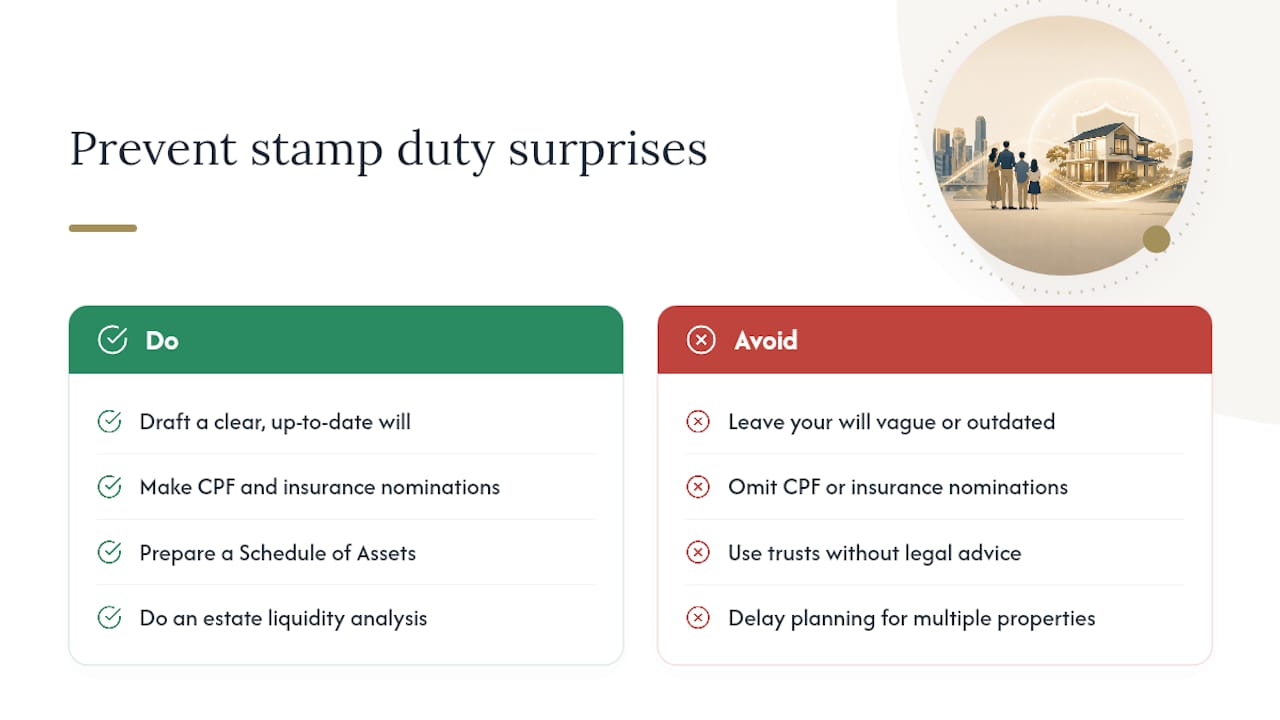
Most of the stamp duty headaches beneficiaries face trace back to a will that was vague, outdated, or nonexistent. A clearly drafted will, paired with proper nominations on insurance and CPF accounts, keeps a transfer inside the exempt “assent” category instead of drifting into gift or sale territory. Trust structures can also help manage future ABSD exposure, though they need careful drafting to avoid creating a chargeable event during the settlor’s lifetime, as outlined in trust consultation guidance.
Families with multiple properties or business interests benefit most from planning this early. A Comprehensive Will, a Schedule of Assets, and an Estate Liquidity Analysis give your executor the clarity to act fast instead of scrambling under a stamping deadline.
— Joseph
How Elite Legacy Planning Helps With Inheritance and Stamp Duty Exposure
Some estate planning firms help Singapore families plan around ABSD and SSD exposure before it becomes an urgent problem, not just react to it after a death. A Comprehensive Will (Testamentary Trust), priced between $1,250 and $1,900, sets out exactly how property should transfer so it stays inside the stamp duty exemption instead of drifting into gift or sale territory.

A Trust Consultation looks at whether a Living Trust or Private Trust Company structure reduces future ABSD exposure, while a Schedule of Assets and Estate Liquidity Analysis helps an executor understand what exists and how to fund any duties that do arise. If your estate involves multiple properties, an HDB flat alongside private property, or a family business, book a consultation through the services overview or book online directly and bring your existing will, property title documents, and a rough list of assets to the first meeting.
Where to Verify These Stamp Duty Rules
For rates and current ABSD/BSD tiers, go straight to IRAS’s stamp duty pages. For SSD examples specific to inherited property, IRAS’s SSD guidance walks through the acquisition-date rule. HDB eligibility questions belong with HDB directly, and the underlying legal text sits in the Stamp Duties (Inherited Properties) Remission Order.
Sources
FAQ
Do You Pay Stamp Duty When You Inherit Property?
No, not when the transfer happens through a valid Will, the Intestate Succession Act, or the Administration of Muslim Law Act. IRAS treats these as non-chargeable transfers by assent, though the property still counts toward your property total for future ABSD purposes.
Do I Pay Stamp Duty on a Gifted Property in Singapore?
Yes. A gift of residential property is a chargeable event, and the recipient typically pays Buyer’s Stamp Duty (and ABSD, if applicable) calculated on the property’s market value. This is different from lawful inheritance, which is exempt.
Do I Need to Pay Inheritance Tax in Singapore?
No. Singapore abolished estate duty in 2008, so there is no inheritance tax on assets you receive from a deceased person’s estate. Stamp duty only becomes relevant later, when you sell the inherited property (potential SSD) or buy another one (potential ABSD).
Do I Need to Sell My HDB Flat If I Inherit a Private Property?
Possibly. HDB rules generally don’t allow you to own an HDB flat and private property at the same time, so inheriting one while owning the other can trigger a disposal requirement within a set timeframe. Check your specific eligibility with HDB before making any decisions about either property.
Recommended
Comments