


From $2,500–$50,000: Probate Costs in Singapore with Practitioner Ranges


Uncontested probate in Singapore typically costs between $2,500 and $8,000 in legal fees, plus roughly $300 in court fees and a $400 filing deposit. Contested or complex estates can run $10,000 to $50,000 or more. Disbursements add a few hundred to several thousand dollars on top. The executor pays these costs upfront and gets reimbursed from the estate once assets are collected.
TL;DR:
Probate costs range from about $2,500 to $8,000 for simple estates, with complex or contested cases costing $10,000 to over $50,000 due to additional legal and disbursement fees.
Court fees for uncontested applications are approximately $300, with a $400 deposit that covers initial charges and is refunded if not fully used.
Disbursements for searches, valuations, and foreign documents can add several hundred to thousands of dollars, often requiring an initial deposit of $1,000 to $1,500.
Lawyers typically bill either a flat fee for the grant, hourly rates, hybrid models, or percentage of estate value, making scope clarity essential to avoid cost overruns.
Costs increase significantly with multiple properties, foreign assets, disputes, or complex distributions, so early estate planning and clear scope negotiations can help control expenses.
Table of Contents
How Much Does Probate Cost in Singapore for Different Estate Types?
The fee you pay depends almost entirely on how much friction exists between the paperwork and the payout. A cash-only estate with one bank account and a cooperative family looks nothing like an estate tangled up in property, CPF nominations, and a sibling who refuses to sign anything.
At the simple end, a straightforward Grant of Probate or Letters of Administration application typically runs $2,500 to $8,000 in legal fees, according to practitioner estimates. That flat fee usually covers drafting and filing the originating application, preparing the Schedule of Assets, and extracting the grant once the court approves it. It does not usually cover asset collection, property transfers, or handling a dispute that pops up mid-process.
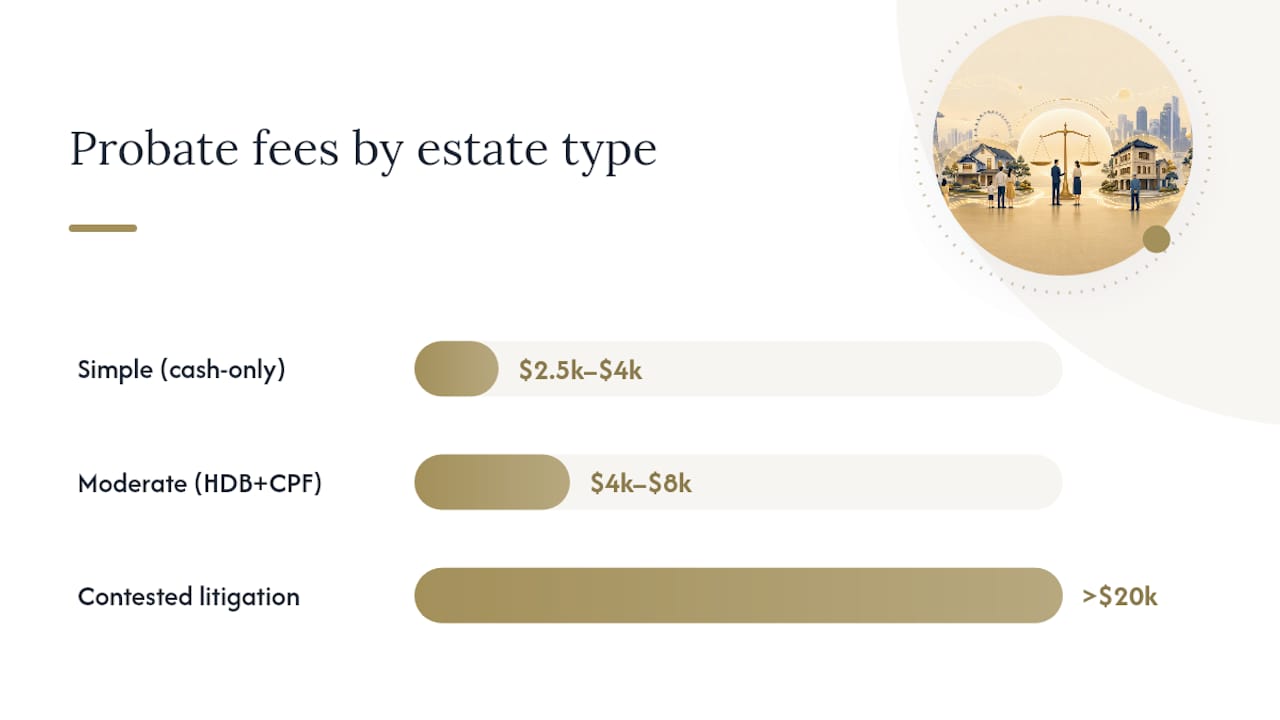
Moderately complex estates, ones involving CPF nominations, a residential property, or several beneficiaries who need separate correspondence, tend to land in the middle of that range or slightly above it. Contested matters or high-value estates with multiple properties, business interests, or litigation over the will’s validity commonly incur significantly higher fees.
Three quick scenarios illustrate the spread:
A single bank account, one beneficiary, no property: likely near the lower end, around $2,500 to $4,000.
An estate with a HDB flat, CPF nomination, and three beneficiaries: mid-range, often $4,000 to $8,000.
A disputed will with a caveat lodged and competing claims: five figures, sometimes well past $20,000 once litigation costs stack up.
What Do Court Fees and the Probate eService Actually Cost?
Court fees are separate from legal fees, and they’re the smallest, most predictable line item in the whole process. For a standard uncontested application filed through the Probate eService, total court fees come to approximately $300. The system requires a $400 deposit at the point of filing, which covers the anticipated fees and any incidental charges before the final tally is settled.
Quick fact: The $400 deposit is not an extra fee. It is a holding amount against the roughly $300 in actual charges, with any balance typically adjusted once the application closes.
The Judiciary’s fee schedule itemizes charges for each step, including the originating application, the Schedule of Assets, and certified copies of the grant.
Item | Typical Fee |
Originating application | Part of the ~$300 total |
Schedule of Assets filing | Part of the ~$300 total |
Certified copies of grant | Small per-copy charge |
eService deposit required at filing | $400 |
These figures apply to uncontested matters. Add a caveat or a contested hearing, and court fees climb because of additional filings and hearing-related charges.
What Disbursements Should You Budget for Beyond Legal Fees?
Disbursements are the out-of-pocket costs a law firm pays on your behalf, then bills back to the estate. They’re often the part executors underestimate most, because quotes for legal fees rarely fold these in.
Bank, property, and share searches, used to confirm what the deceased actually owned, typically cost $100 to $500 depending on how many institutions and registries need checking. Property valuations run higher: expect $1,000 to $5,000 per property when a formal valuation is required for distribution or sale.
If the estate involves overseas assets, translation, notarization, apostille certification, or foreign counsel fees can add several hundred to a few thousand dollars, and may multiply quickly if multiple jurisdictions are involved. Advertising for missing or unknown beneficiaries, sometimes required before a grant is finalized, is a smaller but real one-off cost.
Common disbursement categories to expect on your bill:
Search fees for banks, property, and shareholdings
Property valuation reports where a sale or transfer is pending
Translation and certification for foreign-language documents
Advertising costs when beneficiaries can’t be located
Courier and administrative charges for document handling
Most firms request an initial deposit of $1,000 to $1,500 to cover these disbursements before work begins.
How Do Lawyers Bill for Probate Work in Singapore?
Understanding the billing structure matters more than the headline number, because two quotes with the same total can cover wildly different scopes of work.
Flat fee for the grant only. This usually covers drafting, filing, and extracting the Grant of Probate or Letters of Administration. It typically excludes asset collection, property transfers, and disputes.
Hourly billing. Senior associates in probate work commonly bill in the low hundreds per hour, with partners charging more. This model suits estates where the scope is uncertain at the outset.
Hybrid billing. A flat fee covers getting the grant, then hourly rates apply for post-grant work like distributing assets or handling a late-surfacing creditor claim. This is increasingly the standard structure for moderately complex estates.
Percentage-based fees. Reserved for very large estates, typically 1% to 3% of estate value. The absolute dollar cost can end up far higher than a flat or hourly quote, so compare carefully before agreeing.
Pro Tip: Before signing any engagement letter, ask exactly what triggers the move from flat fee to hourly billing. A quote that looks cheap on paper can balloon fast once “post-grant work” starts accumulating hours.
What Drives Probate Costs Up in Singapore?
A handful of factors separate a $3,000 estate from a $30,000 one, and most of them are visible before you even file.
Multiple properties or business interests. Each asset class needs its own valuation, transfer process, and sometimes separate legal advice, which multiplies both time and disbursements.
Foreign assets. Overseas bank accounts or property often require foreign probate proceedings or local counsel in that jurisdiction, adding cost and months to the timeline.
Caveats and will challenges. Once someone lodges a caveat or contests validity, the matter shifts from administrative filing to litigation, and legal fees jump into the $10,000 to $50,000-plus range.
Complicated distributions. Trust clauses buried in the will, minority beneficiary interests, or a long list of beneficiaries who each need separate notice and correspondence all add billable hours.
Executors managing multiple properties or business assets should expect valuation and transfer costs to dominate the bill, not the court filing itself.
How Can You Legally Reduce Probate Costs in Singapore?
Cutting costs without cutting corners comes down to reducing the hours a lawyer bills, not skipping steps the law requires.
Self-file through the Probate eService when the estate is genuinely simple. A single-beneficiary cash estate with no disputes may not need full representation, and self-filing avoids legal fees entirely, though it demands accuracy since errors cause delays.
Prepare a clean Schedule of Assets before your first meeting. Gathering bank statements, CPF nomination details, and property documents yourself cuts the hours a lawyer spends chasing paperwork.
Negotiate a defined flat-fee scope upfront. Ask what triggers additional charges and get milestone billing in writing so there are no surprises after the grant issues.
Consider a specialist for complex estates. Paying more upfront for a corporate executor or proper trust structure can prevent far larger costs down the line when multiple jurisdictions or business succession are involved.
Pro Tip: If you’re the sole beneficiary of a small, uncontested estate, ask whether the Public Trustee can handle administration before committing to a private law firm.
How Long Does Probate Take, and When Are Fees Charged?
Uncontested probate in Singapore typically takes around two months from filing to grant issuance, assuming documents are in order and no one contests the application.
Filing stage (weeks 1 to 2): The originating application and Schedule of Assets go in; most flat-fee billing happens here.
Court review (weeks 3 to 6): The court processes the application; delays here usually stem from incomplete paperwork, not court backlog.
Grant issuance (around week 8): The grant is extracted, triggering asset collection and, in hybrid billing arrangements, the switch to hourly charges.
Caveats or foreign elements: Either can add months, since a caveat forces a hearing and foreign assets often require separate proceedings abroad.
Property transfers and business succession add extra months beyond the grant itself, particularly when a property is involved.
Who Pays Probate Costs and How Does Reimbursement Work?
The executor typically pays legal fees and disbursements out of pocket first, then reimburses themselves from estate funds once the grant issues and accounts are accessible. This is standard practice, not a personal financial risk the executor absorbs permanently.

In contested matters, the court has discretion over who bears litigation costs, sometimes ordering the losing party to pay, sometimes splitting costs across the estate. Executors should keep detailed records of every payment made on the estate’s behalf. Clear documentation prevents disputes with beneficiaries later, since reimbursement transparency matters as much as the total amount spent.
When Is Professional Help Worth the Cost?
Specialist support earns its fee once an estate involves more than one moving part, multiple properties, a business interest, CPF and insurance nominations, or beneficiaries spread across jurisdictions. That’s precisely where DIY filing or a generalist lawyer tends to underestimate scope, and where costs balloon mid-process rather than at the outset.
Some estate planning firms structure services around this complexity threshold, offering testamentary trusts, corporate executorship, and portfolio structuring designed for estates where a simple grant application isn’t the whole story. For high-net-worth families, the calculation isn’t “can I save money doing this myself,” it’s “what does an unplanned estate actually cost my family later.”
— Joseph
Get Clarity on Your Estate Costs Before You Commit
A law firm quote for probate work tells you one number. It rarely tells you what happens when the estate includes a business, CPF nominations, property overseas, or beneficiaries who don’t agree on anything. Elitelegacyplanning approaches this differently: instead of quoting a flat fee for a grant application and leaving the rest to hourly billing surprises, the firm structures estate plans upfront, through tools like the Comprehensive Will, Standby Trust, and Business Value Protection Trust, so probate costs stay predictable rather than open-ended.

For estates with property, CPF nominations, or multiple beneficiaries, a Schedule of Assets and Estate Liquidity Analysis starting from $500 can flag cost drivers before they turn into five-figure legal bills. If your family’s situation involves complexity beyond a single bank account, book a consultation to map out what your estate will actually cost to administer, and what you can do now to bring that number down.
Sources
Fee figures in this guide come from the Judiciary’s probate fee schedule, the Probate eService deposit guidance, and the Probate and Administration Act, Singapore’s statutory basis for estate administration.
This article is general information, not a substitute for advice from a qualified lawyer. Consult a qualified legal professional about your own circumstances before acting on anything here.
FAQ
What Is the Cheapest Way to Do Probate in Singapore?
Self-filing through the Probate eService is the cheapest route when the estate is simple, cash-only, and uncontested, since it avoids legal fees entirely and leaves you paying only the roughly $300 in court fees. For very small or single-beneficiary estates, the Public Trustee may also offer a lower-cost administration path.
Do You Need a Lawyer to Apply for a Grant of Probate?
No, Singapore law doesn’t require a lawyer for an uncontested application, and you can file directly through the Probate eService. Most executors hire one anyway once the estate involves property, CPF nominations, or multiple beneficiaries, since errors in self-filed applications often cause delays that cost more in time than the legal fee would have.
How Long Does It Take to Get Probate in Singapore?
Uncontested Grant of Probate applications typically take around two months from filing to issuance. Caveats, foreign assets, or incomplete paperwork can extend that timeline by several months.
Do Bank Accounts Go Through Probate?
Yes, bank accounts held solely in the deceased’s name typically require a Grant of Probate or Letters of Administration before the bank releases funds. Joint accounts with rights of survivorship and accounts with valid CPF or insurance nominations usually bypass probate and pass directly to the named recipient.
Recommended
Comments