


Check Before a Claim: Policy Nomation vs Assignment in Singapore


A valid assignment that transfers policy ownership generally overrides a prior nomination once the insurer registers it. A nomination only designates who gets paid; it never changes who owns the policy. And CPF savings sit outside this entirely: they need a separate nomination filed directly with the CPF Board, since a will has no power over them.
TL;DR:
Properly registered assignments generally revoke previous nominations once ownership transfers, so ensure all documents are submitted and processed before a claim arises.
Nomination forms only designate payout recipients and do not transfer policy ownership, which remains with the original policyholder until a formal assignment occurs.
CPF savings are managed separately through direct nominations with the CPF Board and are unaffected by life insurance nominations or assignments.
Insurers treat revocable nominations as automatically revoked once a registered assignment to another owner is completed, making prior nominations irrelevant in such cases.
For complex estate plans or protecting assets for minors or creditors, adding trusts provides more control than simple nominations or assignments.
Table of Contents
Nomination Vs Assignment: The Core Differences at a Glance
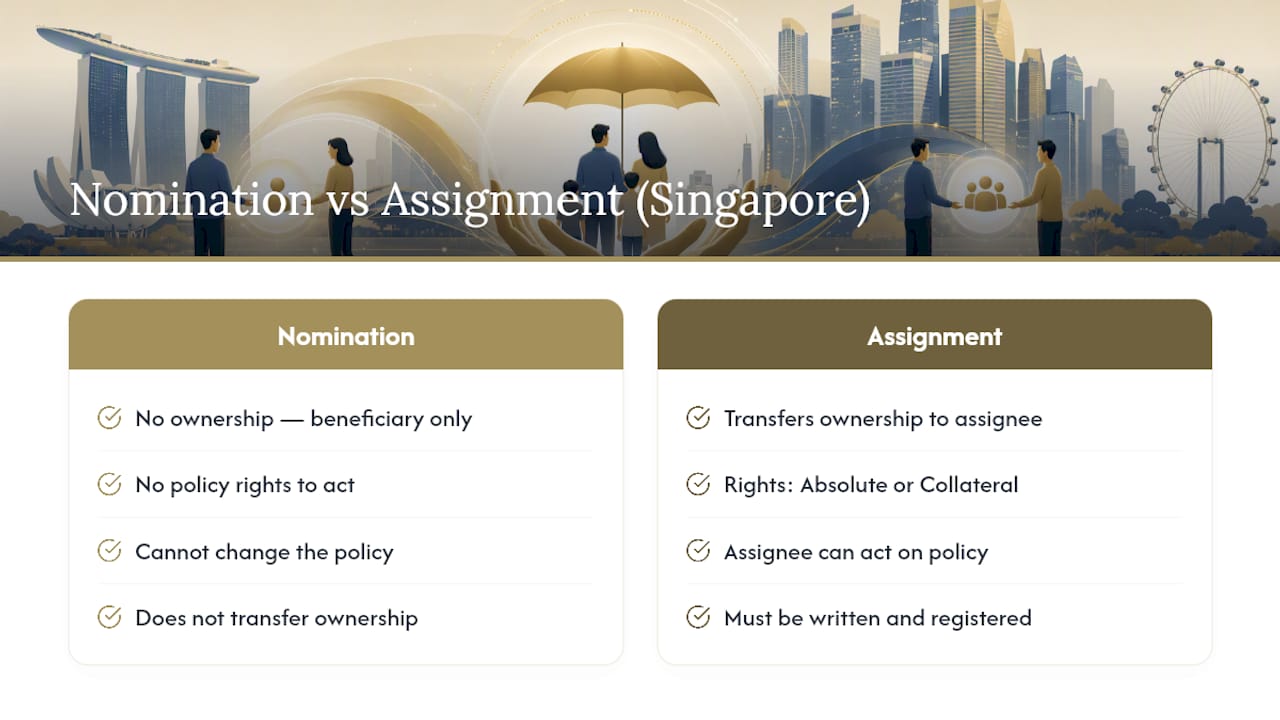
The two mechanisms answer different questions. Nomination answers “who gets the payout?” Assignment answers “who owns the policy?” Confusing them is how families end up in disputes years after everyone thought the paperwork was settled.
Here’s how they actually diverge in practice:
Ownership: Nomination leaves ownership with you. Assignment transfers it to someone else entirely.
Formalities: Nomination is recorded with the insurer through a form. Assignment usually needs a signed Deed of Assignment plus formal insurer notification.
Who can act on the policy: A nominee typically can’t surrender, borrow against, or alter the policy. An assignee who takes absolute ownership can do all three.
Effect on payout: If ownership has changed hands through a registered assignment, the assignee (or their estate) receives the proceeds, not the original nominee.
Interaction with wills: Neither a nomination nor a completed assignment is overridden by a will. A will governs assets that remain in your estate, and a validly nominated or assigned policy usually isn’t one of them, per MoneySense.
CPF savings: Entirely separate. Your CPF nomination controls your Ordinary Account, Special Account, MediSave, and Retirement Account balances, and it’s filed with the CPF Board, not your insurer.
That last point trips up more people than it should. Plenty of Singaporeans assume their will or their insurance nomination “covers everything.” It doesn’t.
How Nominations Work Under Singapore Law
Nominations for life insurance policies are governed by the Insurance (Nomination of Beneficiaries) Regulations 2009, made under the Insurance Act. The regulations set out how a nomination is made, how it’s recorded, and how insurers treat it when a claim comes in. Practically, this means your insurer keeps your nomination on file and pays out according to it when you pass away, provided no assignment or later valid nomination has changed the picture.
Singapore recognizes two kinds of nominations: revocable and trust (irrevocable) nominations. A revocable nomination is the default for most policies. You can change it anytime by submitting a new form to your insurer, and critically, it can be automatically revoked the moment you assign the policy to someone else. A trust nomination locks in the named beneficiaries more firmly, and insurers usually require the nominee’s consent (or a court order) before you can alter it.
Here’s the part that surprises people: nomination never transfers ownership. You remain the policy owner throughout. That’s exactly why insurers treat a valid nomination as sufficient discharge of their obligation, they simply pay whoever is named, without needing to check your will or consult your executor. A will drafted after the nomination doesn’t undo it. If you want a different outcome, you update the nomination itself.
How Policy Assignment Works in Singapore
Assignment moves ownership of the policy from you to someone else, and Singapore recognizes two versions of it. An absolute assignment transfers full ownership and all rights, permanently. It’s common when someone gifts a policy to a family member or transfers it as part of restructuring personal assets. A collateral assignment is narrower and temporary: it’s typically used to pledge a policy as security for a loan, with rights reverting to you once the debt is repaid, as Insured & More explains.
Neither type happens informally. Assignment must be in writing, and most insurers require a Deed of Assignment or a formal Notice of Assignment, properly witnessed, before they’ll act on it. Great Eastern’s assignment process is a good real-world example: the insurer requires the completed deed, identification documents, and formal registration before the change of ownership is reflected on their books. Until that registration happens, the insurer still treats you as the owner on record.
Once an assignment is properly registered, the assignee steps into your shoes. They can surrender the policy, take a loan against it, change the nomination, or sue on the policy if a claim is wrongly denied. That’s a materially different set of rights than a nominee ever holds, and it’s the reason lenders insist on collateral assignment rather than a simple nomination when a policy secures a loan.
Does a Nomination Survive After You Assign the Policy?
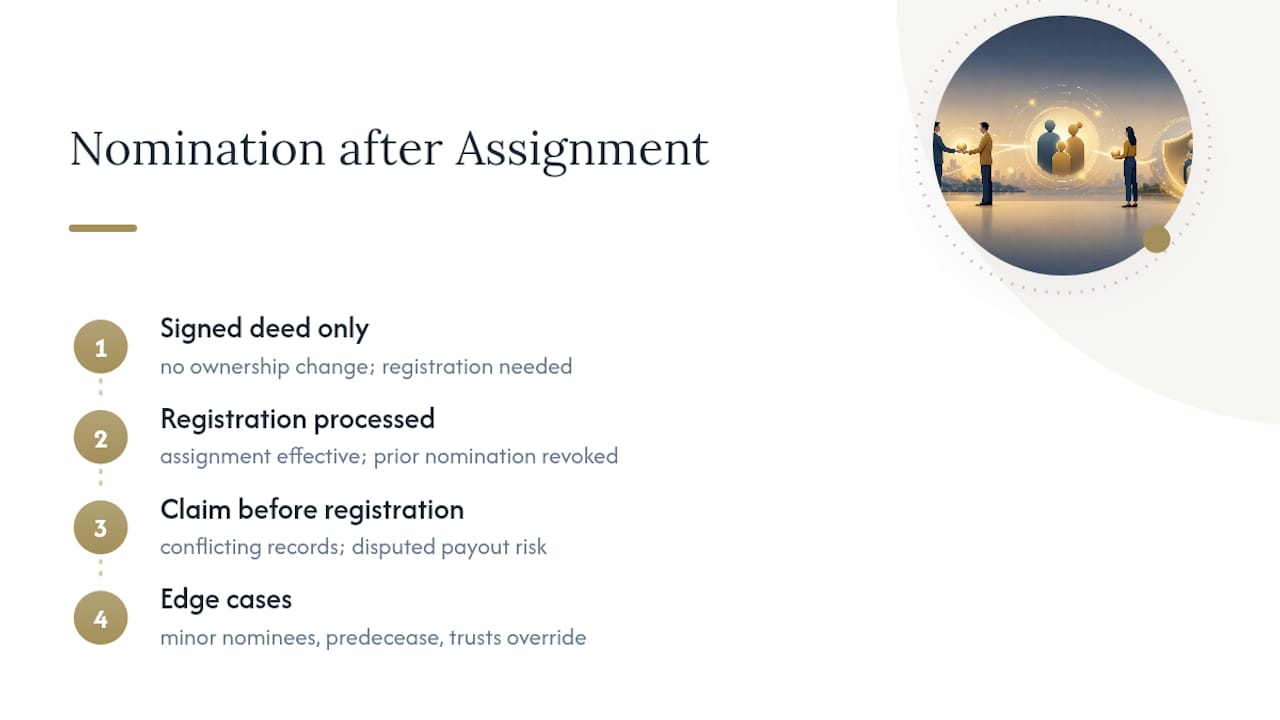
Usually not. Once ownership has genuinely changed hands through a properly registered assignment, the prior nomination typically stops applying, since the person who made it is no longer the owner with authority over the policy. Most insurers treat a revocable nomination as automatically revoked the moment assignment is registered, which is exactly the outcome Great Eastern’s guidance describes for its own policies.
Registration is the pivot point, not the signing of the deed. If paperwork is signed but never submitted, or submitted but not yet processed when a claim arises, insurers can end up with conflicting records, and that’s when disputes happen. Analysis of assignment and nomination interactions around traded endowment policies shows how easily incomplete registration creates contested payouts.
A few edge cases deserve attention: a nominee who is a minor cannot receive proceeds directly, they’re usually paid to a trustee or guardian. A nominee who predeceases the policy owner without a substitute named can send proceeds back into the estate. And a nomination never overrides separate trust instructions covering the same asset.
Your Action Checklist Before Anything Goes Wrong
Do these in order, ideally before a claim is ever triggered, not after:
Verify current records. Call your insurer and confirm, in writing, whether the policy carries an active nomination, an assignment, or both.
If you’re assigning a policy, get the Deed or Notice of Assignment from your insurer, complete the required witnessing, and submit it for formal registration, don’t assume signing is enough.
Handle CPF separately. Log in to MyLegacy@LifeSG to make or update your CPF nomination; it has nothing to do with your insurer’s records.
Get advice for anything complex, minors, blended families, or large estates often need a trust structure layered on top of a simple nomination.
Pro Tip: Ask your insurer for written confirmation once an assignment is registered, not just a phone call. A dated letter or email confirming registration is the single best piece of evidence if the payout is ever contested later.
Where Trusts Fit Once Nomination Isn’t Enough
Nomination and assignment solve narrow problems well: paying a beneficiary quickly, or securing a loan. Neither handles staggered payouts, protection from a beneficiary’s creditors, or provision for a minor beyond the point they turn 18. That’s where a trust earns its place in the plan.
Clients usually come in holding a policy with a nomination they set up years ago and no clear sense of whether it still matches their family situation. A Private Trust Company structure, or a straightforward testamentary trust, gives you control a nomination form simply can’t: staged distributions, named trustees, and protection against a beneficiary’s own poor decisions or creditors. A proper consultation usually produces a clear action plan and a review of exactly which documents need updating first.
— Joseph
How You Can Get Help Sorting This Out
Untangling nomination, assignment, and CPF rules across multiple policies is exactly the kind of detail work that gets postponed until it’s urgent. Professional estate planning services can help you work through this directly, reviewing existing nominations and assignments alongside your comprehensive will, so nothing contradicts anything else on paper.

Services can include will drafting, trust consultation and lifetime advisory, corporate executorship, and a review of how your existing insurance nominations line up with your broader estate plan. If loans secured against a policy or a family business are part of the picture, that can be modeled into the plan too. Booking a consultation is simple: visit the booking page to schedule a session and get a document review started before any of this becomes urgent rather than after.
Where to Verify the Details Yourself
For the legal text on nominations, read the Insurance (Nomination of Beneficiaries) Regulations 2009. For CPF-specific action, use CPF Board’s MyLegacy nomination page. For assignment procedures, contact your insurer’s policy services team directly, using Great Eastern’s assignment page as a reference point for what to expect.
This article is general information, not a substitute for advice from a qualified lawyer. Consult a qualified legal professional about your own circumstances before acting on anything here.
Sources
Recommended
Comments