


Avoid 20% ABSD When Gifting Property in Singapore: Lawyer Checklist


A lifetime gift of property in Singapore triggers stamp duty, specifically Buyer’s Stamp Duty and possibly Additional Buyer’s Stamp Duty, both assessed on market value even though no money changes hands. There is no gift tax or estate duty here, but that stamp duty bill can be substantial. Inheritance through a will skips it entirely. Before you sign anything, talk to a conveyancing lawyer and check your mortgage, CPF, and HDB status first.
TL;DR:
Gifting property in Singapore triggers Buyer’s Stamp Duty and possibly Additional Buyer’s Stamp Duty based on market value, not consideration paid, and depends on the recipient’s residency and property ownership status.
The transfer process requires engaging a conveyancing lawyer, obtaining a professional valuation, executing a Deed of Gift, paying stamp duty within deadlines, and lodging the transfer with the Land Authority, which can take several weeks.
Restrictions on HDB flats, CPF charges, and mortgages often require prior consent from banks, CPF Board, or meeting eligibility criteria before a gift can proceed or be registered.
Donating property to registered charities can provide stamp duty relief and tax deductions, but it involves valuation and IRAS approval steps to qualify.
Gifting can lead to hefty tax and family dispute risks, especially if the recipient already owns property or if the gift is manipulated to hide consideration, making wills or trusts preferable for some families.
Table of Contents
Which Stamp Duties Apply When You Gift Property in Singapore
Gifting property in Singapore doesn’t dodge tax the way many people assume. Buyer’s Stamp Duty applies to every transfer of property, including one where the “buyer” pays nothing, because IRAS calculates BSD on market value, not on the price stated in the transfer document. If you hand your daughter a condo worth $1.5 million with zero consideration paid, BSD is still assessed as if $1.5 million changed hands.
Additional Buyer’s Stamp Duty complicates things further. ABSD depends on the recipient’s residency status and how many properties they already own, not the donor’s situation. A Singapore citizen receiving their first property gift pays no ABSD. A Singapore citizen who already owns one property and receives a second faces ABSD of 20%. A permanent resident or foreigner receiving a gifted property can face even steeper rates.
Pro Tip: Run the numbers before you decide who receives the gift. Transferring a high-value flat to a child who already owns a home can trigger BSD plus ABSD that together can be very costly, money the recipient usually has to find in cash.
Quick breakdown of what typically applies:
BSD: charged on every property transfer, gift or sale, based on market value
ABSD: charged based on the recipient’s residency status and existing property count, not the donor’s
Market value: IRAS assesses stamp duty on the market value whenever declared consideration falls below it, and this applies squarely to zero-consideration gifts
IRAS doesn’t accept a nominal transfer price as a way around this. If a deed states $1 or “for love and affection” as consideration, the taxman still values the transaction at open market rates and taxes accordingly. Anyone structuring a transfer to understate value risks a reassessment plus penalties, and IRAS actively watches for exactly this pattern.
How to Gift Property in Singapore: The Conveyancing Steps
Gifting property isn’t a matter of signing a letter and handing over keys. It runs through the same conveyancing machinery as a sale, minus the price negotiation. Here’s the sequence most transactions follow.
Engage a conveyancing lawyer. They’ll confirm the title is clean, check for existing charges, and draft the transfer documents.
Get a professional valuation. A licensed property valuer establishes current market value, the figure IRAS will use to calculate BSD and ABSD regardless of what the deed says.
Draft and execute the Deed of Gift. This document names the donor and recipient, describes the property, states that no consideration is paid, and sets out any conditions attached to the gift (such as a right of residence for the donor).
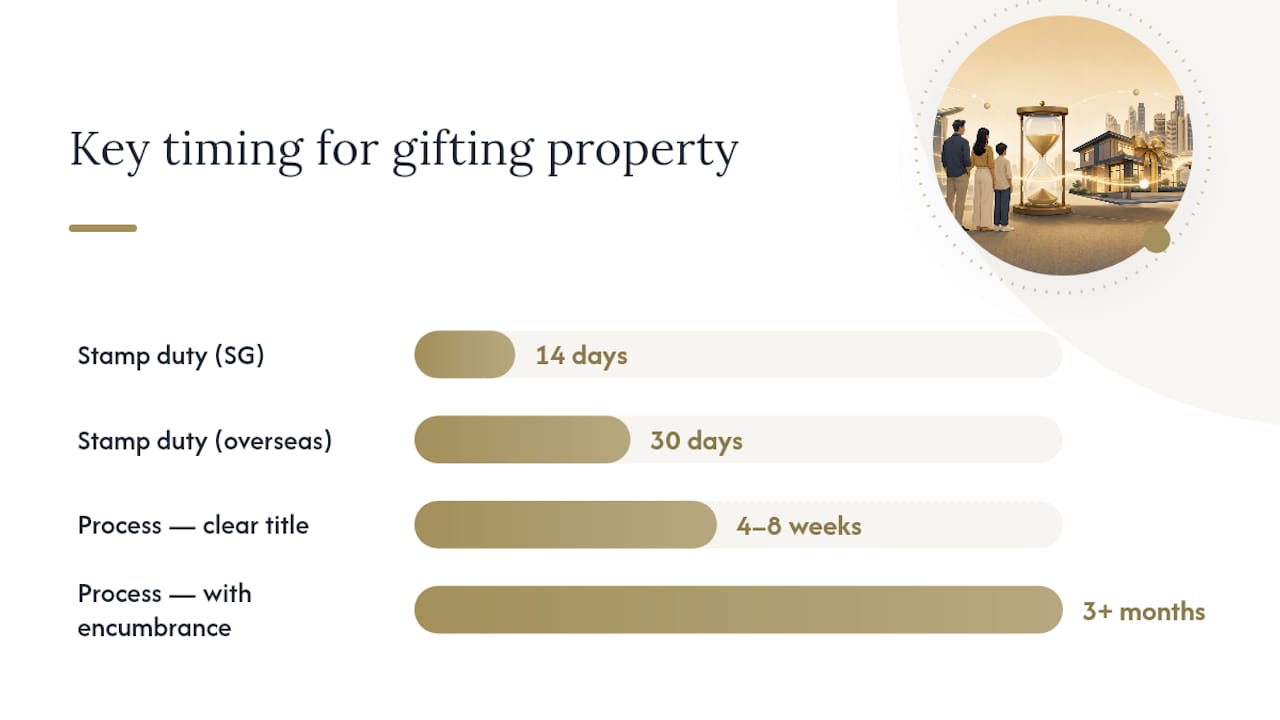
Pay stamp duty. Payment is due within 14 days of executing the deed if signed in Singapore, or 30 days if signed overseas. Miss the deadline and penalties stack up fast.
Lodge the transfer with SLA. Once duty is paid, your lawyer lodges the instrument with the Singapore Land Authority to update the title register in the recipient’s name.
Pro Tip: If there’s an outstanding mortgage or CPF charge on the property, start those consent conversations with your bank and CPF Board weeks before you touch the deed. Waiting until the valuation is done just means sitting on a stalled file while the bank’s legal department works through its own timeline.
The whole process, from first lawyer meeting to updated title, usually takes four to eight weeks when there are no encumbrances. Add a mortgage discharge or CPF charge into the mix and it can stretch to three months or more.
HDB Flats, CPF Charges, and Mortgages: What Blocks a Gift
Not every property in Singapore can simply be signed over to someone else. Public housing carries its own rulebook, and financing arrangements often need a third party’s blessing before a gift can proceed.
HDB flats come with eligibility restrictions that private property doesn’t have. Change-of-ownership rules require the recipient to meet HDB’s eligibility criteria, covering citizenship, family nucleus requirements, and the minimum occupation period. A flat still within its five-year minimum occupation period generally cannot be transferred at all outside narrow exceptions like divorce or the death of an owner.
CPF charges exist whenever an owner used CPF savings to fund the purchase. That charge sits on the property, and transferring it away requires the CPF Board’s consent, plus arrangements to refund the CPF monies used, along with accrued interest, back into the donor’s CPF account.
Mortgages raise a similar problem. Banks rarely let a mortgaged property change hands without the loan being settled or refinanced first, since the recipient becomes the new party on the hook for repayment.
Joint tenancy deserves a separate flag. Property held under joint tenancy passes automatically to the surviving co-owner on death, regardless of what a will says. If you want to gift your share to someone other than your co-owner, whether during your lifetime or through your estate, you need to sever the joint tenancy first and convert to tenancy in common.
Donating Property to Charity: Stamp Duty Relief and Tax Deductions
Gifting to family isn’t the only route. Donating property to a registered Institution of a Public Character opens a different set of rules, ones considerably more favorable than a family transfer.
IRAS allows enhanced tax deductions for donations of land or buildings to approved IPCs, and where specific conditions are met, the transaction may also qualify for stamp duty remission. That combination, a tax deduction on one side and reduced duty on the other, makes philanthropic property donation genuinely different from gifting to a relative.
Getting there requires paperwork. Requirements typically include:
The recipient must be a registered IPC at the time of donation
Ad valorem stamp duty must have been paid when the donor originally acquired the property, unless it was previously remitted
A licensed valuer must appraise the property, and the IPC must obtain IRAS endorsement of that market value to support the deduction claim
The date that matters for tax purposes is the date of legal transfer, not the date you first decided to donate. Line up the valuer and the IPC’s paperwork before you execute anything, because a gap between valuation and transfer can create discrepancies IRAS will ask about.
The Real Risks of Gifting: ABSD, Bank Refusals, and Family Disputes
Gifting looks generous on paper. In practice, it can leave the recipient holding a bill they didn’t budget for, and it can leave the donor exposed if family relationships sour later.
ABSD hits the recipient, not the donor. If your child already owns a property, gifting them a second one can trigger ABSD north of 20%, payable in cash within weeks of the deed.
Banks get nervous about recently gifted property. Lenders scrutinize gifted assets differently than purchased ones, and refinancing a gifted property can be harder if the recipient’s income doesn’t independently support the loan.
Gifts can be challenged. A gift made shortly before bankruptcy, divorce, or death invites scrutiny from creditors, ex-spouses, or disappointed relatives, and courts have set aside transfers found to be attempts to defeat legitimate claims.
IRAS watches structured arrangements. Deeds that understate consideration, or gifts dressed up as sales to obscure the real relationship between parties, get reassessed at market value plus penalties.
Pro Tip: If a family dispute feels even remotely possible down the line, document the reasoning behind the gift in writing at the time you make it. A short memo explaining intent has saved more than one family from years of litigation.
Gifting vs. Wills vs. Trusts: Which Costs Less in Stamp Duty
Three main paths move property from one generation to the next in Singapore, and they carry very different price tags.
Wills generally win on cost. Property passed through inheritance typically doesn’t trigger BSD or ABSD at all, since the transfer happens by operation of law on death rather than through a dutiable instrument. For most families without an urgent reason to transfer during their lifetime, a properly drafted will remains the most stamp-duty-efficient route, and our guide to property inheritance in Singapore walks through how that process works.
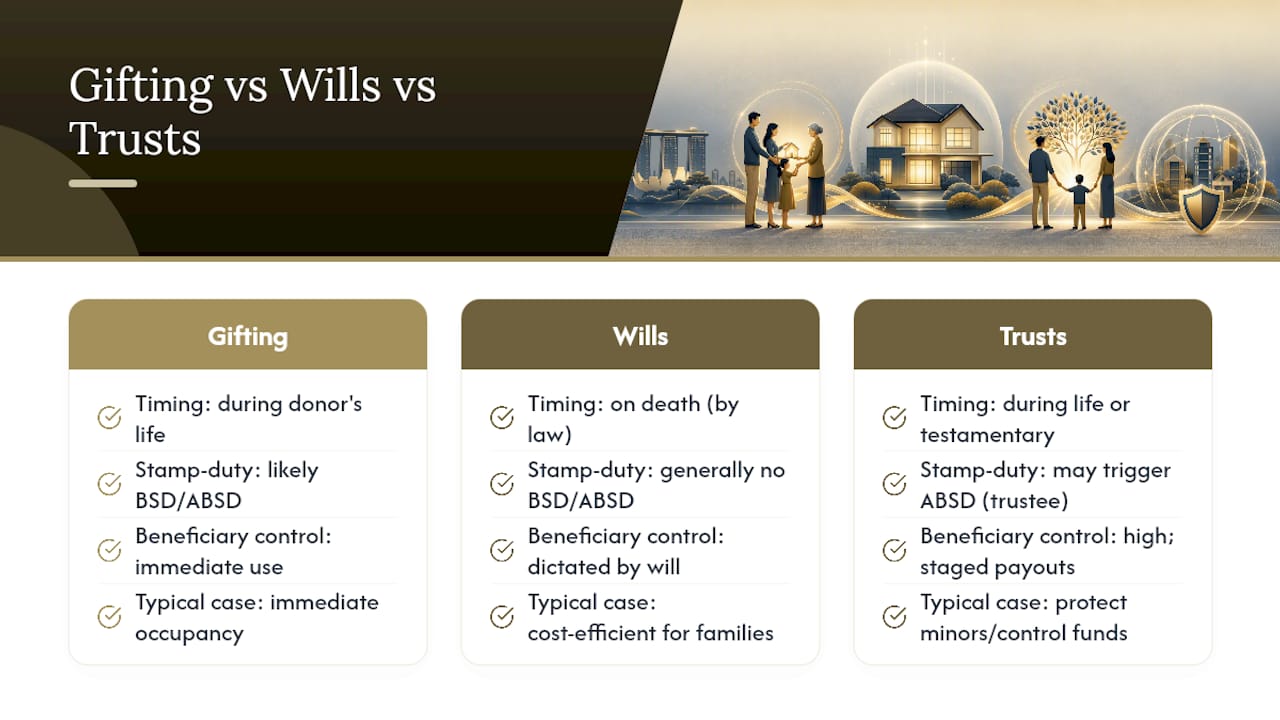
Trusts sit in the middle. Placing property into certain trust structures can itself trigger ABSD at the trustee level, so the tax treatment isn’t automatically cleaner than gifting. Trusts earn their place for a different reason: control. A testamentary trust lets you dictate how and when beneficiaries receive assets, which matters enormously for minor children or beneficiaries you don’t want handed a lump sum at 21.
Lifetime gifting still makes sense in narrow situations, typically when a donor needs a beneficiary to have immediate use of a property (an aging parent moving in with an adult child, for instance) and the stamp duty cost is an acceptable trade for that certainty now rather than later.
Your Pre-Meeting Checklist Before Gifting Property
Walking into a lawyer’s office prepared saves you a second meeting and, often, real money. Bring a copy of the title deed or search, your most recent mortgage statement, any CPF charge documentation, and a recent valuation or comparable sale prices from your area.
Ask your lawyer directly: What is the IRAS-assessed market value likely to be? Will the recipient owe ABSD, and roughly how much? Can lender consent be secured, and on what terms, if there’s an outstanding mortgage?
Some estate planning firms coordinate the pieces that sit around the conveyancing itself, comprehensive wills, trust structuring, and property trust setup, so gifting decisions get weighed against the full estate picture rather than in isolation. A property trust, for instance, can sometimes achieve what a family wants from a gift without the immediate stamp duty exposure. That’s the kind of comparison worth having before, not after, a deed gets signed.
When Gifting Makes Sense and When It Doesn’t
Gifting property works best when timing and family readiness align, not just when the tax math looks tolerable. A parent gifting to a child who genuinely needs housing now, and who isn’t going to face crushing ABSD, is a fundamentally different situation from a parent gifting purely to “get ahead” of estate planning.
I recommend gifting in specific scenarios: a recipient with no existing property who needs a home immediately, or a donor who wants to see a beneficiary settled while they’re still around to help navigate it. Outside those cases, a will or trust usually serves the family better and costs less. If you’re unsure which category you fall into, that uncertainty itself is the signal to get advice before acting rather than after.
— Joseph
How Elite Legacy Planning Helps You Plan the Transfer
Gifting a property is one decision inside a much larger estate picture, and getting it wrong on paper can cost far more than the stamp duty itself. Elite Legacy Planning works through that fuller picture with you: a comprehensive will for the assets you’d rather pass on death, a trust consultation where control matters more than speed, or a property trust structure when you want a beneficiary provided for without an immediate stamp duty hit.
Bring your title search, mortgage statement, and any CPF charge details to your first session, and we’ll help you estimate the likely stamp duty exposure before you commit to anything, coordinating with your valuer and conveyancing lawyer along the way. If gifting isn’t the right fit once we’ve run the numbers, we’ll walk you through the will or trust alternative that is. Book a consultation to get a clear answer for your specific property and family situation.
This article is general information, not a substitute for advice from a qualified lawyer. Consult a qualified legal professional about your own circumstances before acting on anything here.
Sources
Recommended
Comments