


S$15,000–S$35,000 to Set Up a Singapore Offshore Trust for HNW Families


A Singapore offshore trust, more precisely a foreign trust administered under the Trustees Act (Cap. 337) and licensed by MAS, is a credible onshore vehicle for international families pursuing asset protection and succession planning. Specified foreign-sourced income can qualify for tax exemption under Section 13G, provided the settlor and beneficiaries stay non-resident and a licensed trustee runs the structure. This is regulated governance, not secretive banking.
TL;DR:
The trust must be administered by a licensed MAS trustee and involve non-Singapore residents to qualify for the QFT exemption, even if residency later changes.
Trustees must file annual declarations and ensure residency status stays compliant; failing to do so risks retroactive tax assessments.
Setting up a standalone discretionary trust costs S$15,000 to S$35,000 with yearly fees up to S$60,000, while a Private Trust Company can exceed S$150,000 in initial costs and S$200,000 annually.
Asset audits, residency mapping, and regular review of the letter of wishes are essential for maintaining long-term compliance and exemption status.
Effective governance and periodic updates are more critical for preserving trust benefits than choosing between a PTC and a standalone trust.
Table of Contents
What Is an Offshore Trust in Singapore, Legally Speaking?
A trust is a legal arrangement where a settlor transfers assets to a trustee, who holds legal title and manages those assets for named beneficiaries under duties set out in the Trustees Act (Cap. 337). The settlor gives up direct ownership; the trustee gains fiduciary control, bound by law to act in the beneficiaries’ interest rather than their own.
What makes a trust “foreign” for Singapore tax purposes has nothing to do with where the paperwork gets signed. It hinges on residency: the settlor and all beneficiaries must be non-Singapore citizens and non-residents, and the trust must be administered by a company licensed for trust business here. Three regulatory bodies define the landscape:
Monetary Authority of Singapore (MAS) licenses and supervises trust companies under the Trust Companies Act.
Trustees Act (Cap. 337) sets fiduciary duties, trustee powers, and the framework for reserved powers arrangements.
Inland Revenue Authority of Singapore (IRAS) administers the Income Tax Act, including the exemption rules that make Singapore trusts tax-efficient for qualifying structures.
Singapore’s approach differs from classic offshore jurisdictions in one important respect: there’s no blanket secrecy regime. Everything runs through a licensed, supervised entity, which is exactly why serious families use it instead of shakier alternatives.
How the QFT Exemption Actually Works, and What You Must Report
The Qualifying Foreign Trust exemption under Section 13G and its accompanying regulations is the mechanism most families are really asking about when they search for “offshore trust Singapore.” It exempts specified foreign-sourced income from Singapore tax when strict conditions are met.
To qualify, every settlor and every beneficiary must be a non-Singapore citizen and non-resident, and the trust must be administered by an MAS-licensed trustee company. Income typically covered includes foreign-sourced dividends, interest, rental income, royalties, and gains on designated investments, though the exact scope depends on how the underlying assets are structured and where they sit.
One detail practitioners flag as unusually flexible: the framework can preserve QFT status even if a settlor or beneficiary later becomes a Singapore resident, provided the trustee meets specific conditions and reporting deadlines. That’s rare accommodation compared with jurisdictions that revoke exemptions the moment residency changes.
Reporting obligations don’t disappear just because Singapore tax does:
Trustees must file annual declarations with the IRAS Comptroller confirming continued eligibility.
Failing to meet conditions can trigger retroactive assessments on income previously treated as exempt.
Settlors and beneficiaries remain on the hook for home-country tax reporting; the trust itself becomes reportable under Common Reporting Standard (CRS) and FATCA frameworks.
A Qualifying Foreign Trust is often the primary reason international families choose Singapore over other planning centers, but the exemption applies specifically to Singapore tax. It says nothing about what your home tax authority does with the same information once it’s shared under CRS.
Which Trust Structure Actually Fits Your Family
Most HNW families default to a standalone discretionary trust because it’s the simplest structure to license and run. A trustee holds assets for a class of discretionary beneficiaries, with the settlor’s wishes captured in a letter of wishes rather than binding contract terms. This works well for single-family estates with moderate complexity and doesn’t require the governance overhead of a corporate trustee vehicle.
Three structures dominate practitioner recommendations, each suited to a different scale of wealth and control appetite:
Standalone discretionary trust. Lower cost, faster to license, appropriate for most first-generation succession plans where the family doesn’t need a dedicated corporate trustee.
Private Trust Company (PTC). A bespoke corporate trustee owned or controlled by the family, giving direct board-level input into trustee decisions. Practitioner guidance generally reserves PTCs for estates around S$50 million and above, where the added governance control justifies the cost.
Reserved powers trust. Under Section 90A of the Trustees Act, a settlor can retain specific investment powers, such as directing asset allocation, while the trustee still holds legal title and fiduciary responsibility. This suits entrepreneurs who built the wealth and aren’t ready to hand over every decision.
Pro Tip: If your family is weighing a PTC purely for prestige rather than genuine governance needs, run the annual cost against a standalone trust first. Many families overestimate how much board control they actually want to exercise year after year.
Family office structures often pair with any of these three. A 13O or 13U tax incentive scheme, or a Variable Capital Company (VCC), frequently sits alongside the trust to handle active investment operations while the trust holds the long-term succession assets. Families exploring living trust arrangements for privacy and probate avoidance can find more detail in this guide to living trusts in Singapore.
What a Singapore Trust or PTC Actually Costs
Budgeting for a trust means separating two cost lines: what it takes to set up, and what it costs to run every year after. The gap between a standalone trust and a PTC is significant enough to change which structure makes financial sense.
Standalone discretionary trust: setup typically runs S$15,000 to S$35,000, with annual trustee fees between S$15,000 and S$60,000 depending on asset complexity and the number of underlying entities.
Private Trust Company: setup costs climb to S$50,000 to S$150,000, and annual running costs frequently exceed S$60,000, sometimes topping S$200,000 once directors’ fees, compliance, and governance meetings are factored in.
Timeline for a standalone trust: roughly 4 to 8 weeks from engagement to execution, assuming clean asset documentation.
Timeline for a PTC: 12 to 20 weeks, driven by licensing exemption applications, board formation, and more extensive KYC on multiple directors.
Complex assets, such as operating businesses, foreign real estate, or private equity stakes held across several jurisdictions, push both cost and timeline higher on either structure. Due diligence on cross-border tax exposure alone can add several weeks if the family hasn’t already mapped where each asset sits.
Setting Up a Singapore Trust: The Practical Checklist
Getting the structure right starts before you ever meet a trustee, with decisions only the family can make.
Settle the family objectives first. Decide who is settling assets, who the beneficiaries are, and whether the family wants one unified trust or separate “pots” for different branches or purposes.
Choose the structure and trustee together. Confirm the trustee company holds an active MAS license and has genuine cross-border reporting experience, not just a local administration function.
Audit every asset before funding the trust. Some assets trigger exit taxes in the source jurisdiction the moment they’re transferred; others may simply be unsuitable for immediate settlement. Skipping this step is the single most common way families accidentally trigger a taxable event.
Draft the trust deed, letter of wishes, and any reserved powers documents. Complete KYC and AML onboarding with the trustee and open the trust’s banking relationship, a step covered in more depth in this guide to trust bank accounts in Singapore.
Build the post-execution governance rhythm. Set a family council meeting schedule, agree on a trustee reporting cadence, and calendar periodic reviews of the letter of wishes as family circumstances change.
Pro Tip: Treat the letter of wishes as a living document, not a one-time exercise. Families who revisit it every two to three years avoid the awkward scenario where a trustee is bound by instructions that no longer reflect who’s actually in the family or what they need.
Families weighing a trust against a standalone will should look at testamentary trust structures as a complementary, not competing, tool for the assets that stay outside lifetime settlement.
Where Offshore Trusts Go Wrong
The biggest risk isn’t fraud or bad faith. It’s drift. A family sets up a QFT-compliant structure, then years later a beneficiary relocates to Singapore for work, and nobody flags that this quietly jeopardizes the exemption until IRAS asks questions during a routine trustee review.
Residency drift is the most common failure mode: once a settlor or beneficiary becomes a Singapore tax resident without proper restructuring, the trust can lose QFT status and face retroactive assessments.
Transparency is not optional. CRS and FATCA mean account information typically reaches a beneficiary’s home tax authority within 12 to 18 months of the relevant reporting period. Anyone selling a Singapore trust as a secrecy tool is misrepresenting the product.
Weak governance undoes good structuring. A vague letter of wishes, a trustee chosen on price alone, or a “set and forget” mentality after signing turns a well-drafted trust into a source of family disputes down the line.
Provider red flags matter. Avoid any advisor promising secrecy, unclear fee structures, or light-touch AML processes. Fiduciary duties and compliance obligations sit at the center of any legitimate trustee relationship, and a provider dodging them is a warning sign, not a selling point.
Practitioners also flag a subtler mistake: appointing beneficiaries in a way that creates absolute entitlements for someone who later becomes resident, which can convert an expected exemption into a taxable event without anyone realizing it happened.
How Elite Legacy Planning Approaches Trust Structuring
We work with families and family offices on trust consultation, living trust design, and Private Trust Company advisory, alongside comprehensive wills and corporate executorship services. The focus stays narrow and deliberate: structures that actually get used and maintained, not paperwork that sits in a drawer.
The practical checklist covered above, asset audits, residency mapping, and periodic letter of wishes reviews, isn’t theoretical. It reflects the sequence clients typically follow before any trust deed gets drafted, because the sequence itself is what prevents the residency drift and governance failures described earlier.
Asset audits that flag cross-border exit tax exposure before funding, not after.
Residency mapping for every settlor and beneficiary, revisited as family circumstances change.
Scheduled letter of wishes refreshes rather than a one-time drafting exercise.
Why Most Trust Advice Undersells the Governance Work
The industry sells trusts on tax exemption and asset protection, and both are real. But the more consequential decision families skip past is governance, who reviews the letter of wishes, how often, and what happens when a beneficiary’s circumstances change. Section 13G gets the marketing attention because it’s a clean, quotable number. Governance failure is what actually erodes these structures over a decade.

Conventional advice treats trust setup as the finish line. It isn’t. A trust executed cleanly in year one can still fail its purpose in year eight if nobody revisited the residency status of beneficiaries or the family’s actual wishes. The PTC-versus-standalone debate matters less than most advisors suggest, too; the S$50 million threshold is a reasonable rule of thumb, not a hard rule, and plenty of families overpay for PTC governance they never use.
If there’s one thing to prioritize first, it’s the asset audit, before the trust deed, before the trustee selection. Skipping it is how a well-intentioned structure quietly triggers the tax event it was built to avoid.
— Joseph
Start a Trust Consultation With Elite Legacy Planning
We offer a Trust Consultation & Lifetime Advisory service that works through your specific family situation, structure, residency exposure, and asset mix, rather than using a one-size-fits-all template.
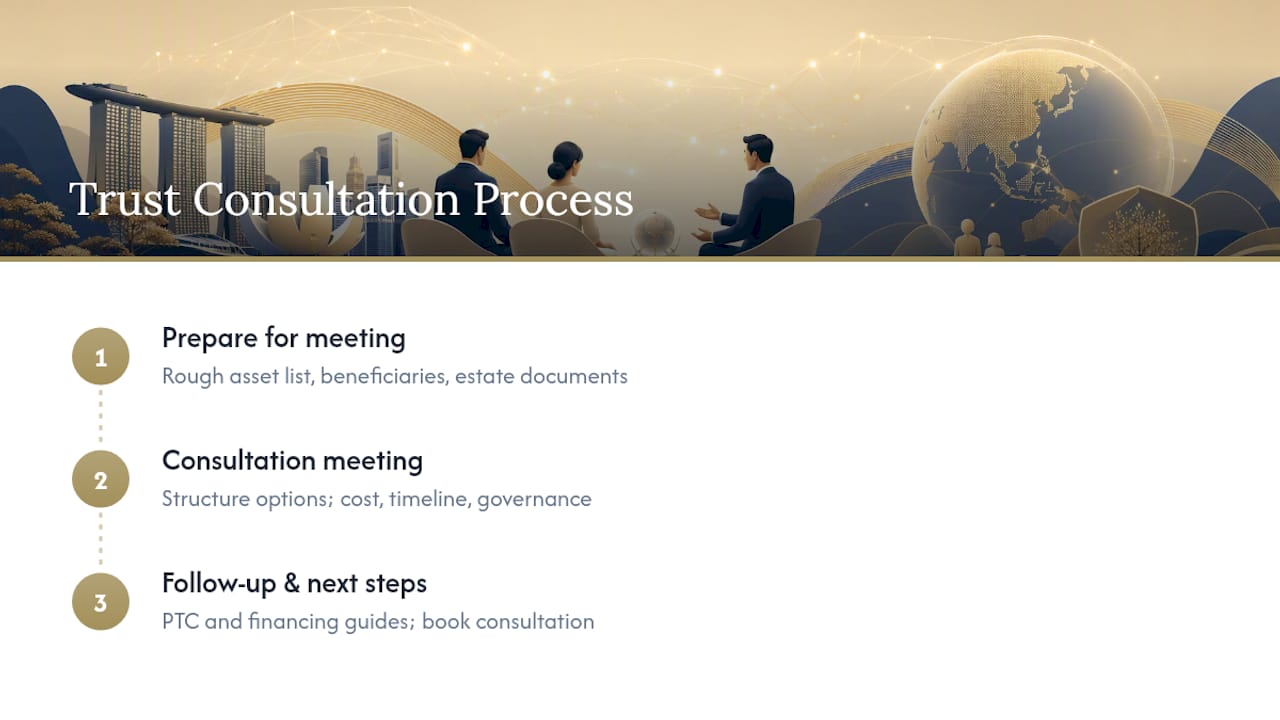
Bring a rough asset list, a sense of who your beneficiaries are, and any existing wills or estate documents to the first meeting. From there, the firm walks through structure options, realistic cost and timeline expectations, and the governance setup that keeps a trust working long after it’s signed. Families already exploring a private trust company can also review this guide to PTC structuring in Singapore beforehand, or check financing considerations if property will sit inside the trust through this property financing guide.
Ready to talk specifics? Book a trust consultation directly, or browse the full range of estate planning services before you commit to a first meeting.
Where to Verify the Rules Yourself
Cross-check details against the Income Tax Act and QFT regulations, the MAS licensed trust company directory, and a current practitioner guide. Always confirm binding advice with a licensed lawyer or tax adviser.
This article is general information, not a substitute for advice from a qualified financial advisor. Consult a qualified financial professional about your own circumstances before acting on anything here.
Sources
Recommended
Comments