


When Mirror Wills Fail: What Singapore Couples Need to Know

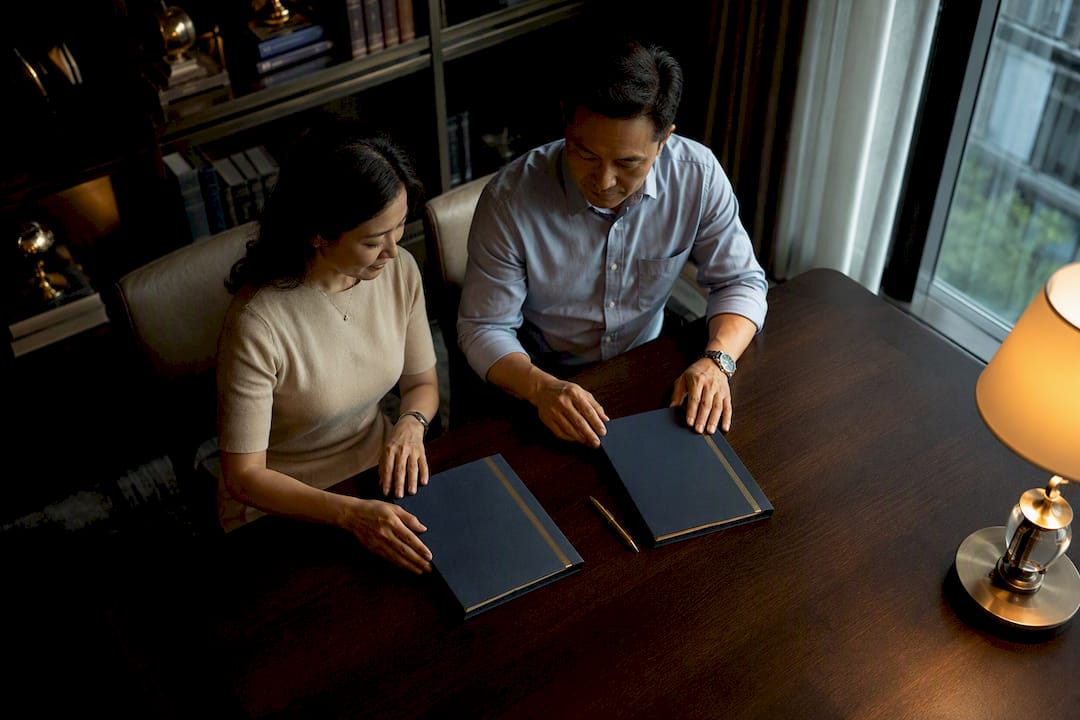
A mirror will is a pair of separate wills, one for each partner, that leave near-identical instructions, usually naming each other as primary beneficiary before assets pass to shared children. Mirror wills work well for most Singapore couples because they’re simple and easy to update, but neither partner can be forced to keep the terms after the first death. If you want that guarantee, you need a trust, not a mirror will.
TL;DR:
Mirror wills in Singapore are two independent documents that can be revoked or rewritten by either spouse at any time, without binding each other.
They do not offer legal protection against future remarriage or changing circumstances of the surviving spouse who may revoke or alter the will.
Formal revocation or modification requires signing a new will or codicil, with proper legal formalities, and should be carefully documented to avoid disputes.
Trusts provide a more secure alternative for those needing to guarantee asset distribution, especially in blended families or for complex estates.
Regular review, especially after life events such as divorce or birth of children, is essential to ensure mirror wills stay aligned with current intentions.
Table of Contents
What Is a Mirror Will Under Singapore Law?
A mirror will is not one document. It’s two separate wills, each written for one spouse, that happen to mirror each other’s terms. Typically, each spouse leaves everything to the other first, with children or other beneficiaries next in line if both pass away. Crucially, the two wills create no binding contract between the couple. Each will is legally independent, and either spouse can revoke or rewrite theirs at any time, with or without telling the other.
This matters because Singapore has no dedicated “mirror wills act.” Ordinary wills law governs the whole arrangement: execution, revocation, and interpretation all fall under the Wills Act 1838. Where things get legally interesting is when couples try to make their wills binding on each other, which pushes the arrangement into mutual wills territory, a very different and far riskier legal concept covered below.
Mirror Wills, Mutual Wills, and Joint Wills: What’s the Difference?
These three terms get used interchangeably by people who shouldn’t, and the confusion causes real problems. Here’s the breakdown that actually matters:
Mirror wills: two separate documents, similar terms, full freedom for either party to change theirs later. No agreement not to revoke.
Mutual wills: created alongside an agreement (sometimes written, sometimes implied by conduct) that neither party will revoke after the other’s death. Courts may enforce this through a constructive trust, but Singapore case law on how that enforcement actually works remains unsettled, as the Singapore Journal of Legal Studies has documented.
Joint wills: a single physical document signed by both parties, rare in Singapore and generally discouraged because it complicates probate and revocation for the surviving spouse.
The practical risk sits squarely with mutual wills. If a surviving spouse remarries or changes their will after promising not to, beneficiaries can end up in court arguing over a constructive trust, a dispute that’s expensive, slow, and far from guaranteed to succeed.
The Real Trade-Off: Flexibility vs. Protection
Mirror wills exist because most couples want something simple that reflects how they actually feel about each other at the time of signing, not a legal cage. Here’s what you gain and what you give up.
Advantages:
Straightforward to draft and inexpensive relative to trust structures
Easy to update as circumstances change
Reflects shared intentions clearly without complex legal machinery
Works well for first marriages with shared children and uncomplicated assets
Disadvantages:
The surviving spouse can revoke or rewrite their will at any time, potentially cutting out stepchildren or agreed beneficiaries
No protection if the survivor remarries and a new spouse or family later inherits everything
Limited defense against claims under the Inheritance (Family Provision) Act if dependents are left out
Offers no certainty for blended families who want a guaranteed outcome
Pro Tip: If you’re worried about your spouse changing the will after you’re gone, a mirror will won’t stop that. Only a properly structured trust or a documented mutual wills agreement, reviewed by a lawyer, creates that kind of binding certainty.
Changing or Revoking a Mirror Will in Singapore
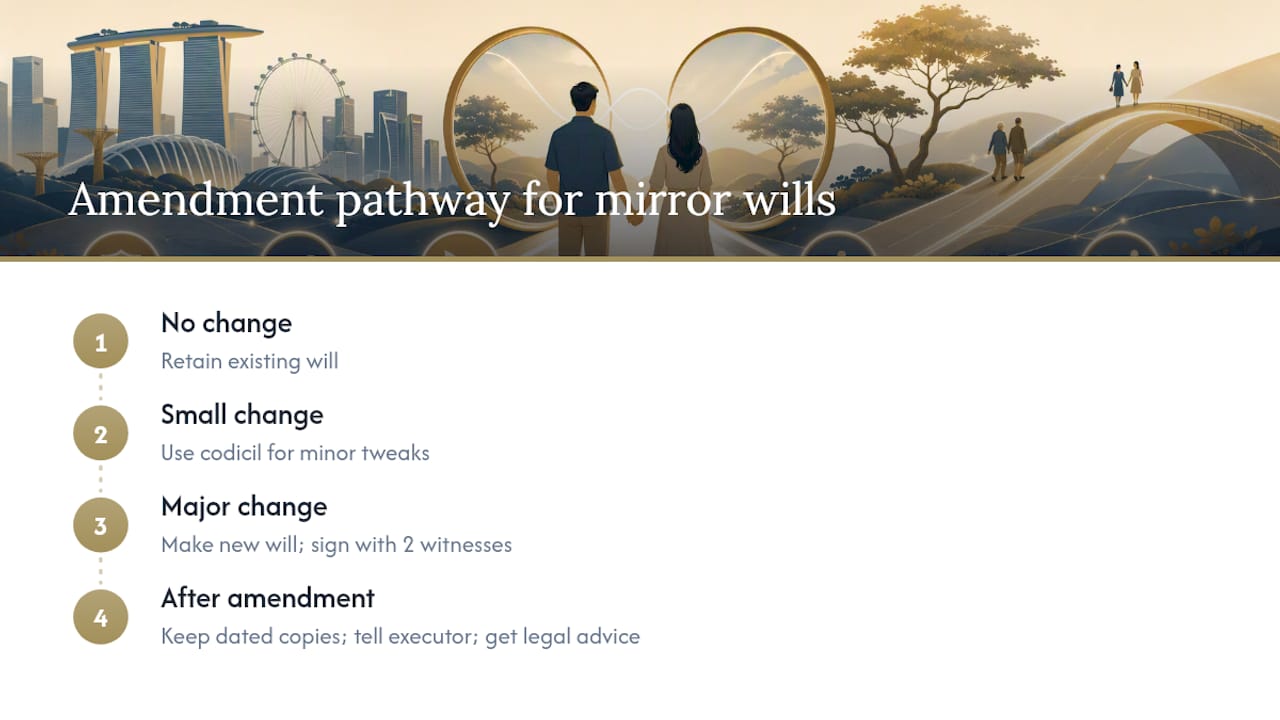
Either spouse can revoke their mirror will unilaterally, and no formal notice to the other party is legally required, though it’s obviously wise practice. A new will automatically revokes the earlier one to the extent they conflict, and the Wills Act requires the new document to be signed and witnessed by two people present at the same time, just like the original.
A codicil (a formal amendment) works for small tweaks, like changing an executor, but a full rewrite is usually cleaner for bigger changes. Keep dated copies of every version and tell your executor where the current one lives. Disputes often arise not from bad intentions but from confusion over which version was valid at death, so get independent legal advice whenever you’re amending shared estate plans.
How to Make Mirror Wills in Singapore: Steps, Timeline, and Costs
Getting mirror wills draft properly follows a predictable sequence:
List your assets and liabilities. Property, CPF nominations, insurance, business interests, and overseas assets all need separate consideration since CPF nominations and insurance often pass outside the will.
Choose executors and guardians. Decide together whether you’re naming each other, a trusted relative, or a professional executor.
Book a consultation. A lawyer or estate planner reviews your assets and flags anything a template can’t handle, like foreign property or a family business.
Draft and review. Expect at least one round of revisions once you see the terms in writing.
Sign with two witnesses present, satisfying the Wills Act’s execution formalities.
Most couples move from first meeting to signed wills within two to four weeks, faster if assets are simple. Costs vary: basic mirror wills for straightforward estates are generally low-cost, while tailored plans involving trusts, multiple properties, or corporate executorships can cost significantly more. Elitelegacyplanning’s will writing cost breakdown gives a realistic sense of what drives the price up or down before you book a consultation.
When Mirror Wills Aren’t Enough: Trusts and Lifetime Gifts
Mutual wills sound like the answer to mirror wills’ biggest weakness, binding the survivor to the agreed terms, but Singapore courts haven’t settled exactly how that binding effect works in practice. The Singapore Law Gazette points to VTL v VTM as a case where the High Court had to grapple with mutual wills’ scope, and the uncertainty means litigation risk for anyone relying on an informal understanding rather than a properly drafted trust.
That’s why practitioners increasingly steer clients toward structures with clearer legal footing:
Testamentary trusts, created within a will, take effect on death and can control how and when beneficiaries receive assets, useful for young children or spendthrift heirs.
Living trusts, set up during your lifetime, offer more privacy and can bypass probate delays entirely.
Lifetime gifts or property transfers move assets out of your estate immediately, useful for high net worth individuals managing tax exposure or protecting assets from future claims.
Consider a trust over a mirror will if you’re in a blended family, hold significant assets, or genuinely need to bind the survivor’s future decisions. If matrimonial property is part of the picture, understanding property financing structures in Singapore also helps clarify how jointly held assets interact with your estate plan.
How Practitioners Actually Advise Couples on This Choice
Most couples who come in asking about mirror wills fall into one of two camps: first marriages with straightforward assets who genuinely just need clarity, and blended families who think they want a mirror will but actually need a trust. The first group is well served by mirror wills. The second group often isn’t, and a good adviser will say so before drafting anything.
Bring these questions to your first consultation:
Does either of us want to bind the other, or are we comfortable with full future flexibility?
What happens to our children’s inheritance if one of us remarries?
Do any assets, CPF, insurance, property overseas, need handling outside the will?
Should our executor be one of us, a family member, or a professional executor?
Consultations around wills and trusts should match the legal tool to the family situation rather than defaulting to a template.
Appointing Executors and Guardians in Mirror Wills
Most couples default to naming each other as sole executor, which works fine as a first choice but leaves a gap: who steps in if both spouses die together or close in time? Every mirror will need at least one backup executor named explicitly, ideally someone younger than both spouses or a professional executor with continuity beyond any single person’s lifetime.
Guardianship decisions carry more emotional weight and deserve equal rigor. If you have children under 21, your will should name a guardian and, ideally, a backup guardian in case your first choice is unable or unwilling to serve later. Courts generally respect a parent’s written wishes, but naming no guardian at all leaves the decision to the courts under the Guardianship of Infants Act, a process that adds delay and uncertainty during an already difficult time.
For couples with meaningful assets, professional or corporate executorship is worth serious consideration. It removes the burden from a grieving relative, avoids family conflict over who’s “in charge” of the estate, and provides continuity if named individual executors have since died, moved overseas, or become unable to act. Elitelegacyplanning’s guide on executor duties in Singapore walks through what the role actually involves before you commit a family member to it.
One detail people overlook: your mirror will’s executor and guardian appointments should be reviewed at the same time you review the will itself. Naming a guardian when your child was two looks very different once they’re sixteen and have their own relationship with extended family.
Mirror Wills and Changing Family Circumstances
Mirror wills reflect your intentions at the moment of signing, and life doesn’t stay still. Divorce is the clearest trigger for review. Singapore law generally treats provisions in favor of a former spouse as revoked once a divorce is finalized, but relying on that default rather than actively rewriting your will is a mistake, particularly around executor and guardian appointments that the automatic revocation rule doesn’t touch. Local firm guidance consistently flags divorce and remarriage as the two events that most often make an old mirror will dangerously outdated.
The birth of a child is the second major trigger, and it’s one couples handle inconsistently. A mirror will drafted before children were born often names the surviving spouse as sole beneficiary with no contingency plan. Once children exist, you need to specify what happens if both parents die together, who acts as guardian, and whether assets pass to children directly or through a trust that controls timing and access.
Remarriage after widowhood introduces the sharpest tension in mirror wills generally. Because either spouse can revoke and rewrite freely, a surviving spouse who remarries can legally leave everything to a new partner, cutting out children from the first marriage entirely. This is precisely where mirror wills fall short of protecting blended family interests, and it’s the scenario that drives many people toward trusts once they understand the exposure.
As a general rule, review your mirror will every three to five years or immediately after marriage, divorce, a new child, or a significant change in assets. Waiting for “someday” is how outdated wills end up governing estates.
Tax Implications of Mirror Wills in Singapore
Singapore abolished estate duty for deaths occurring on or after February 15, 2008, so there’s no inheritance tax to plan around when drafting mirror wills today. That’s a genuine advantage compared to jurisdictions like the UK, where estate size directly affects the tax bill and shapes how wills and trusts get structured.
That doesn’t mean mirror wills are entirely tax neutral in practice. If your estate includes overseas property or investments, those assets may still be subject to inheritance or estate taxes in the country where they’re located, regardless of what Singapore law says. A mirror will drafted without accounting for foreign tax exposure can leave beneficiaries facing an unexpected bill abroad even though Singapore itself imposes none.
Income generated by estate assets during the administration period, before final distribution to beneficiaries, is still subject to ordinary income tax rules, and CPF savings pass according to CPF nomination rules rather than through the will at all, another reason your mirror will and your CPF nomination need to stay aligned rather than drifting apart over time.
For high net worth individuals, the absence of estate duty shifts the planning conversation from tax minimization to asset protection and control, which is exactly where trusts start outperforming mirror wills. A living trust or private trust company structure won’t reduce a tax bill that doesn’t exist in Singapore, but it does offer privacy, continuity, and protection against family disputes that a simple mirror will can’t match.
Making Sure Your Mirror Will Actually Holds Up
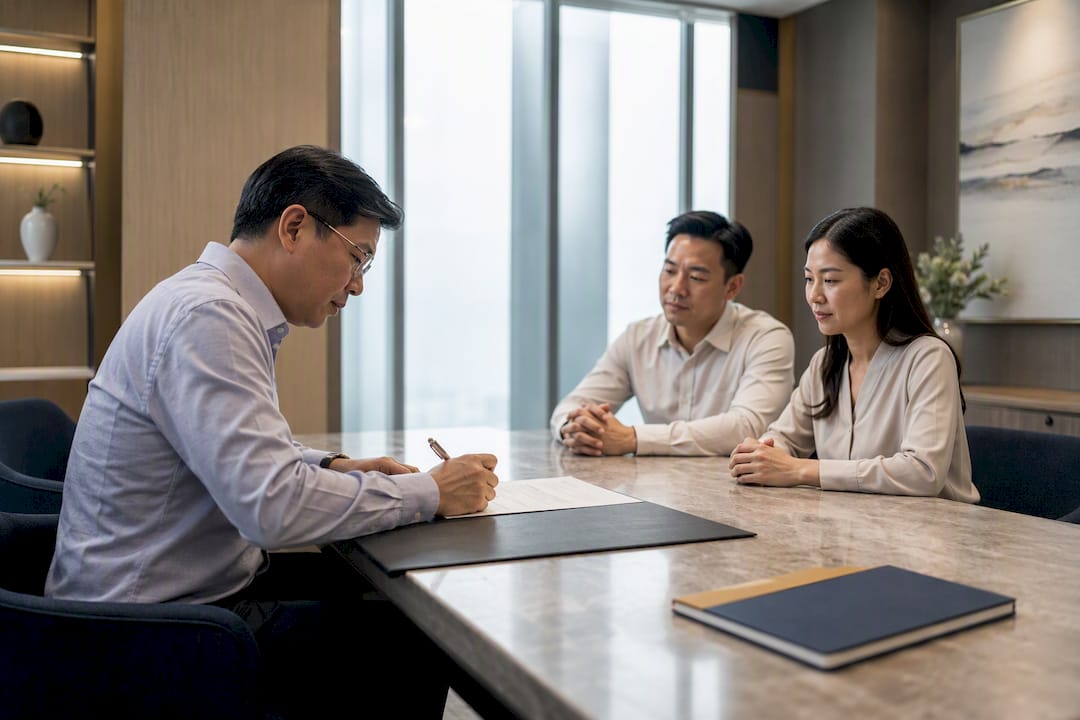
A mirror will is only as good as its execution. The Wills Act requires the testator to sign in the presence of two witnesses, both present at the same time, and neither witness can be a beneficiary or the spouse of a beneficiary, a mistake that can invalidate an entire gift even when the rest of the will is sound.
Vague language causes more disputes than outright errors. “My belongings to my children” invites arguments over what counts as belongings and which children, if there are stepchildren or children from a prior relationship involved. Specific, itemized language, drafted with proper legal advice rather than a generic template, closes off most of the ambiguity that ends up in court.
Capacity and undue influence are the two grounds most commonly used to challenge a will after death. Couples making mirror wills later in life, or where one spouse has a health condition affecting cognition, should consider a capacity assessment at the time of signing and keep records of it. This single step has ended more contested probate cases before they start than almost any other precaution.
Storage matters more than people assume. A validly executed will that can’t be found or that conflicts with an old, undestroyed copy creates exactly the confusion that ends up in the Family Justice Courts. Keep one clear, dated original with your executor or lawyer, destroy prior drafts, and tell your family where it is.
Why Mirror Wills Work for Most, But Not Everyone
The conventional advice on mirror wills is basically right for most first marriages: they’re simple, cheap, and flexible enough to cover changing circumstances without a lawyer’s involvement every time life shifts. Where that advice falls short is in how casually it gets applied to blended families, where the flexibility that makes mirror wills appealing is exactly what makes them dangerous.
I’d push back on the instinct to treat mirror wills as the default and trusts as the upgrade for wealthy people. The real dividing line isn’t net worth, it’s whether you need the survivor bound to specific terms. A young couple with shared kids and modest assets rarely needs that guarantee. A remarried parent trying to protect a first family’s inheritance almost always does, regardless of how much money is involved.
What gets prioritized wrong most often is timing. Couples draft mirror wills once, at marriage or after a first child, and then don’t revisit them for a decade or more. Given how much VTL v VTM and the surrounding case law show about how unsettled these questions can get in court, the safer habit is treating your will as a living document, not a one-time task to check off.
— Joseph
How Elitelegacyplanning Helps Couples Get This Right
Professional estate planning services give Singapore couples what a template or DIY will kit can’t: a conversation about whether a mirror will actually fits your family, before you sign anything. Comprehensive wills, trust consultations, and living trust structures are often part of the same advisory process, so clients aren’t left guessing whether they need more protection than a mirror will offer.

If you’re weighing a mirror will against a trust, a comprehensive will consultation is the right place to start. Couples with blended families, business interests, or overseas assets often benefit more from a conversation about trust consultation and lifetime advisory services before committing to a structure. Either way, you can book a consultation online directly and get a clear answer on which approach actually protects your family, rather than guessing based on what worked for someone else.
This article is general information, not a substitute for advice from a qualified lawyer. Consult a qualified legal professional about your own circumstances before acting on anything here.
Sources
Recommended
Comments