


Who Inherits Under Singapore's Intestate Succession Act?


If someone in Singapore dies without a valid will, the Intestate Succession Act 1967 divides the estate in fixed statutory shares. There’s no discretion, no reading of intentions, no accounting for who needed the money most.
For non-Muslims, section 7 of the Act sets a rigid formula:
A surviving spouse with no children inherits the entire estate.
A spouse plus children splits the estate: the spouse takes half, the children share the other half equally.
Children alone (no surviving spouse) divide the whole estate among themselves.
Two exceptions matter immediately. CPF savings don’t form part of the estate at all, they follow your CPF nomination separately. And Muslim estates fall outside the Act entirely, governed instead by faraid through the Syariah Court. Both get fuller treatment below.
Key Takeaways
Dying without a will in Singapore hands control of your estate to a fixed statutory formula that ignores your actual relationships, business interests, and family circumstances.
Point | Details |
Spouse and children split evenly | With both surviving, the spouse takes 50% and children share the remaining half. |
CPF isn’t part of the estate | It follows your CPF nomination separately; check nomination status early. |
S$50,000 threshold matters | Estates at or below this can use the Public Trustee instead of court-ordered Letters. |
Muslims are excluded from the Act | Faraid and the Syariah Court govern Muslim estate distribution instead. |
Complex estates need professional input | Businesses, cross-border assets, and blended families rarely fit the statutory formula well. |
Table of Contents
How Does Intestate Succession Work in Singapore?
The Intestate Succession Act runs on a ladder. If there’s no spouse and no children, the estate moves down to the next tier of relatives, and it keeps moving until someone qualifies or, in the rare case of no relatives at all, the Singapore Government takes the estate as a last resort.
Here’s the full sequence:
Spouse only, no children or parents: spouse gets everything.
Spouse and children: spouse takes 50%, children split the remaining 50% equally.
Children only, no spouse: children divide the estate equally.
Spouse and parents, no children: spouse gets 50%, parents share 50%.
Parents only: parents inherit equally, with nothing left to siblings.
Siblings only: siblings share equally if no spouse, children, or parents survive.
Grandparents: inherit only if no spouse, children, parents, or siblings exist.
Uncles and aunts: next in line after grandparents.
Government: takes the estate only if no eligible relative can be found at any tier.
One wrinkle trips up a lot of families: per stirpes distribution. If a child of the deceased has already died but left children of their own, those grandchildren step into their parent’s share and split it between them, rather than being cut out or receiving an equal share alongside their aunts and uncles. Say a father dies leaving two surviving children and three grandchildren from a third child who predeceased him. The estate still splits into three equal shares at the child level, one for each surviving child and one for the deceased child’s line, and that third share gets divided three ways among the grandchildren.
Recording Law’s explainer on intestate succession reinforces this point: intestacy is a fallback mechanism, not a reflection of what the deceased would have wanted, and per stirpes representation is exactly the kind of rigid rule that a will lets you avoid.
What Assets Fall Outside the Intestate Succession Act?
Not everything you own gets swept into the statutory formula. Four categories cause the most confusion.
Muslim estates are excluded by law. Section 2 of the Act carves out Muslims entirely; their estates are distributed under faraid, administered through the Syariah Court, which issues an Inheritance Certificate setting out each heir’s share.
CPF savings bypass the estate. They pass according to your CPF nomination, not the Act’s formula. Without a nomination, the Public Trustee distributes the funds separately under CPF rules, adding another layer of process your family has to navigate.
Adopted children count as children. Where a valid adoption order exists, adopted children inherit exactly as biological children would.
Foreign property gets messy. Immovable property held overseas is often governed by the law of the country where it sits, not Singapore’s Act, which can mean parallel legal processes in two jurisdictions.
One more point worth stating plainly: unmarried partners and charities get nothing under intestacy, regardless of how long a relationship lasted or how often you supported a cause. The Act only recognizes legally defined relatives.
How Do You Apply for Letters of Administration?
Once you know who inherits, someone has to be legally authorized to collect assets, pay debts, and distribute what’s left. For estates above S$50,000, that means applying for a Grant of Letters of Administration through the Family Justice Courts. Priority to apply typically follows entitlement size, meaning a surviving spouse usually applies first, according to Singapore Judiciary guidance. Applicants must be at least 21 and have mental capacity.

You’ll generally need the death certificate, proof of your relationship to the deceased, a list of assets and liabilities, and consent from other beneficiaries where relevant. Processing isn’t instant. Between gathering documents, court filing, and asset realization, expect the process to run several months, longer if assets are complicated or family members contest the application.
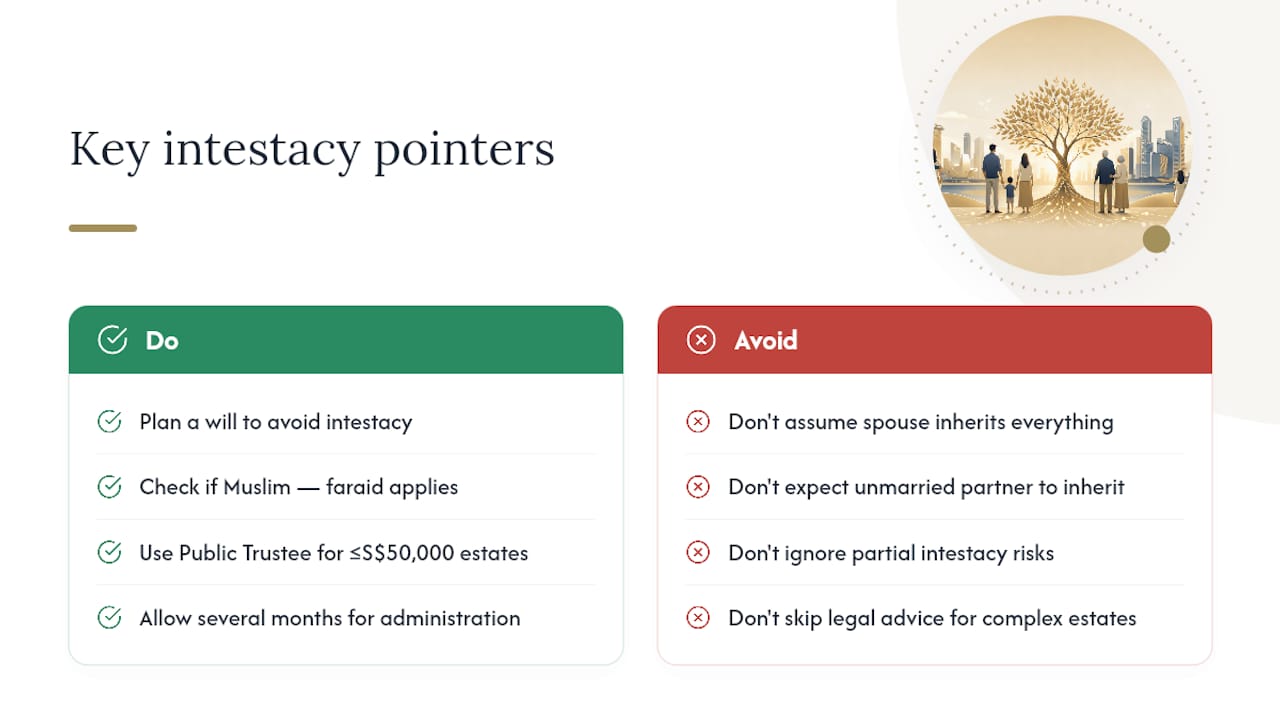
For smaller estates, there’s a simpler path. Where the estate doesn’t exceed S$50,000, families can ask the Public Trustee’s Office to administer it for a fee instead of going through the courts. It’s slower on customization but often faster and cheaper than a full Letters application, which is why many families with modest estates choose it over private administration.
Pro Tip: Before applying anywhere, get a certified death certificate and check whether the deceased left any CPF nomination on file, since that determines whether you’re dealing with one process or two running in parallel.
Immediate next steps for a surviving spouse or close relative:
Obtain the death certificate and check for a will (even an old or informal one changes everything).
Check CPF nomination status through the CPF Board.
List known assets, debts, and liabilities.
Decide whether the estate likely exceeds S$50,000, and route accordingly toward Letters of Administration or the Public Trustee.
Settle outstanding debts and funeral expenses before distributing anything to beneficiaries, since creditors are paid ahead of heirs.
What Goes Wrong When There’s No Will?
Intestacy doesn’t just redirect money, it can actively work against what a family actually needs. MoneySense’s consumer guidance flags several recurring problems:
An unmarried partner of decades receives nothing, no matter how entwined your finances were.
There’s no mechanism to name a guardian for minor children, leaving that decision to the court.
Statutory shares can hand money to relatives you barely stayed in touch with while bypassing an elderly parent who actually depends on you.
The court appoints an administrator rather than the executor you would have chosen, someone who may not know your affairs or your family’s dynamics.
The administrative burden compounds these problems. Delays, legal costs, and disputes among relatives are common when no one holds clear authority from day one. Intestacy is riskiest where the estate isn’t simple, private business holdings, cross-border property, or a portfolio of complex investments all tend to force awkward, forced splits that a tailored will or trust structure would have avoided.
When Should You Talk to an Estate Professional?
A few situations make professional advice worth the cost rather than a nice-to-have. If your estate includes a private business, closely held shares, property in more than one country, a blended family, or minor children who’ll need a trust rather than a lump sum at 21, the statutory formula almost never fits your actual wishes.
An estate planning lawyer or specialist typically drafts wills that reflect specific intentions, sets up living trusts or a private trust company for larger or more complicated holdings, and can act as a corporate executor so administration doesn’t fall entirely on a grieving relative. For business owners specifically, forced fractional splits under intestacy can undermine continuity in ways a properly structured executorship prevents.
Pro Tip: If you own a business or hold assets in more than one country, get advice before anything happens, not after, since untangling cross-border intestacy is far harder than planning around it upfront.
Why the Statutory Formula Isn’t a Substitute for a Plan
The research here supports a blunt conclusion: intestacy works fine for very simple households and fails everyone else. A young couple with no children and modest joint savings might genuinely be fine under the default rules. Almost nobody else is.
Where conventional advice falls short is treating “get a will eventually” as a low-priority task. It isn’t. The gap between what the Act delivers and what most families actually need shows up hardest in exactly the situations people delay planning for: business ownership, blended families, aging parents who depend on you financially. Those are precisely the cases where a rigid 50/50 split or a per stirpes ladder produces outcomes nobody would have chosen deliberately.
If you take one thing from this, prioritize checking your CPF nomination today, it takes minutes and it’s the one part of your estate you can fix immediately. Then treat a proper will or trust conversation as infrastructure, not paperwork.
Ready to Put a Plan in Place?
Reading about intestacy is one thing. Making sure your family never has to rely on it is another. Elitelegacyplanning works with individuals and families across Singapore to draft comprehensive wills tailored to real family circumstances, not statutory defaults, and to structure trusts and corporate executorships for estates where a simple will isn’t enough. If your situation involves a business, property in more than one country, or beneficiaries the Act wouldn’t recognize, book a consultation to talk through what a tailored plan would actually look like for your family.
Frequently Asked Questions
What happens if you die without a will in Singapore? Your estate is distributed according to fixed shares under the Intestate Succession Act, following the spouse and children ladder described above, unless you’re Muslim, in which case faraid rules apply instead.
Does a spouse automatically inherit everything? Only if there are no surviving children or parents. With children present, the spouse takes half and the children share the rest.
Can an unmarried partner inherit under intestate succession Singapore rules? No. The Act recognizes only legally defined relatives, so unmarried partners and charities receive nothing regardless of the relationship’s length.
What is partial intestacy Singapore residents should know about? Partial intestacy happens when a will doesn’t cover all of a person’s assets, leaving the uncovered portion to be distributed under the Act’s default rules even though a will exists.
How long does the Letters of Administration process take? Timelines vary with estate complexity, but expect several months between filing documents with the Family Justice Courts and completing distribution, longer if there’s a dispute among beneficiaries.
Is the Public Trustee always cheaper than applying for Letters? For estates at or below S$50,000, the Public Trustee’s Office is often simpler and more affordable, but it charges its own administration fee and offers less flexibility than a lawyer-guided process for anything more complex.
Sources
Recommended
Comments