


Avoid Stamp Duty and CPF Pitfalls: How to Fund a Trust in Singapore


Funding a trust means legally transferring assets into a trustee’s name so they’re held for your beneficiaries under the terms of a trust deed. Cash, shares, property, and insurance can all go in, but each has different mechanics. Two cautions trip up most families: CPF savings cannot be directly transferred into a trust, and moving property into one can trigger stamp duty or Additional Buyer’s Stamp Duty (ABSD). Start with an asset audit and a tax check before you sign anything.
TL;DR:
Trusts funded with liquid assets like cash and insurance should be established first to ensure immediate operational capital before transferring property or private shares.
Proper asset audit, timely deed signing, and coordinated transfer processes are crucial to avoid delays and paperwork mishaps during trust funding.
Property transfers into a trust trigger stamp duty and ABSD, requiring professional advice to prevent costly mistakes or unintended tax liabilities.
CPF savings cannot be directly transferred into a trust; families should use nominations and standby trusts to manage CPF assets effectively.
Costs for setting up and funding trusts vary from a few thousand dollars for simple arrangements to over S$20,000 for complex private trust company structures.
Table of Contents
Which Assets Can You Put Into a Trust in Singapore?
A trust only protects what’s actually inside it. An unfunded trust deed is just paperwork, and that gap catches out more families than any tax rule does. Here’s how the common asset types actually get funded.
Cash: the trustee opens a dedicated bank account in the trust’s name, and you’ll go through standard KYC checks (proof of identity, source of funds) before the bank lets money move in.
Bank accounts and deposits: existing accounts need to be re-titled or closed and re-opened under the trustee, with the bank requiring the trust deed and trustee identification documents.
Listed shares and unit trusts: these transfer through your broker’s share transfer forms and custodial re-registration; if you’re funding with CPF monies via the CPF Investment Scheme, remember CPFIS holdings stay under CPF rules and can’t simply be re-titled to a trustee.
Private company shares: these need share transfer instruments, board and shareholder approval, and often a valuation exercise, especially where the company’s articles carry pre-emption clauses that give existing shareholders first right of refusal.
Property: funding real estate means full conveyancing, discharge of any existing mortgage or arranging a trustee mortgage, and a hard look at whether the transfer triggers stamp duty or ABSD.
Insurance policies: you can assign a policy outright into the trust or use a nomination, and the two produce very different levels of control for the policyholder versus the trustee.
Intangible assets: intellectual property, royalties, and digital assets need their own assignment documents and, where applicable, registration with the relevant authority.
Pro Tip: Order matters. Fund liquid assets like cash and insurance first so the trust has working capital, then tackle property and private shares once conveyancing and valuations are underway. Trying to do everything in one sitting is how transfers get rushed and paperwork gets missed.
How Do You Actually Fund a Trust Step by Step?
Funding a trust in Singapore follows a fairly fixed sequence, even though the paperwork for each asset type differs. Skipping steps or doing them out of order is the single biggest cause of delays.
Audit your assets and liabilities. List everything you plan to place in trust, get current valuations, and flag any mortgages, charges, or loans attached to those assets.
Draft and sign the trust deed. Your lawyer or planner finalizes the deed, and the appointed trustee formally accepts the role in writing, usually alongside a letter of wishes that guides discretionary decisions.
Execute the transfers. This is where the actual mechanics happen: share transfer instruments for equities, conveyancing for property, assignment forms for insurance, and a funded trustee bank account for cash.
Notify every institution involved. Banks, insurers, and share registries all need formal notice of the change in ownership, and you should keep every confirmation and receipt.
Set up post-funding governance. Establish an investment mandate, a reporting schedule, and a record-keeping system so the trustee’s decisions stay auditable year after year.
Stage | Who typically handles it | What you need on hand |
Asset audit | You, with your planner | Bank statements, share certificates, property titles, policy documents |
Deed execution | Lawyer and trustee | Signed trust deed, letter of wishes |
Asset transfers | Conveyancer, broker, insurer | Transfer instruments, assignment forms, valuation reports |
Post-funding governance | Trustee | Investment mandate, annual reporting calendar |
What Tax and Stamp Duty Rules Apply to Trust Funding?
Trust income carries its own tax treatment, and trustees carry the compliance burden. The Inland Revenue Authority of Singapore sets out distinct tax rules for trustees and beneficiaries, and trustees must file and report trust income correctly even when the funds haven’t yet been distributed.
Property is where costs escalate fastest. Transferring a home or investment property into a trust is treated as a conveyance, which means stamp duty applies, and ABSD can apply on top depending on the structure and existing property holdings involved.
Confirm whether your transfer counts as a sale, a gift, or a settlement, since each is taxed differently.
Check the Trustees Act framework and, for licensed trustees, the oversight that the Monetary Authority of Singapore applies under the Trust Companies Act.
Get a stamp duty and tax opinion before signing the transfer, not after.
For foreign-sourced assets or cross-border beneficiaries, bring in a specialist early since double-tax and reporting obligations multiply quickly.
Advisory guides on Singapore trusts consistently flag conveyancers and tax advisors as the two professionals to loop in before, not after, property funding decisions are finalized. That sequencing alone avoids most of the costly surprises families report.
How Much Does It Cost to Fund a Trust in Singapore?
Setup costs scale with structure. A simple testamentary trust sits at the lower end, while a full Private Trust Company structure costs considerably more given the added governance and licensing requirements. Industry guides put simple trust setups in the low thousands of Singapore dollars, rising past S$20,000 for more complex arrangements, with PTC and family-office routes higher still.
Ongoing fees: administration, custody, and investment management, billed either as a flat annual fee or a percentage of assets under management.
One-off costs: conveyancing, stamp duty, independent valuations, and tax advice, all incurred at the funding stage rather than at setup.
Special-needs planning: the Special Needs Trust Company offers heavily subsidized trust services for eligible beneficiaries, which materially lowers costs for families who qualify.
How Do CPF, Insurance, and SNTC Fit Into Your Funding Plan?
CPF savings can’t be transferred into a trust directly. Under CPF Investment Scheme rules, the CPF member has to remain the legal and beneficial owner of those funds, full stop. Families work around this with CPF nominations paired with a standby trust, which activates only when needed rather than holding CPF assets directly.
Insurance policies give you more flexibility. A revocable nomination lets you change beneficiaries anytime, while an irrevocable nomination or a full assignment into a trust locks in your choice and hands more control to the trustee. Many families use policy assignment to achieve a CPF-like payout for beneficiaries without running into CPF’s transfer restrictions.
For families with a dependant who has special needs, SNTC is often the most accessible route. Eligibility depends on the beneficiary’s condition and family circumstances, and the subsidy model, largely supported by the Ministry of Social and Family Development, keeps fees far below what a private trust structure would cost.
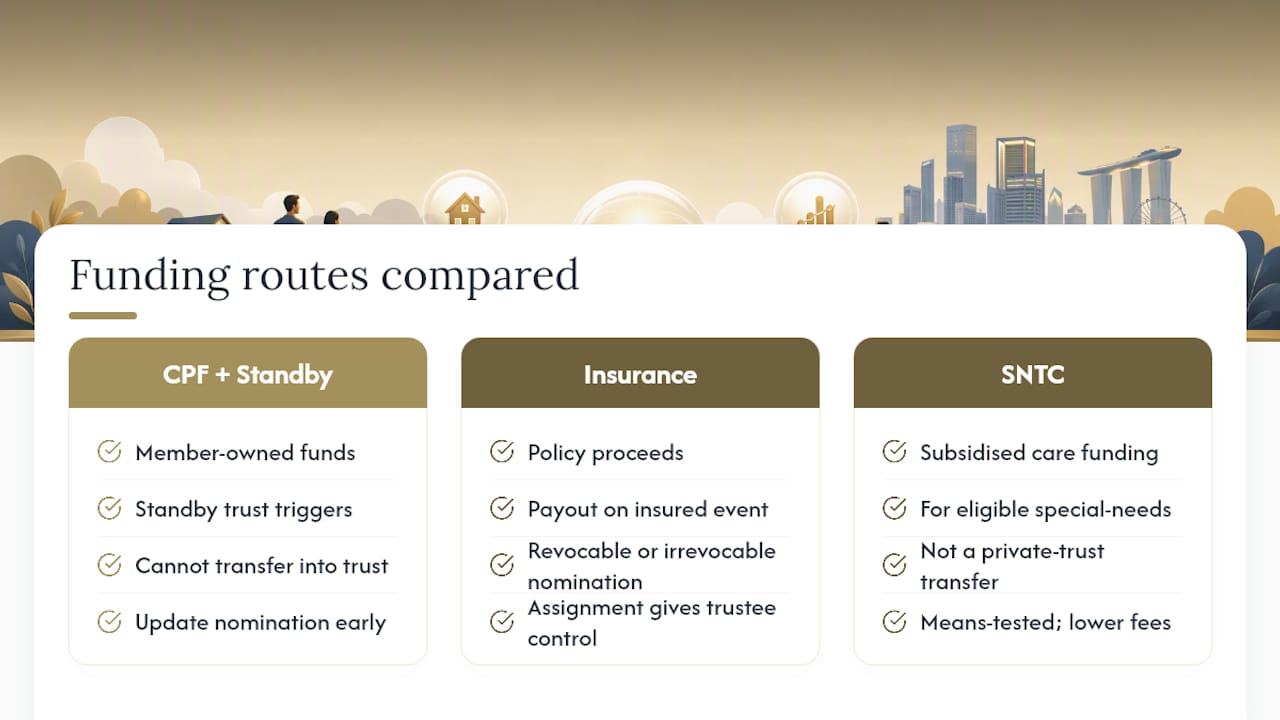
Pro Tip: If CPF forms a large share of your estate, don’t wait until your later years to sort out nominations. Update your CPF nomination and pair it with a standby trust while you’re still able to make clear, documented decisions about who controls what.
Who Should Be Your Trustee?
Choosing a trustee shapes how smoothly the trust runs for decades, not just at setup. Three options exist, each with real trade-offs.
Professional or licensed trustee. You get technical expertise, institutional continuity, and regulatory oversight, but you pay ongoing fees for it, and private banks like DBS offer this as a core wealth planning service.
A private individual, such as a family member. Costs less and keeps decisions close to the family, but carries a real risk of conflict of interest, especially if that trustee is also a beneficiary.
A Private Trust Company. Gives the family direct control over investment and distribution decisions, appropriate once asset size and complexity justify the extra cost and governance overhead.
Before appointing anyone, confirm their licensing status, insurance coverage, and custody arrangements for trust assets. Insist on a written letter of wishes, a clear investment mandate, a reporting schedule, and a documented conflicts policy. Ask directly how the trustee can be removed or replaced if the relationship breaks down. A PTC generally only makes sense once you’re managing multi-generational wealth or business interests complex enough to need dedicated governance.
Pro Tip: Ask any trustee candidate how they’d handle a disagreement among beneficiaries before you sign anything. Their answer tells you more about fit than their fee schedule does.
Do Trusts Avoid Probate in Singapore?
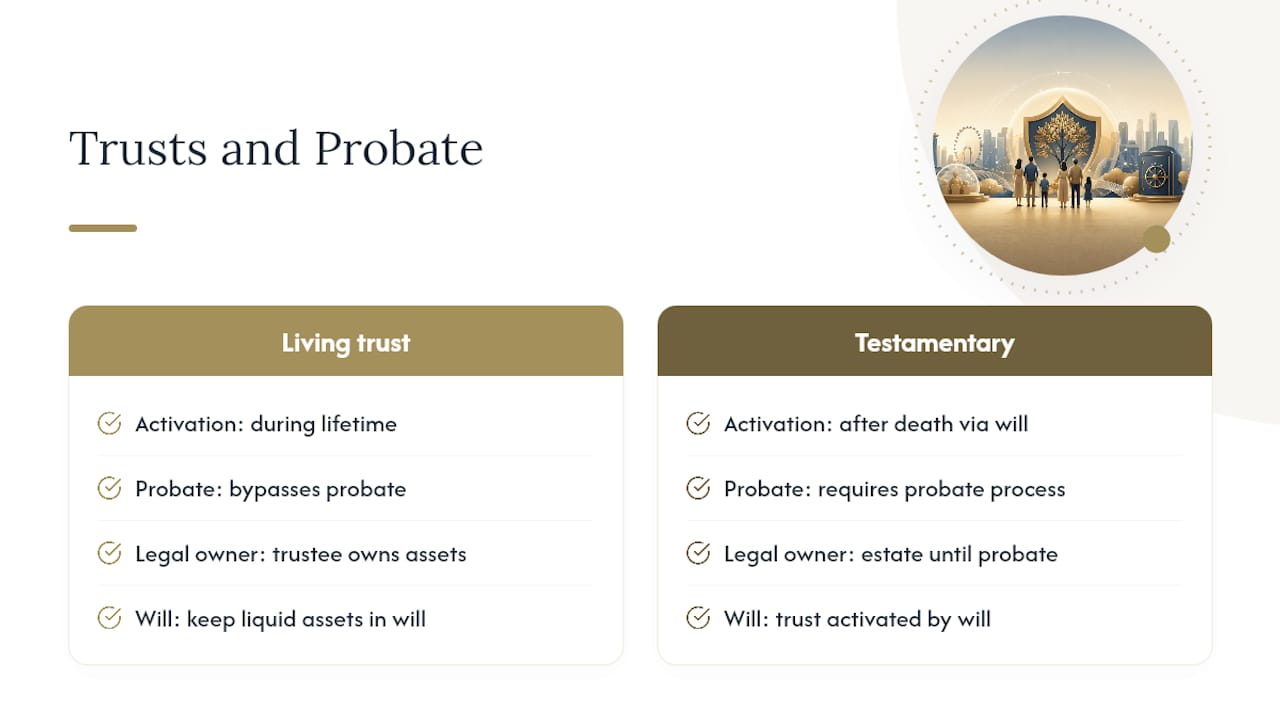
Assets held inside a properly funded trust generally bypass probate entirely, since the trustee already legally owns them rather than your estate. That keeps the transfer private and avoids the court process that a will triggers.
There’s an important distinction here: a testamentary trust only activates through your will after probate, while an inter vivos or living trust is funded and operating during your lifetime. Make sure your will still covers enough liquid assets to handle immediate post-death expenses, and keep your will, Lasting Power of Attorney, and CPF or insurance nominations consistent with your trust’s beneficiaries.
What I See Go Wrong When Families Fund a Trust
The pitfalls repeat: a property transfer proceeds without mortgage consent, an asset gets valued once at setup and never again, or a family assumes CPF savings simply roll into the trust like everything else. None of these are exotic mistakes. They’re ordinary oversights that a proper asset audit catches early.
Funding projects typically follow the stages of audit, funding plan, deed execution, trustee liaison, and ongoing governance. Most family trust engagements take a few weeks from signed deed to fully funded structure, depending on how many asset types are involved.
— Joseph
How Elite Legacy Planning Helps You Fund a Trust
Elite Legacy Planning is the alternative to piecing this together yourself across a lawyer, a banker, and a conveyancer who’ve never spoken to each other. You get one team coordinating the trust deed, the trustee liaison, and the actual asset transfers, from a Standby Trust for CPF and insurance nominations to full Private Trust Company setup for larger estates.

Bring your asset schedule, insurance policy documents, and current CPF nomination status to your first appointment, and Elite Legacy Planning will map out exactly which transfers need conveyancing, which need broker paperwork, and which need nothing more than an updated nomination form. If property is part of your estate, the property trust service coordinates conveyancing and stamp duty checks before you sign anything. Visit the full range of estate planning services or book a consultation to get your funding plan started.
This article is general information, not a substitute for advice from a qualified financial advisor. Consult a qualified financial professional about your own circumstances before acting on anything here.
Sources
FAQ
How Much Does It Cost to Set Up a Trust Fund in Singapore?
Costs vary widely by structure: a simple testamentary trust sits at the lower end, while complex arrangements can run past S$20,000, and PTC structures cost more still. Elite Legacy Planning’s Comprehensive Will, which includes testamentary trust drafting, runs $1,250 to $1,900 one-off, while other trust services are priced on request.
Does a Trust Need to Be Funded?
Yes. A trust deed with no assets transferred into it has nothing to protect or distribute, so funding, actually retitling assets to the trustee, is what makes the trust operational rather than just a signed document.
How Do You Set Up a Trust Fund in Singapore?
You draft a trust deed with a lawyer, appoint and confirm trustee acceptance, then execute transfers for each asset type, from bank accounts to property to insurance. From there, IRAS reporting and ongoing governance keep the structure compliant year over year.
What Are the Disadvantages of Putting Money in a Trust?
Trusts carry setup and ongoing administration costs, and once assets are transferred to a trustee, you generally give up direct control over them. Property transfers can also trigger stamp duty or ABSD, and CPF savings can’t be moved into a trust directly, which limits how much of some estates can actually be funded this way.
Recommended
Comments