


Ethical Will: The HNW Last Will & Testament Guide
- Joseph Tan

- Aug 6
- 12 min read

In this guide, “ethical will” means one thing: a legally operative Last Will and Testament designed for the complexity of a high-net-worth estate. Not a values letter, not a memoir, not a non-binding statement of wishes. A signed, witnessed, state-compliant document that transfers assets, appoints fiduciaries, and holds up in court.
Three legal elements every HNW will must address immediately:
Executor appointment and powers — who administers the estate and what authority they carry
Residuary clause — what happens to everything not specifically named elsewhere
Pour-over language — directing probate assets into a pre-existing revocable trust
Your next step: contact a state-licensed estate attorney to confirm your domicile’s execution formalities before you sign anything.
Key Takeaways
A legally precise Last Will and Testament, coordinated with trusts and beneficiary designations, is the foundation of a defensible HNW estate plan.
Point | Details |
Define the will’s legal scope | An ethical will in this context is a legally operative Last Will and Testament, not a values letter. |
Coordinate with trust documents | Conflicts between the will, trust, and beneficiary designations are the leading cause of estate disputes. |
Meet state execution formalities | Witness requirements, notarization, and self-proving affidavits vary by state and determine validity. |
Review after every major change | Business events, new jurisdictions, tax law changes, and family changes all require a formal will review. |
Elitelegacyplanning | Offers coordinated will drafting, trust setup, and corporate executorship for HNW families. |
This article is general information, not a substitute for advice from a qualified lawyer. Consult a qualified legal professional about your own circumstances before acting on anything here.
Table of Contents
Why a precisely drafted will matters for high-net-worth estates
How estate attorneys, financial advisors, and tax counsel should work together
How to articulate personal values within the legal framework of a will
Legal challenges unique to integrating wills with complex HNW estate structures
An advisor’s perspective on drafting wills for affluent clients
What an ethical will actually covers in this guide
The term “ethical will” circulates online in two very different contexts. Here, it refers exclusively to the Last Will and Testament and its related testamentary instruments: pour-over provisions, residuary clauses, executor powers, specific bequests, and business succession language. That is the document that governs what happens to your estate when you die.
What this guide does not cover:
Legacy letters or “ethical will” letters that communicate personal values to heirs
Non-binding memoirs or family history documents
Sentimental narratives intended to accompany a will
One critical warning: explanatory or sentimental letters should be kept entirely separate from operative will language. Courts may use such letters to interpret ambiguous clauses, but they carry no binding effect. Mixing personal statements into operative provisions creates ambiguity and litigation risk. Keep sentiment out of the operative text.
Why a precisely drafted will matters for high-net-worth estates
A will for a wealthy family has to do far more than name beneficiaries. It must coordinate titles across multiple entities, synchronize with trust structures, and address successor management for operating businesses. A generic will template fails at every one of those tasks.
A comprehensive estate plan typically includes a last will and testament, a revocable living trust, durable POA, healthcare POA, advance directive, and beneficiary designation review — and how these instruments interact determines probate exposure, delays, and whether the estate becomes a public record. The will governs only probate assets; everything else passes through trusts, beneficiary designations, or operation of law. Getting the coordination wrong means assets land in the wrong bucket.
High-value use cases where will drafting demands extra precision: business succession language for closely held companies, real property held in multiple states, art and collectibles with contested valuation, and charitable or dynasty planning flags that interact with generation-skipping transfer (GST) rules. HNW financial plans must address irrevocable trusts, charitable vehicles, and GST considerations — all of which affect what the will needs to say and what it should deliberately leave to the trust.
Core clauses every HNW will should include
A bespoke will for an affluent estate typically needs all of the following:
Executor appointment and powers — name a primary and at least one successor; specify powers to sell, manage, and distribute without court approval
Residuary clause — catches all assets not otherwise disposed of; must align with trust beneficiary designations
Specific bequests — real property, art, jewelry, and named accounts directed to named beneficiaries with clear identification
Pour-over clause — transfers probate assets into a revocable living trust at death, keeping distribution instructions private and unified
Business succession language — addresses ownership interests in LLCs, S-corps, or partnerships; names a successor manager or buy-sell trigger
Digital asset directions — grants the executor authority to access, manage, or transfer cryptocurrency, online accounts, and digital files
Guardianship provisions — required if minor children are involved; name primary and successor guardians separately from the executor
Pro Tip: A pour-over clause only works if the trust is funded before death. An unfunded trust with a pour-over will still send assets through probate. Coordinate with your attorney and financial advisor to retitle assets into the trust during your lifetime, not after.
Legal scholarship advises drafting a will that reflects the testator’s persona while keeping operative language precise and defensible. The will can sound like you without being ambiguous. Those two goals are not in conflict when the drafting is done carefully.
For multi-jurisdictional assets, flag real property in other states (which triggers ancillary probate), foreign accounts, and passthrough entities with operating agreements that may restrict transfer.
What execution formalities apply in your state
Compliance with state execution rules is non-negotiable. A will signed without proper witnesses is void, regardless of how carefully it was drafted.
Most states require two adult witnesses who are not beneficiaries, signing in the testator’s presence. Many states also allow a self-proving affidavit, signed before a notary at execution, which eliminates the need for witnesses to testify in probate court later. That affidavit is worth the extra ten minutes.
State-specific issues to confirm with counsel before execution:
Holographic wills — handwritten, unwitnessed wills are valid in roughly half of U.S. states; for HNW estates, they are almost never advisable regardless of validity
Electronic wills — a growing number of states now recognize electronically signed wills, but requirements vary significantly
Domiciliary probate — the state where you are domiciled at death governs the will’s admission to probate
Ancillary probate — real property in a state other than your domicile requires a separate probate proceeding in that state; a properly funded revocable trust avoids this
For a practical execution-day checklist, state-level practice resources illustrate common formalities including witness requirements, notarization, and ID. Bring government-issued photo ID, your witnesses (pre-screened for conflicts), and the notary arranged in advance. Never sign a page you have not read in full.
What the process looks like and what drives the cost
From first meeting to signed will, a bespoke HNW engagement typically runs several weeks to a few months. The range depends on estate complexity, how quickly clients gather documents, and how many advisors need to coordinate.
Stage | Typical Duration | Who Participates |
Discovery and intake | 1–2 weeks | Attorney, client, financial advisor |
Draft preparation | 2–3 weeks | Attorney, tax counsel |
Client review and revision | 1–2 weeks | Client, attorney |
Execution | 1 day | Client, witnesses, notary |
Follow-up retitling and funding | 2–4 weeks | Attorney, advisor, trustee |
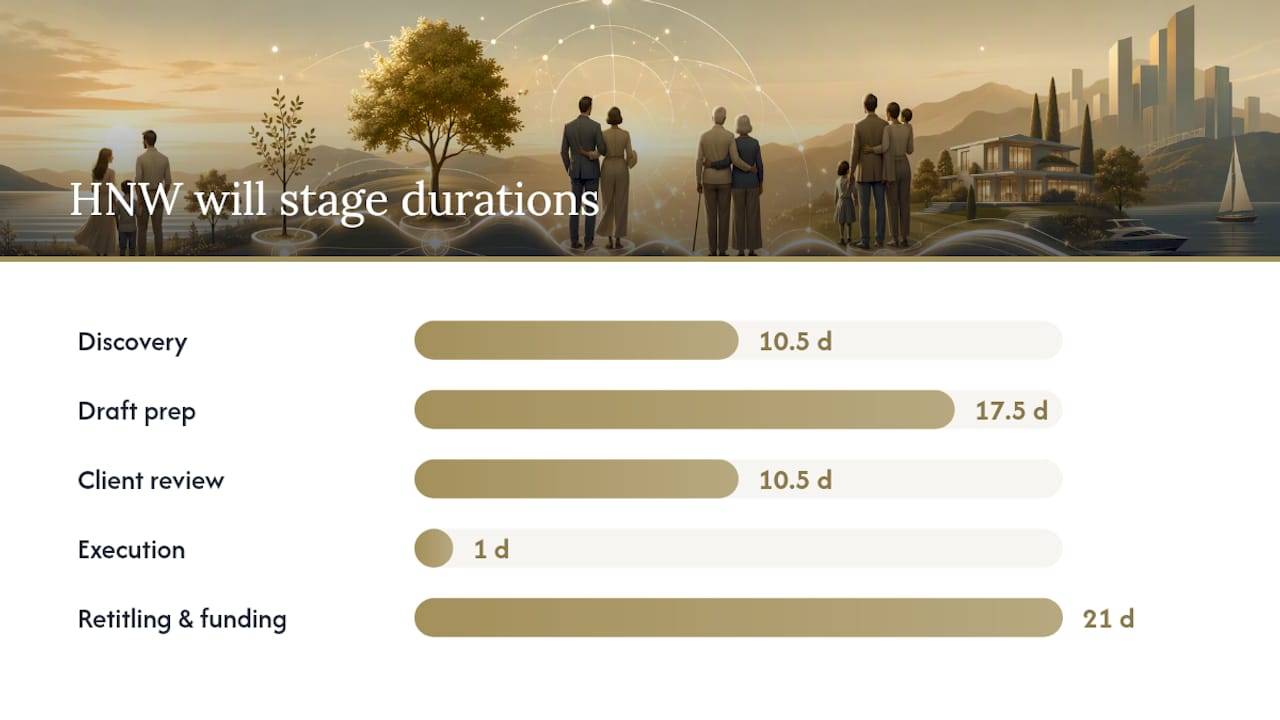
A staged workflow with dedicated meetings and deadlines significantly improves completion rates for estate documents. Estates that skip the follow-up retitling stage often end up with a beautifully drafted will and a trust that holds nothing.
Cost drivers for HNW engagements: number of entities and trusts requiring coordination, involvement of tax counsel for GST or charitable modeling, international assets requiring foreign counsel, bespoke business succession language, and whether a corporate executor or private trust company is engaged. Leading advisors recommend integrating estate planning into the broader financial plan to avoid siloed billing and duplicated work across disciplines.
Common drafting pitfalls and how to avoid disputes
Ambiguity and contradictions between the will and trust documents are the two most avoidable sources of estate litigation. A will that says “my residuary estate to my children equally” while the trust names different shares creates a conflict that courts resolve expensively.
Practical mitigation checklist for counsel and clients:
Define every term used in distribution clauses (“children” — does it include stepchildren? adopted children?)
Synchronize beneficiary designations on retirement accounts and life insurance with the will’s distribution scheme before execution
Name at least two successor executors and two successor trustees; single-successor provisions fail more often than clients expect
Never include explanatory clauses in operative provisions; if a rationale is needed, it belongs in a separate letter that cannot contradict the will
Pro Tip: If you want to explain why a child receives a smaller share, put that explanation in a separate letter to your executor — not in the will itself. Courts can use explanatory language in a will to reinterpret distribution clauses in ways the testator never intended.
A short anonymized example: a client with a revocable trust and a pour-over will add a handwritten codicil naming a specific account to a grandchild. The account was already titled in the trust. The result was a conflict between the codicil and the trust instrument that required court interpretation. The fix was simple: a coordinated amendment to both documents. The lesson is that no single document in an HNW estate plan can be amended in isolation.
Where to store the will and how often to review it
Secure, redundant storage plus clear notice procedures reduce the risk that a valid will is never found. Options: your attorney’s fireproof safe (most reliable for original documents), a fireproof physical safe at home with a combination known to your executor, or an encrypted digital vault for copies. Most states require the original for probate; a copy alone is usually insufficient.
Review triggers that should prompt a full will review:
Marriage, divorce, or death of a named beneficiary or fiduciary
Birth or adoption of a child or grandchild
Significant change in federal estate tax exemptions or GST rules
Business sale, acquisition, or restructuring
Acquisition of real property in a new state or country
Change in domicile state
Who to notify when the will is executed or updated: your primary executor, successor executor, trustee, lead financial advisor, and tax counsel. Maintain a one-page access protocol listing where the original is stored, who has the combination or access credentials, and the attorney’s contact information. Review that protocol every time you update the will.
How estate attorneys, financial advisors, and tax counsel should work together
Coordinated multidisciplinary planning reduces implementation risk more than any single document can. The attorney drafts; the financial advisor inventories assets and manages retitling; tax counsel models estate tax exposure and GST elections. When those three work in sequence without sharing information, the plan has gaps.
A practical joint meeting agenda:
Discovery — client presents asset inventory, entity documents, existing beneficiary designations, and liquidity plan
Legal implications — attorney identifies probate exposure, ancillary probate risks, and executor authority gaps
Tax modeling — tax counsel runs estate tax projections, GST scenarios, and charitable deduction analysis
Trust interactions — attorney and advisor confirm that trust funding aligns with will pour-over language and beneficiary designations
Implementation checklist — assign retitling tasks, beneficiary designation updates, and document execution deadlines
Next steps and responsibilities — each advisor leaves with named tasks and a deadline; no open items without an owner
Integrated plan construction emphasizes sequencing, documenting rationale, and coordinating referrals when technical tools interact. For HNW estates, that sequencing is not optional. A trust funded after the will is signed, or a beneficiary designation updated without telling the attorney, can unravel months of careful drafting.
Why this guidance can be relied on
This article draws on published estate planning scholarship, practitioner resources, and the multidisciplinary advisory approach that Elitelegacyplanning applies across its HNW client engagements. Three trust signals worth noting:
Elitelegacyplanning’s trust consultation and lifetime advisory services reflect exactly that approach: attorney-grade drafting coordinated with financial and tax advisors, not produced in isolation. The firm’s published materials and HNW client education events demonstrate ongoing engagement with the planning challenges described here.
Disclaimer: This article provides general information about estate planning concepts and is not legal advice. Domiciliary execution rules, tax thresholds, and probate procedures vary by state. Consult a state-licensed estate attorney for advice specific to your situation.
Ethical considerations and client intentions in HNW wills
The ethical dimension of a Last Will and Testament for a wealthy family is not about sentiment. It is about intentionality: making deliberate, documented choices about who receives what, why, and under what conditions. That intentionality is what separates a defensible will from a disputed one.
For HNW clients, the most common ethical tension is between equal treatment and equitable treatment. Leaving equal shares to children who have received vastly different lifetime gifts, business interests, or educational support can feel fair on paper and produce conflict in practice. The will is the place to address that imbalance explicitly, through specific bequests, equalization clauses, or trust conditions, rather than leaving heirs to interpret silence.

Client intentions around charitable giving, family governance, and wealth stewardship also belong in the legal framework. A charitable bequest clause, a dynasty trust provision, or a condition on a specific bequest (such as completing a degree or maintaining a family property) can all be drafted into a will with precision. The key is that the intention must be expressed in operative language, not in a preamble or explanatory note that a court may treat as non-binding.
How to articulate personal values within the legal framework of a will
Personal values find their way into a legally operative will through specific drafting choices, not through narrative paragraphs. A testator who values philanthropy expresses that through a named charitable bequest or a charitable remainder trust provision. A testator who values family continuity expresses that through a dynasty trust clause or a family limited partnership interest transferred under defined conditions.
The practical approach: work with your attorney to translate each value into a legal mechanism. “I want my children to work for what they receive” becomes a trust distribution standard tied to earned income. “I want the family vacation home preserved” becomes a qualified personal residence trust or a specific bequest with a right of first refusal among heirs. Values without legal mechanisms are wishes. Values expressed through operative clauses are instructions.
What does not belong in the operative will: personal messages to heirs, explanations of why certain decisions were made, or statements about family relationships. Those belong in a separate letter to your executor, kept outside the will, where they cannot be used to reinterpret distribution language.
Sample will clauses for high-net-worth estates
These are illustrative examples only, not legal advice. Have your attorney adapt any language to your state’s requirements and your estate’s specific facts.
Residuary clause with pour-over:“I give, devise, and bequeath all of my remaining estate, both real and personal, to the Trustee of the [Name] Revocable Trust dated [Date], as amended, to be held, administered, and distributed in accordance with the terms of that trust.”
Executor powers clause:“I grant my Executor full power and authority, without court approval, to sell, lease, mortgage, invest, reinvest, and otherwise manage any asset of my estate as the Executor deems advisable in the best interests of the estate and its beneficiaries.”
Business succession clause:“With respect to my interest in [Entity Name], I direct my Executor to transfer such interest to [Named Successor or Trust] within [X] days of my death, subject to the terms of the Operating Agreement dated [Date], and I authorize my Executor to execute any documents necessary to effect that transfer.”
Equalization clause:“In determining the shares of my residuary estate, my Executor shall take into account prior lifetime gifts exceeding $[Amount] made to any beneficiary, as documented in Schedule A attached hereto, and shall adjust each beneficiary’s share accordingly.”
Each of these clauses does one thing: converts an intention into an instruction. That is the standard every operative clause should meet.
Legal challenges unique to integrating wills with complex HNW estate structures
The most common legal challenge is document conflict: the will says one thing, the trust says another, and the beneficiary designation on a retirement account says a third. Courts resolve those conflicts through state-specific priority rules, and the outcome rarely matches what the client intended.
A second challenge is the moving-target problem. An HNW estate changes constantly: new entities are formed, properties are acquired, business interests shift. A will drafted three years ago may reference an entity that no longer exists or omit an asset acquired last year. Without a regular review cycle, the will drifts out of alignment with the actual estate.
A third challenge is multi-jurisdictional complexity. Real property in multiple states triggers ancillary probate in each state where property is held, unless that property is titled in a trust. Foreign assets add another layer: some countries do not recognize U.S. wills, and a separate local will or legal structure may be required. Clients with international holdings need counsel in each relevant jurisdiction, coordinated by the lead estate attorney.
The mitigation strategy for all three: treat the will as a living document within a coordinated plan, not a one-time filing. Schedule a formal review annually or after any significant change in the estate, and require all advisors to flag changes that may affect document alignment.
An advisor’s perspective on drafting wills for affluent clients
The conversation that matters most in HNW estate planning is not about tax rates or trust structures. It is about what the client actually wants to happen, and why. Most clients arrive with a general sense of fairness and a list of assets. The work is translating both into language that holds up when the client is no longer in the room to explain what they meant.
What I have found, working through complex estates, is that the families who avoid disputes are the ones whose documents leave no room for interpretation. Not because they were cold or transactional, but because they were precise. Clear drafting is an act of care for the people left behind.
Elitelegacyplanning: bespoke will drafting for HNW families

Elitelegacyplanning offers comprehensive will drafting built specifically for affluent and high-net-worth families who need more than a standard template. The firm’s process integrates will drafting with trust coordination, corporate executorship, and lifetime advisory, so every document in your estate plan works from the same set of facts. For clients who need both a will and a revocable living trust, the standby living trust service handles both instruments in a single coordinated engagement. For ultra-high-net-worth families requiring a dedicated fiduciary structure, the private trust company service provides a bespoke solution. Book a consultation to start with a discovery meeting and a clear scope of what your estate plan needs.
Sources
Recommended
Comments