


Deed of Family Arrangement in Singapore: A Practical Guide


A Deed of Family Arrangement (DOFA) lets beneficiaries lawfully redistribute a deceased person’s assets by mutual agreement, without going back to court to contest the will. If everyone entitled to inherit consents, signs, and disclosure is honest, the arrangement stands. Your immediate next step: confirm who must consent, gather the probate documents, and instruct a solicitor before any family negotiation begins.
Before that first meeting, pull together these three documents:
Death certificate of the deceased
Grant of Probate or Letters of Administration (whichever applies)
The latest valid will (or confirmation of intestacy if no will exists)
Pro Tip: If any beneficiary is under 21 or lacks mental capacity, flag this before negotiations start. Court approval is likely required, and skipping that step can invalidate the entire arrangement.
Key Takeaways
A Deed of Family Arrangement in Singapore is a legally binding contract that can redistribute an estate by consent, but it requires full disclosure, unanimous beneficiary agreement, and careful execution to survive later challenge.
Point | Details |
Unanimous consent required | Every beneficiary under the will or intestacy must agree; one refusal ends the arrangement. |
Disclosure is the foundation | A signed asset schedule with independent valuations is the strongest defense against a later challenge. |
Stamp duty is a real cost | Property transfers departing from the will’s terms can attract ad valorem stamp duty; model this before finalizing terms. |
Minors need court approval | Beneficiaries under 21 or lacking capacity require a court-sanctioned arrangement before the DOFA can bind them. |
Elitelegacyplanning coordinates the full process | From will review and DOFA drafting to valuations, conveyancing, and trust alternatives for HNW families in Singapore. |
Table of Contents
What is a deed of family arrangement in Singapore?
A DOFA is a consensual legal agreement among all beneficiaries of a deceased person’s estate. It lets them vary how assets are distributed, departing from what the will says or what intestacy rules would produce. Think of it as a private contract that sits alongside probate, not a replacement for it. As CNP Law explains, a DOFA lets beneficiaries agree to redistribute the estate differently from the will or intestacy rules, but consent from all beneficiaries is required and transfers may trigger stamp duty and conveyancing steps.
Probate still proceeds normally. The executor remains responsible for collecting assets, paying debts, and effecting transfers. The DOFA simply instructs the executor to distribute differently than the original document required, once all parties have agreed.
Common scenarios where families reach for a DOFA:
An adult child was omitted from the will, and the remaining beneficiaries want to include them
The will leaves unequal shares that no longer reflect the family’s circumstances
Siblings want to consolidate a family company’s shares rather than split them fractionally
One beneficiary prefers a cash payment over inheriting a property share
The estate includes jointly held assets that need restructuring before distribution
One firm boundary: a DOFA cannot prejudice third-party creditors. If the estate has outstanding debts, those must be settled first. Rearranging distributions among beneficiaries does not shield assets from legitimate creditors.
When should your family consider using a DOFA?
The clearest trigger is a will that no longer fits reality. A parent drafted the will fifteen years ago; circumstances have shifted, and the family agrees the current terms are impractical or unfair. Rather than litigating, a DOFA lets everyone reach a negotiated outcome faster and at lower cost.
Other common situations:
Perceived unfairness: A beneficiary received a disproportionately small share relative to their contribution to the family business or care of the deceased
Omitted beneficiary: A child born after the will was signed, or a dependent who was overlooked
Family business or jointly held property: Fractional ownership of shares or real estate is operationally messy; a DOFA can consolidate ownership cleanly
Cross-border assets: Families with overseas property sometimes use a DOFA to simplify which beneficiary takes which jurisdiction’s assets
Avoiding court disputes: Litigation over estates is expensive, slow, and corrosive to family relationships
The practical benefits are real. A negotiated DOFA typically resolves faster than contested probate proceedings. It allows tailored transfers — one sibling takes the property, another takes the investment portfolio — rather than forcing a sale. And it keeps the dispute private rather than on a public court record.
The deal-breakers are equally clear. Plain English Law notes that a DOFA only works if all beneficiaries entitled under the will or intestacy agree; minors or those without capacity may require a court-sanctioned arrangement. A single non-consenting adult beneficiary kills the arrangement. There is no majority vote.
What are the key legal requirements for a valid DOFA?
Consent and capacity
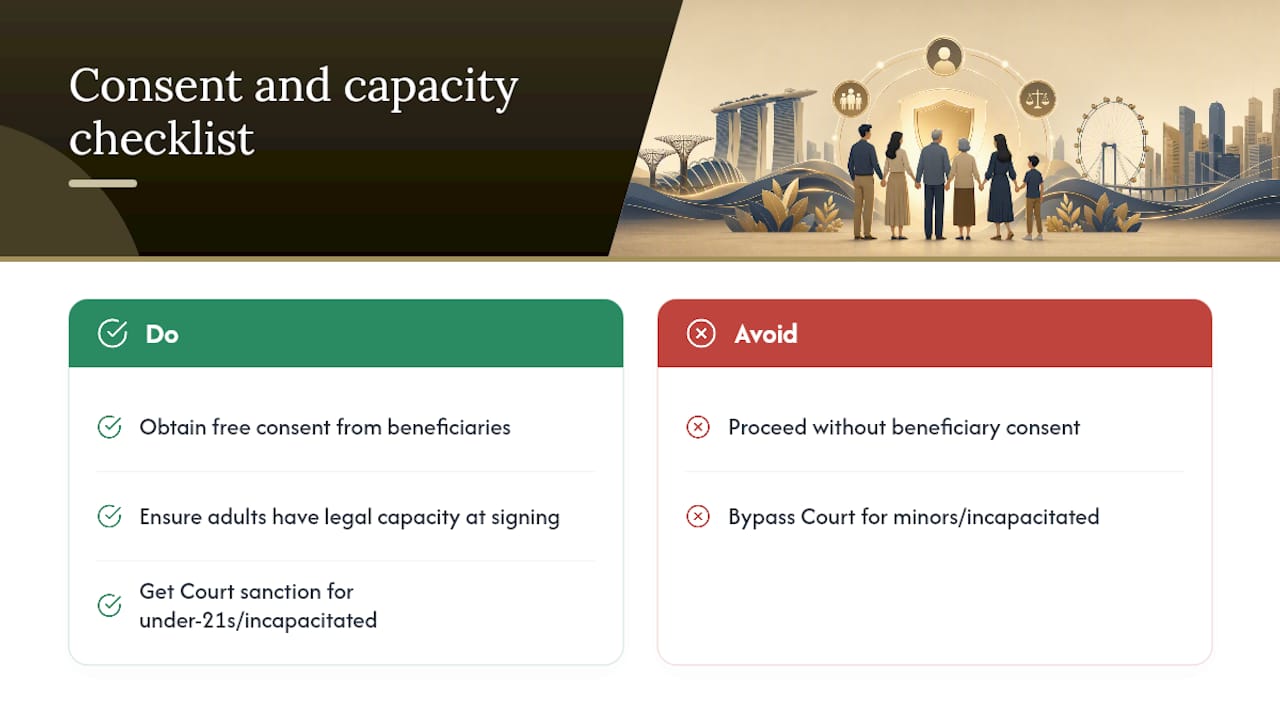
Every beneficiary entitled under the will or intestacy must consent freely. Adults must have legal capacity at the time of signing. For beneficiaries under 21 or those who lack mental capacity, the court’s involvement is not optional. The Supreme Court of Singapore handles applications to sanction arrangements on behalf of vulnerable beneficiaries, and its published procedural requirements govern how those applications are filed.
Disclosure obligations
Material non-disclosure is the most common ground for setting a DOFA aside. Every beneficiary must have accurate information about the estate’s size, asset values, and any competing entitlements before they sign. Concealing a significant asset or understating a property’s value is enough to unwind the whole arrangement. Singapore appellate commentary confirms that private family agreements are subject to the court’s fairness review and must meet ordinary contract requirements, with courts retaining broad discretion to ensure an outcome is just and equitable.
Execution formalities
A DOFA should be executed as a deed, not merely a signed letter. Where land is involved, written documentation is legally required for any disposition to be effective. Each party must sign in the presence of a witness who is not a party to the deed. Solicitors typically prepare execution pages with attestation clauses that satisfy these requirements.
Property transfers and stamp duty
Transfers that depart from the will’s terms can attract ad valorem stamp duty. A beneficiary who receives property under a DOFA rather than directly under the will may be treated as receiving a transfer for stamp duty purposes. Conveyancing steps at the Singapore Land Authority are required to update title. For shares, the company’s share register must be updated and any relevant board or shareholder approvals obtained. Families with foreign beneficiaries should also check whether Additional Buyer’s Stamp Duty applies; a practical guide to ABSD and foreign purchaser rules is worth reviewing before finalizing any property transfer terms.

Court scrutiny and case law
Singapore High Court decisions, including the 2020 judgment in SGHC 124, illustrate how courts evaluate family arrangements and provide concrete examples of circumstances where arrangements were upheld or set aside. The consistent message: fairness, full disclosure, and genuine consent are the three pillars.
Documents solicitors should gather before drafting:
Full estate inventory with asset valuations
Mortgage or encumbrance statements on any real property
Probate documents (Grant of Probate or Letters of Administration)
Proof of identity for all beneficiaries
Valuation reports for property, business interests, and significant personal assets
Confirmation of any outstanding estate debts or third-party claims
Pro Tip: Ask your solicitor to prepare a written disclosure schedule listing every estate asset and its current value. Each beneficiary signs to confirm they received and reviewed it. That single document is your strongest defense if the DOFA is challenged later.
How do you prepare, negotiate, draft, and execute a DOFA?
Confirm the beneficiary list. Pull the will and the Grant of Probate or Letters of Administration. Every person entitled to inherit under the will or intestacy must be identified and contacted. Do not assume a beneficiary will agree or that their share is small enough to ignore.
Gather documents and valuations. Commission property valuations, obtain share valuations for any business interests, and collect mortgage statements. An estate inventory signed by the executor gives everyone a common factual baseline. Practical guides confirm that executors and solicitors must coordinate to effect transfers under a family arrangement, so involve the executor early.
Negotiate the terms. Agree on who takes what: cash settlements versus property transfers, timing of payments, and any trustee or company mechanisms for share consolidation. Document the negotiation in writing, even informally, so there is a contemporaneous record of how the agreement evolved.
Instruct solicitors to draft the deed. The deed should include a full disclosure schedule, acknowledgment that each party received independent legal advice (or a clear waiver with explanation of risk), recitals setting out the background, and operative clauses specifying each transfer. Plain English Law recommends executing the DOFA as a deed and maintaining written documentation throughout.
Execute and implement. Each party signs in front of a witness. For minors or incapacitated beneficiaries, obtain court sanction before execution. After signing, effect the transfers: lodge title documents with the Singapore Land Authority for real property, update share registers for company shares, and notify the executor to distribute accordingly.
Realistic timeline per stage:
Beneficiary identification and document gathering: 2–4 weeks
Negotiation and valuation: 4–8 weeks (longer for complex business assets)
Drafting and review: 2–4 weeks
Execution and transfer registration: 4–8 weeks
Court approval (if required for minors): add 8–16 weeks
A straightforward DOFA with cooperative adult beneficiaries and simple assets can close in three to four months. Add a business valuation dispute or a minor beneficiary, and six to twelve months is realistic.
What does a DOFA typically cost in Singapore?
Cost depends heavily on complexity. A straightforward arrangement with two or three adult beneficiaries, a single property, and no contested valuations sits at the lower end. Add a family business, overseas assets, or a non-consenting party, and costs climb quickly.
Stamp duty is the wildcard. Transfers that depart from the will’s terms may be assessed at the standard buyer’s stamp duty rates on the property’s market value. Singapore currently has no estate duty, so the estate itself is not taxed on death, but the property transfer and decoupling costs that arise from a DOFA-driven reallocation can be material and should be modeled before the arrangement is finalized.
Where court approval is needed for a minor or incapacitated beneficiary, add legal costs for the application and the time it takes to get a hearing date. That alone can add S$5,000–S$15,000 and several months to the process.
How do DOFAs get challenged, and how do you protect against it?
The three most common attacks on a DOFA are non-disclosure, undue influence, and lack of capacity. Each is avoidable with the right process.
Non-disclosure is the most frequent. A beneficiary later discovers an asset was omitted from the disclosure schedule, or that a property was undervalued. Courts take this seriously. Singapore appellate authority confirms that fairness and full disclosure are decisive, and case summaries show DOFAs being set aside where concealment was proven.
Undue influence arises when a dominant family member pressures a more vulnerable one into signing. The antidote is independent legal advice: each beneficiary consults their own solicitor, who certifies in writing that the advice was given and the client understood what they were agreeing to.
Lack of capacity at the time of signing is harder to defend after the fact. If there is any doubt about a beneficiary’s mental state, obtain a medical assessment before execution.
Practical mitigations:
Prepare a signed, dated disclosure schedule listing every estate asset and its valuation source
Require each beneficiary to obtain independent legal advice and produce a signed certificate confirming it
Keep contemporaneous attendance notes of all negotiation meetings
Record any consideration payments (even nominal ones) in the deed to support enforceability as a contract
Where a beneficiary is elderly or unwell, obtain a medical capacity assessment before signing
Involve the court proactively for minors or incapacitated beneficiaries rather than attempting workarounds
Pro Tip: Treat the negotiation record as evidence you may one day need in court. A signed summary of each meeting, agreed by all parties at the time, is far more persuasive than anyone’s recollection years later.
Special issues: HDB flats, overseas assets, family businesses, and tax
HDB flats
HDB properties carry statutory restrictions that a DOFA cannot override. Eligibility rules, occupancy requirements, and the Housing & Development Board’s own approval processes apply independently of any private agreement among beneficiaries. A DOFA that purports to transfer an HDB flat to a beneficiary who does not meet HDB’s eligibility criteria will not be given effect. Families must obtain HDB’s approval separately, and the DOFA should be drafted to make any HDB transfer conditional on that approval.
Overseas assets
A DOFA governed by Singapore law may not automatically be recognized or enforceable in another jurisdiction. Where the estate includes overseas real property, the law of the country where the property is located typically governs its transfer. The deed should include a choice-of-law clause and, where necessary, local counsel in the relevant jurisdiction should be engaged to effect the transfer under local rules.
Family businesses and shares
Share transfers under a DOFA require the company’s share register to be updated. Check the company’s constitution for any pre-emption rights or transfer restrictions that could block a direct transfer to a beneficiary. Minority squeeze considerations arise where one beneficiary ends up with a small stake in a private company with no clear exit mechanism. Structuring the transfer through a trust or a holding company can address this, and trust consultation and lifetime advisory services are worth considering for complex family business situations.
Tax and stamp duty
Singapore has no estate duty, so the estate itself pays no inheritance tax. However, transfers of property under a DOFA that depart from the will’s terms can attract buyer’s stamp duty at ad valorem rates. Singapore’s broader tax environment, including the absence of capital gains tax, is generally favorable for estate transfers, but stamp duty on property reallocation is a real cost that must be factored into the negotiation. Model the stamp duty exposure before agreeing on who takes which asset.
Why estate planners treat DOFAs as high-stakes documents
Most families approach a DOFA as a paperwork exercise. Experienced estate planners treat it as a document that must survive a court challenge years later, under adversarial conditions, with a judge who was not in the room when the family agreed.
That reframing changes everything about how the process is run. Disclosure is not a formality; it is the foundation. Valuation reports are not optional extras; they are evidence. Independent legal advice certificates are not bureaucratic box-ticking; they are the single most cost-effective insurance a beneficiary can buy.
For high-net-worth families, the stakes are higher still. A DOFA that reallocates a family business, a portfolio of investment properties, or a private trust company structure is not a simple document. It requires coordinated input from solicitors, valuers, accountants, and sometimes offshore counsel. The executor’s role must be carefully managed so that probate proceeds in parallel without creating conflicting obligations.
Living trusts and private trust company structures sometimes offer a cleaner alternative for families who want to avoid the DOFA process entirely. Where assets are held in trust before death, the trust deed governs distribution and a DOFA may not be needed at all. That is a planning conversation worth having before a death occurs, not after.
The families who navigate DOFAs well are the ones who treat the process as a negotiation with legal consequences, not a family meeting with paperwork attached.
How Elitelegacyplanning supports families through a DOFA
Estate redistribution after a death is rarely just a legal problem. It is a family problem with legal dimensions, and the two require different skills handled together.
Elitelegacyplanning works with affluent and high-net-worth families in Singapore to manage exactly that combination: the legal structure of a DOFA alongside the practical coordination of valuations, probate, conveyancing, and trust alternatives. The firm reviews existing wills, identifies which beneficiaries must consent, and coordinates independent valuations so that the disclosure schedule is defensible from day one.

For families where a DOFA is not the right tool, standby living trusts and private trust company structures offer alternatives that sidestep the consent and stamp-duty complications entirely. Every engagement begins with a confidential assessment, a conflict check, and a clear written scope before any fees are committed. Fixed-fee estimates are available for standard DOFA work. To start with a document review or book an initial consultation, visit the online booking page or review service pricing to find the right entry point.
Sources
The sources below are the primary and practical references to share with your solicitor or use to verify procedural steps.
Primary law and court decisions:
Practice notes and practical guides:
This article provides general information about Deeds of Family Arrangement in Singapore and is not a substitute for professional legal advice. Confirm current procedural requirements and stamp duty rules with a qualified Singapore solicitor before taking any steps.
Recommended
Comments