


What Happens to CPF LIFE Savings After Death in Singapore


When a CPF member dies, any remaining CPF LIFE premium balance and leftover CPF account savings get paid out in cash to the nominees the member named. There is one notable exception: members on the CPF LIFE Income Plan don’t have a refund feature built in, so nothing carries over from that specific plan. If there’s no valid nomination on file, the money doesn’t go to the family automatically. It gets routed to the Public Trustee’s Office for distribution under intestacy rules, which is a slower, more bureaucratic path than most families expect.
Here’s the timeline that actually matters:
CPF Board is notified automatically by government agencies. You typically don’t need to call anyone.
Nominees can expect to be contacted within about 10 working days.
If the case goes to the Public Trustee’s Office instead, processing can stretch up to several months.
Pro Tip: Log into your Retirement Dashboard on Singpass today and confirm your CPF nomination is current. It takes five minutes and it’s the single biggest lever you have over how fast your family gets paid.
Key Takeaways
CPF LIFE balances pass to nominees automatically when a valid nomination exists, but families without one face Public Trustee’s Office delays of up to six months.
Point | Details |
Nomination decides speed | A valid CPF nomination lets funds reach beneficiaries in cash without probate; no nomination means PTO involvement. |
Income Plan has no refund | Unused premium balance refunds to nominees under most plans, but Income Plan members are excluded. |
10 working days is standard | CPF Board contacts nominees within about 10 working days once notified of a death. |
PTO can take six months | Cases without a nomination route through the Public Trustee’s Office, which may take up to six months and involve fees. |
SRS needs a will | SRS has no nomination system, so it must be addressed directly in a will to avoid intestacy distribution. |
Table of Contents
How CPF Savings and CPF LIFE Payout After Death Get Distributed
Why a CPF Nomination Beats Leaving It to the Public Trustee’s Office
What Nominees Should Expect: Timelines and Automatic Payouts
An Estate Planner’s Checklist for Tying CPF Into the Bigger Picture
Why the Real Risk Isn’t CPF Rules, It’s the Gaps Around Them
How CPF Savings and CPF LIFE Payout After Death Get Distributed
The distribution pool isn’t just your CPF LIFE annuity. It includes your Ordinary Account, Special Account, MediSave Account, and Retirement Account balances, plus whatever premium balance remains in your CPF LIFE annuity. That last figure is the one people misunderstand most. Your CPF LIFE premium balance is essentially the amount deducted from your Retirement Account to buy into the annuity, minus whatever payouts you’ve already collected. If you passed away five years into retirement having received relatively few payouts, that balance can still be substantial.
Here’s how the process actually unfolds once a death is registered:
A government agency, usually triggered through ICA’s death registration process, notifies CPF Board directly.
CPF Board checks for a valid nomination on the deceased’s account.
If a nomination exists, CPF Board contacts the nominees and either pays out automatically or provides instructions on applying.
If no nomination exists, the case gets referred to the Public Trustee’s Office, which may take an extended period to process.
Pro Tip: You can check your own CPF LIFE premium balance and plan type right now through the Retirement Dashboard. Most members have never looked. Do it before you need to.
Does CPF LIFE Actually Refund Unused Money, or Is It Lost?
This is the myth that trips up almost everyone: people assume CPF LIFE “eats” your money if you die early, the way some private annuities do. It doesn’t work that way. CPF LIFE runs on risk-pooling, meaning the interest earned across all annuity premiums in the pool funds lifetime payouts for members who live longer than average. That pooled interest isn’t sitting in your personal account waiting to be inherited. It’s a shared mechanism that’s what makes lifelong monthly payouts possible in the first place, as CPF Board explains in its risk-pooling breakdown.
What you do get back is different from the interest. The unused premium balance itself is refunded to your nominees, separate from the pooled interest that supports everyone else’s payouts.
Standard Plan and Escalating Plan members: unused premium balance refunds to nominees.
Basic Plan members: refund applies similarly, since premiums are deducted gradually from the Retirement Account.
Income Plan members: no refund feature. This is the one plan where the exception genuinely matters.
Check your plan type on the Retirement Dashboard before assuming a refund applies to your situation. The difference between plans isn’t cosmetic. It changes what your family actually receives.
Why a CPF Nomination Beats Leaving It to the Public Trustee’s Office
A CPF nomination is a simple instruction that tells CPF Board exactly who gets your savings and in what proportion, bypassing the need for probate or letters of administration entirely. You make or update one online through Singpass in a few minutes, and it costs nothing.
Skip that step, and here’s what happens instead:
CPF savings transfer to the Public Trustee’s Office once no valid nomination is found.
Next-of-kin must file an application with PTO, providing proof of relationship and identity documents.
Processing takes up to six months, sometimes longer for contested or complex cases.
Administrative fees may apply, and distribution follows intestacy law, which may not match what the deceased actually wanted.
Pro Tip: If you’ve remarried, had children, or lost a family member since you last checked your nomination, update it now. Outdated nominations are one of the most common (and most avoidable) causes of family disputes over CPF money.
What Nominees Should Expect: Timelines and Automatic Payouts

Once CPF Board has been notified, nominees are typically contacted within 10 working days. Some nominees don’t even need to file anything.
Automatic disbursement via PayNow or GIRO applies when the nominee meets these criteria:
Singapore citizen or permanent resident.
At least 18 years old.
Has a local residential address on record.
Has a bank account already registered with CPF Board.
Meet all four, and the payout can land in your account without a separate withdrawal application. If you don’t meet them, expect to submit additional forms and documents.
Nominees can also access the Deceased CPF Member Dashboard through Singpass, generally available around the 10 working day mark after notification. The dashboard shows account balances, the CPF LIFE plan the deceased held, and what’s pending. Have the deceased’s NRIC and your own Singpass credentials ready when you log in. For general guidance on navigating this kind of administrative process, resources like Haio walk through what documents Singapore families typically need to gather.
Don’t Forget SRS: It Doesn’t Work Like CPF
Supplementary Retirement Scheme money follows completely different rules, and this catches families off guard constantly. There’s no nomination system for SRS at all. When an SRS account holder dies, the balance is treated as a deemed withdrawal on the date of death, with up to $400,000 of that withdrawal potentially tax-exempt.
Check your SRS operator’s records now to confirm your current balance and account status.
Name SRS explicitly in your will rather than assuming it’s covered alongside CPF.
Review both documents together so there’s no gap between what CPF handles and what your will needs to cover.
An Estate Planner’s Checklist for Tying CPF Into the Bigger Picture
CPF nominations solve one piece of the puzzle. They don’t touch SRS, they don’t cover property or investment accounts, and they don’t address business succession. For affluent families, the gap between “CPF is sorted” and “the whole estate is sorted” is where real complications tend to surface.
Confirm your CPF nomination is current and reflects your actual family situation.
Check your CPF LIFE plan type. Income Plan members need to plan around the missing refund feature.
Name SRS and other non-nominated assets explicitly in a comprehensive will.
For layered estates involving property, multiple beneficiaries, or business interests, a living trust can keep control and continuity intact where a will alone falls short.
Revisit your plan after marriage, divorce, a new child, or a major asset purchase.
A coordinated approach, CPF nomination, a will that explicitly captures SRS, and a trust structure for complex holdings, closes the gaps that intestacy law and default CPF rules were never designed to handle for high-net-worth estates.
Complex cross-border assets or business succession usually call for a proper trust consultation rather than a do-it-yourself fix.
Why the Real Risk Isn’t CPF Rules, It’s the Gaps Around Them
Most of the anxiety around CPF LIFE after death is misplaced. The rules themselves are reasonably clear, and CPF Board has gotten better at publishing plain-language explanations of the mechanics. The actual risk sits in the gaps: the SRS account nobody named in a will, the outdated nomination from a decade-old relationship, the assumption that a will covers everything CPF and SRS don’t.
Conventional advice stops at “make sure you have a CPF nomination.” That’s necessary, but it’s the floor, not the ceiling. For families with property, business interests, or assets spread across jurisdictions, a nomination handles a fraction of what actually needs coordinating. I’d argue the bigger failure isn’t ignorance of CPF rules. It’s treating estate planning as a single document instead of a system of documents that all need to agree with each other.
Prioritize this: check your nomination today, then ask whether your will and any trust structure actually reflect what your CPF nomination assumes. Most families never ask that second question until it’s too late.
Frequently Asked Questions
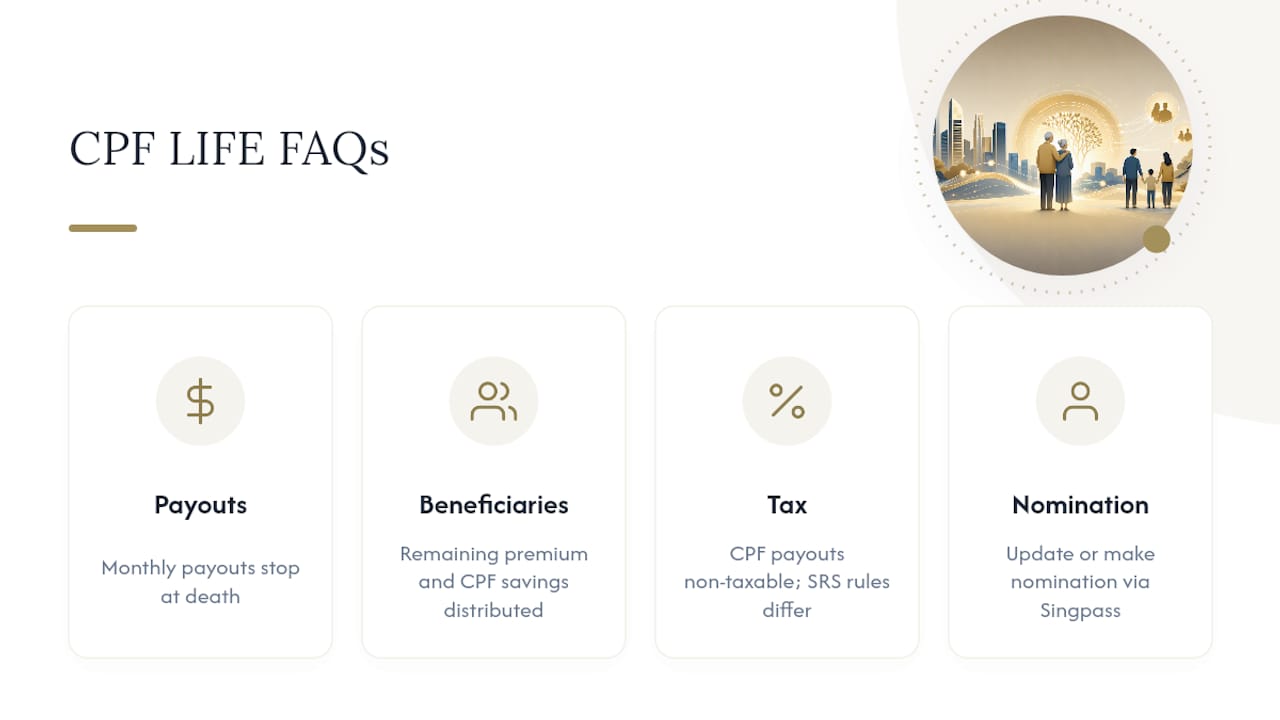
Does the CPF LIFE payout continue after the member’s death? No. Monthly CPF LIFE payouts stop upon death. What continues is the distribution of any remaining premium balance and CPF account savings to nominees, subject to the plan exceptions described above.
What happens to CPF LIFE after death if there is no nominee?
Is there tax on CPF LIFE death benefits received by beneficiaries? CPF payouts to nominees are not treated as taxable income. SRS withdrawals triggered by death follow separate tax rules, with up to $400,000 potentially exempt.
How is the CPF LIFE premium balance calculated after death? It’s the Retirement Account amount used to purchase the annuity minus whatever monthly payouts the member already received before passing away.
Can I update my CPF nomination online? Yes. You can make or update a CPF nomination through Singpass without visiting an office, and it’s the fastest way to keep your estate plan aligned with your actual wishes.
This article is general information, not a substitute for advice from a qualified financial advisor. Consult a qualified financial professional about your own circumstances before acting on anything here.
Sources
Recommended
Comments