


Corporate Executor Fees in Singapore: What They Cost


Professional executors in Singapore typically charge a one-time appointment fee of about S$4,000 to S$20,000, plus an administration fee often set around 1% of the gross estate value, according to figures reported by local estate-planning publishers. Some providers instead bill hourly or in stages as estate work progresses. Legal fees for handling the probate application sit separately from executor fees, and both are almost always paid out of the estate, not from the executor’s own pocket.
Appointment/retainer fee: typically varies by provider and estate size
Administration fee: often around 1% of gross estate, or a flat/staged fee for simpler estates
Non-contentious probate legal fees vary depending on case complexity
A quick gut-check: on a S$2 million estate, a 1% administration charge alone works out to S$20,000, before appointment fees or legal costs. That is the number worth asking about before you sign anything.
Key Takeaways
Corporate executor fees in Singapore typically combine a one-time appointment retainer with a percentage-based or staged administration charge, both paid from estate assets.
Point | Details |
Appointment fee range | Expect roughly S$4,000 to S$20,000 for a one-time nomination retainer, varying by estate size. |
Administration fee model | Around 1% of gross estate is common, alongside flat or staged hourly alternatives for simpler cases. |
Probate legal costs | Non-contentious matters run S$2,000 to S$6,500; contentious cases can exceed S$40,000. |
Statutory alternative exists | The Public Trustee (Fees) Rules set fixed statutory bands as a lower-cost, standardized option. |
Elite Legacy Planning approach | Structures fees in written, milestone-based stages tied to estate complexity, not a flat guess upfront. |
Where to Verify These Figures
Public Trustee (Fees) Rules — the statutory fee bands
SingaporeLegalAdvice’s probate fee guide — legal fee ranges
Who Pays Probate Legal Fees in Singapore — payment responsibility
Property tax and rental income in Singapore — relevant if the estate includes rental property
Get a Clear Fee Estimate for Your Estate
Reading fee ranges only gets you so far. Every estate carries its own mix of property, overseas assets, and family dynamics that changes the real number. Elitelegacyplanning works through your specific situation, will drafting, trust structuring, or corporate executorship, and lays out a written fee schedule before you commit to anything.

If you’re drafting or updating a will and want to name a corporate executor with clear, staged fees instead of a vague estimate, start with a comprehensive will consultation. Ready to move forward now? Book a consultation online or request a fee estimate through the payment page to get the specifics for your estate in writing.
Table of Contents
Corporate Executor Fees in Singapore: The Full Breakdown
Three separate types of costs usually apply when a corporate or professional executor administers a Singapore estate, and confusing them is the single most common reason families feel blindsided by a final bill.
The first is the appointment or nomination fee, a one-time charge for naming the firm as executor in your will. This can vary depending on estate size and complexity, from modest to higher ranges for larger or multi-asset estates, per the same estate-planning industry data. Some providers advertise a much smaller nominal retainer, sometimes in the S$500 to S$1,800 range, and bill the bulk of their charges later as an operational administration fee once the estate is actually being wound up. Read the fine print carefully. A low headline number often just shifts cost downstream.
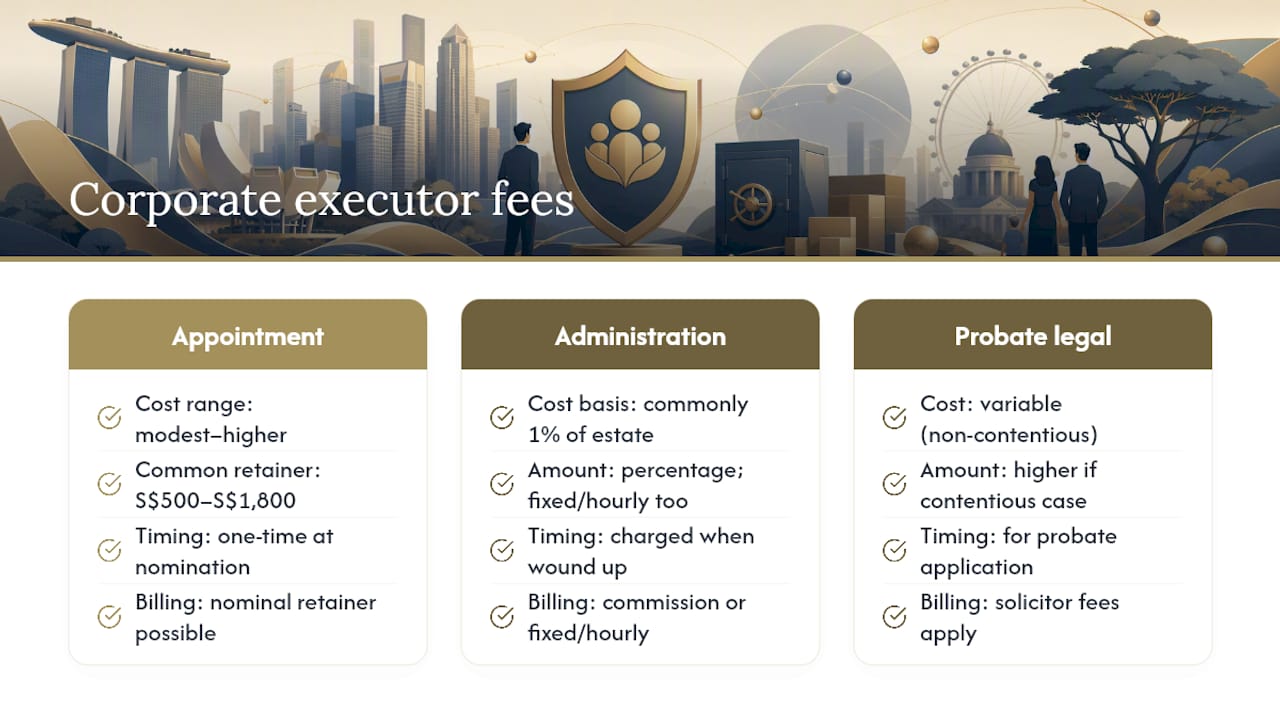
The second bucket is the administration or commission fee, charged once the executor actually gets to work: collecting assets, settling debts, filing tax clearances, and distributing to beneficiaries. A 1% of gross estate figure is commonly cited, though fixed-fee and hourly models exist too, especially for smaller or simpler estates where a percentage fee would feel disproportionate.
The third bucket is legal fees for the probate application itself, usually handled by a solicitor rather than the executor. Non-contentious probate legal fees can vary; contentious probate cases may incur substantially higher legal costs, according to SingaporeLegalAdvice’s fee guide.
Several factors reliably push costs toward the top of these ranges: assets held overseas, property with unclear or disputed title, minor beneficiaries requiring court supervision of their share, or any hint of a family dispute. If your estate has more than one of these, budget for the higher end from the start.
What Are the Public Trustee (Fees) Rules?
Singapore’s Public Trustee (Fees) Rules set statutory percentage bands the Public Trustee can charge when acting as executor or trustee, scaled against the value of the estate, with defined upper and lower limits and some discretion built into how they’re applied. It’s a government-run, standardized alternative to hiring a private firm.
Private corporate executors don’t operate under those same statutory bands. They set their own appointment retainers and administration percentages, which means pricing varies more between firms, but it also buys you something the statutory model doesn’t offer: negotiable service levels, dedicated relationship management, and faster turnaround on complex, cross-border estates.
The Public Trustee suits smaller, uncomplicated estates where standardized handling is perfectly adequate.
Private corporate executors suit HNW estates, overseas assets, business interests, or families who want ongoing advisory continuity, not just probate processing.
Pro Tip: Ask any private provider to show you, in writing, how their total charges would compare to the Public Trustee’s statutory bands for an estate your size. A firm confident in its value will do this without hesitation.
How Are Executor Fees Calculated and Paid?
Here’s how the math actually plays out across three estate types:
Small, simple estate (a flat fee). A S$500,000 estate with one property and a bank account might attract a flat administration fee of S$5,000 to S$8,000, agreed upfront regardless of hours worked.
Mid-size estate (percentage-based). A S$3 million estate charged at 1% administration generates a S$30,000 fee, on top of a S$10,000 to S$15,000 appointment retainer, roughly S$40,000 to S$45,000 total before legal costs.
Complex, cross-border estate (staged hourly billing). An estate with property in three countries might bill in phases, probate application, asset collection, tax clearance, distribution, with each phase invoiced separately as work completes.
Disbursements (court filing fees, valuation costs, statutory declarations) get charged back to the estate on top of the core fee, and executors typically front these costs and reimburse themselves from estate assets rather than paying personally, as probate practice guidance confirms.
One wrinkle worth knowing: Singapore courts retain discretion to allow an executor’s commission of up to 5% of assets collected, even where a fee wasn’t pre-agreed. A will can specify commission directly, though doing so can create a conflict if the executor is also a beneficiary.
When Does a Corporate Executor Make Sense?
Corporate executors earn their fee in exactly the situations individual family members tend to struggle with: estates spanning multiple countries, no relative both willing and equipped to handle months of paperwork, or a family history that suggests disputes are likely once money is on the table. Industry analysis on corporate executor value points to continuity and professional neutrality as the core benefits, an executor who won’t retire, emigrate, or take sides.

The trade-off is straightforward: you pay more than you would asking a sibling to do it for free, but you buy predictability and a professional standard of care.
Before appointing anyone, ask providers directly:
Can you show me a full written fee schedule, not just the headline retainer?
How are disbursements itemized and billed?
What happens if a beneficiary disputes the administration?
What’s your typical timeline from grant of probate to final distribution?
Can you provide references from comparable estates?
Pro Tip: Request the fee schedule in writing before you sign the will, not after. Verbal estimates have a way of growing once the estate is already locked in.
How Elite Legacy Planning Structures Executor Fees
Elitelegacyplanning builds executor fee proposals around estate complexity rather than a one-size-fits-all percentage, so clients see staged billing tied to actual milestones: appointment, asset collection, tax clearance, distribution. That structure pairs naturally with the firm’s comprehensive will drafting and trust consultation and lifetime advisory services, since executorship rarely stands alone for HNW families managing ongoing trust structures.
Fee schedules provided in writing before engagement
Billing aligned to estate milestones, not a flat surprise invoice
Continuity through a private trust company structure where family succession spans generations
Clients considering a corporate executor deserve to see, in advance, exactly what triggers each charge and what happens if the estate turns out more complicated than expected.
What I’d Tell a Family Weighing This Decision
Fee transparency matters more than the headline number. I’ve seen estates where a lower upfront retainer masked vague administration billing that dragged on for eighteen months, while a slightly higher, clearly staged fee schedule closed out in six. Insist on a written schedule before you sign, and weigh continuity, not just cost, when the estate involves overseas property or multiple beneficiaries. In one case I’m aware of, an executor who proactively flagged a property title issue in month one saved the estate roughly a year of court delays that a passive administrator would have let slide. That difference in engagement is what you’re actually paying for.
Frequently Asked Questions
How much are executor fees in Singapore? Professional executor fees typically include an appointment retainer of S$4,000 to S$20,000 plus an administration fee often around 1% of gross estate value, though flat and hourly models exist for simpler estates.
Who pays executor fees, the estate or the executor personally? The estate pays. Executors and their firms generally don’t cover fees or disbursements out of pocket, though they may advance certain costs and reimburse themselves once estate assets are accessible.
Can I negotiate corporate executor fees? Yes. Ask for a written fee schedule before signing, compare the proposal against Public Trustee statutory bands for context, and query how disbursements and staged billing work before committing.
What’s the difference between executor fees and probate legal fees? Executor fees cover appointment and estate administration. Probate legal fees cover the court application process itself, usually handled by a separate solicitor, and run S$2,000 to S$6,500 for non-contentious cases.
When should I choose a corporate executor over a family member? Consider a corporate executor when the estate spans multiple countries, no family member is willing or equipped to manage months of administration, or there’s meaningful risk of disputes among beneficiaries.
Sources
Recommended
Comments