


Asset Inventory Estate Planning: Build a Probate-Ready List


An asset inventory is a single master list of everything you own and owe, complete with ownership details, account identifiers, and proof of value. Start one today: open a spreadsheet, list your top ten holdings (bank accounts, real estate, retirement plans), attach your most recent statements, and schedule an annual review. That one document can save your executor months of searching and protect your estate from costly probate delays.
Your immediate next steps:
Create a one-page master table with at least your top ten assets
Pull account statements from the last three years and save them in one folder
Record ownership/titling, account number (last four digits), and institution contact for each item
Note the fair market value (FMV) as of today and flag which items will need a formal appraisal
Schedule an annual review date on your calendar now
Pro Tip: Include court-relevant fields from day one: FMV as of date of death, ownership/titling, and account identifiers (last four digits). Courts expect these fields, and building them in early means no scrambling later.
Key Takeaways
A complete, court-ready asset inventory is the single document that determines how fast and cleanly an estate settles after death.
Point | Details |
Start with a master table | List your top ten assets with ownership, account identifiers, and FMV before anything else. |
Use court-aligned fields | Capture the fields courts expect: titling, last-four-digit identifiers, FMV, and evidence file names. |
Update after every life event | Review annually and update after marriage, divorce, major purchases, or beneficiary changes. |
File within the court deadline | Most states require an executor to file within 60–90 days; Colorado’s JDF941 sets a three-month window. |
Elitelegacyplanning | Offers will drafting, trust setup, and executorship support to produce probate-ready inventory documentation. |
Table of Contents
Why asset inventory estate planning matters for probate, taxes, and executors
A well-built estate asset inventory does three things at once: it cuts probate delays, supports date-of-death valuations for estate tax purposes, and shields your executor from personal liability. Without one, executors spend weeks chasing statements, calling institutions, and reconstructing ownership chains that you could have documented in an afternoon.
Probate court requirements vary by jurisdiction; disclosure thresholds and documentation formats differ by county and state, so what satisfies a court in Texas may fall short in Massachusetts. Most states give executors a 60–90 day window to file an inventory after appointment. Colorado’s JDF941 form, for example, requires a personal representative to file within about three months, and organizes assets into schedules covering real estate, securities, checking/savings, life insurance, retirement accounts, vehicles, and other assets, plus liens and encumbrances.
SmartAsset notes that some assets, including those held in trust or with named beneficiaries, may bypass probate entirely. Knowing which assets fall into that category before death is the difference between a clean transfer and a contested estate.
Why the stakes are higher than most families realize:
Executors who cannot produce a timely, accurate inventory can face court sanctions or surcharge liability
Missing assets discovered after distribution can reopen probate and trigger additional legal fees
Date-of-death FMV errors on the inventory directly affect estate tax calculations
Complete checklist: what to include in your estate inventory
Charles Schwab’s Asset Inventory Worksheet recommends assembling key documents and account details as the first step in any estate plan. The categories below align with what courts and the IRS expect.
Asset categories to capture:
Real estate: address, legal description, deed location, mortgage lender, estimated FMV
Bank accounts: institution name, account number (last four digits), account type, current balance
Investment/brokerage accounts: institution, account number (last four digits), holdings summary, FMV
Retirement plans (401k, IRA, pension): plan administrator, account number (last four digits), named beneficiary, FMV
Life insurance: insurer, policy number (last four digits), death benefit, cash value, named beneficiary
Business interests: entity name, ownership percentage, valuation method, operating agreement location
Vehicles: make/model/year, VIN or title number, lender if financed, estimated value
Personal property: jewelry, art, collectibles over a threshold value, with appraisal references
Digital assets: online accounts, cryptocurrency wallets, domain names, with access instructions
Intellectual property: patents, royalties, copyrights, licensing agreements
Liabilities: mortgages, car loans, credit card balances, personal loans, liens
Nolo’s property worksheet adds a useful reminder: include digital accounts and access instructions, and exclude low-value household goods and non-transferable licenses that carry no estate value.
For each item, capture these fields:
Field | What to Record |
Owner/title | How the asset is legally titled (sole, joint, trust) |
Location | Physical address or institution name |
Account/ID | Last four digits of account, policy, or VIN |
Institution contact | Phone number and email for the holding institution |
Date-of-death FMV | Current estimated value or appraisal method |
Evidence file | File name or folder path where proof is stored |
How to value assets and which documents to collect
Date-of-death fair market value is the legal standard for probate and estate tax. Some assets are self-valuing: a bank account balance on the date of death is its FMV. Others require a qualified appraisal.
Assets that need a formal appraisal:
Real estate (licensed appraiser)
Closely held business interests (certified business valuator)
Fine art, jewelry, and collectibles (certified personal property appraiser)
Non-publicly traded securities
For life insurance, record both the cash value and the death benefit. They are different numbers and serve different purposes: the cash value appears on the inventory as an asset; the death benefit passes directly to the named beneficiary and typically bypasses probate.
LegalClarity’s template guidance makes the point plainly: the format matters less than including fields that let a court or insurer assign value without guessing. Name every appraisal report with a consistent convention (e.g., “2026-HomeAppraisal-123MainSt.pdf”) and store it alongside the inventory.
Documents to collect for each category:
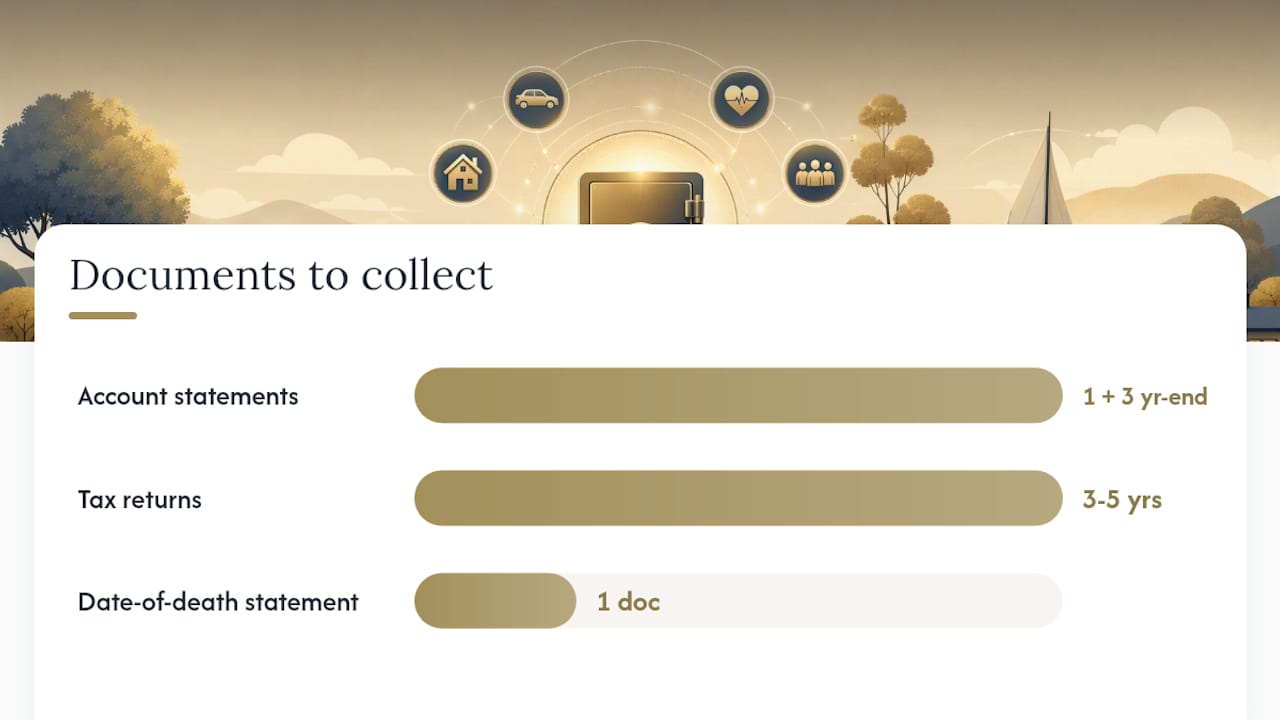
Account statements (most recent, plus year-end for the prior three years)
Property deeds and mortgage statements
Vehicle titles
Insurance policy declarations pages
Retirement plan beneficiary designation forms
Recent federal and state tax returns (last three to five years)
Pro Tip: Request a “date-of-death statement” directly from each financial institution after a death occurs. Most institutions will issue one; it is the cleanest evidence for probate and tax purposes.
Practical sources for locating accounts and hidden assets
Executors routinely discover assets the decedent never mentioned. A structured search order saves weeks.
Start with paper trails:
Federal and state tax returns (last three to five years) reveal interest income, dividend income, rental income, and business distributions
Bank and brokerage statements show recurring transfers that point to accounts not otherwise listed
Credit reports (pull from AnnualCreditReport.com) surface open credit lines and lenders
County property records and DMV title searches confirm real estate and vehicle ownership
Use registries and public databases:
The Missingmoney database and state unclaimed property offices hold billions in forgotten accounts
The NAIC Life Insurance Policy Locator helps beneficiaries search for unknown life insurance policies
The SSA and pension benefit registries can confirm retirement entitlements
Pro Tip: Ask the decedent’s accountant and financial advisor for a complete list of accounts they were aware of. They often know about holdings the family does not.
How to organize, secure, and give access to the inventory
ExecutorChecklists recommends a three-layer system: a master asset table, a document/request tracker, and a transaction/expense log. Together, these three layers convert a static list into a defensible administration system that prevents the “missing document loop” executors dread.
Storage protocol:
Encrypted cloud folder: use a service with two-factor authentication; apply a consistent file-naming convention (Year-Category-Description)
Physical locked copy: a fireproof safe holds a printed inventory and key documents; update it every time the digital version changes
Access instruction sheet: a one-page document telling your executor exactly where to find the cloud folder, the safe combination, and the password manager
Access control:
Your estate attorney and named executor get full access
Trustees or co-executors get view-only access to relevant schedules
Use a password manager (1Password or Bitwarden) to store institution login credentials; share access via the manager’s emergency-access feature, not by emailing passwords
Pro Tip: Limit personally identifiable data in any file you share digitally. Use account last-four-digits rather than full account numbers in shared documents, and keep full numbers only in the encrypted master.
A fillable asset inventory template you can use today
The column structure below mirrors the schedules in the Colorado JDF941 court form and the fields recommended by LegalClarity, making it straightforward to transfer data to a court filing.
One-page quick checklist for immediate action:
Primary residence (deed, mortgage statement)
Checking and savings accounts (all institutions)
Brokerage/investment accounts
401(k) and IRA accounts with beneficiary forms
Life insurance policies (death benefit and cash value)
Vehicles (title and lender if financed)
Business ownership documents
Digital assets and cryptocurrency
Outstanding loans and credit lines
Safe deposit box contents and location
The Charles Schwab Asset Inventory Worksheet and the LegalClarity template are both downloadable starting points. Export your completed spreadsheet as a PDF before sharing with your attorney or filing with a court.
When and how to update your inventory
Recommended update schedule:
Annual review: every January, verify balances, confirm beneficiary designations, and update FMV estimates
After marriage or divorce: retitle assets, update beneficiary designations, and add or remove a spouse from the inventory
After a major purchase or sale: add new real estate, vehicles, or business interests; remove sold assets
After an inheritance: document new assets immediately, including any associated liabilities
After a beneficiary change: update the inventory and confirm the change is reflected at the institution
Date every version of the inventory and keep a change log with a brief note explaining what changed and why. A versioned filename (e.g., “AssetInventory-v4-Jan2026.xlsx”) makes it easy to reconstruct the estate’s position at any point in time.
For high-net-worth holdings, a professional review every three to five years catches issues that routine self-review misses: assets that should be retitled into a living trust but were not, outdated appraisals, or business interests whose valuation method has changed.
State/probate compliance and the executor’s immediate checklist

The executor’s job starts the moment they are appointed, and the inventory is the first deliverable courts expect.
Executor timeline:
Week one: secure the decedent’s home and records; locate the will and any trust documents
Within 30 days: open an estate bank account; notify financial institutions and government agencies
Within 60–90 days: prepare and file the inventory with the probate court (check your state’s exact deadline)
Ongoing: file supplemental inventories if new assets surface after the initial filing
Colorado’s JDF941 requires filing within approximately three months of appointment and lists specific schedules for each asset class, plus a total net value summary. Your state’s form may differ, which is why checking local probate court rules before filing is non-negotiable.
Who to contact immediately:
Estate planning attorney (for probate filing and will interpretation)
Probate counsel (if the estate is contested or complex)
Certified appraiser (for real estate, business interests, or collectibles)
Tax advisor (for estate and income tax filings)
Financial institution (to open an estate account and freeze decedent accounts)
Court-ready filings require FMV evidence for every appraisal-required item and a complete liabilities schedule. Missing either one delays distribution and can expose the executor to surcharge claims.
What most families get wrong about estate inventories
Most people treat the inventory as a one-time task. They build it once, file it away, and forget it exists until someone dies. By then, account numbers have changed, assets have been sold, and the document is more misleading than helpful.
The three-layer executor system described by ExecutorChecklists works precisely because it treats the inventory as a living document, not a snapshot. A master table alone is not enough. The document request tracker tells you what you have asked for and what is still outstanding. The expense log creates the audit trail that protects the executor from accusations of mismanagement. Together, they make the inventory defensible, not just descriptive.
There is also a tendency to over-include. Term life policies with no cash value, non-transferable software licenses, and ordinary household goods add noise without adding value. A cleaner, shorter inventory with strong evidence for each item is more useful to a court than an exhaustive list padded with items that carry no estate value.
Elitelegacyplanning can help you build a probate-ready inventory
Most families know they need an estate plan. Fewer realize the inventory is what makes the rest of it work. Without accurate asset documentation, even a well-drafted will can stall in probate for months.

Elitelegacyplanning offers comprehensive will drafting, trust consultations, living trust setup, private trust company services, and corporate executorship support, all built around producing documentation that holds up in court. The firm works with local counsel to produce U.S.-probate-ready records and can guide you through the exact fields, valuations, and filing formats your state requires. If your estate includes real estate, business interests, or retirement accounts that should be retitled into a trust, that conversation starts with a proper inventory review. Book a consultation to get your inventory audit started.
Sources
The resources below are the most court-relevant starting points referenced in this guide.
This article is general information, not a substitute for advice from a qualified financial advisor. Consult a qualified financial professional about your own circumstances before acting on anything here.
Recommended
Comments