


Charitable Bequests in Singapore: How to Leave a Gift in Your Will


A charitable bequest is a gift to a charity made through your will, and it only works if the will names the right legal entity, the gift is the right type for your family situation, and the assets you mean to give actually pass through the will. In Singapore, that last point catches many people out, because CPF savings, insurance payouts and SRS balances follow their own rules. If you want your generosity to land exactly as you intend, with your family provided for first, the will needs to be drafted as part of a wider estate plan. That is the work we do at Elite Legacy Planning.
TL;DR
A bequest is a gift of cash, stocks or other property given through a will. You make it by signing a new will or amending an existing one.
Choose the gift type deliberately: a fixed sum or percentage, a specific asset, the residue, or a contingent gift that applies only if your named beneficiaries die before you.
Name the charity by its exact legal name and UEN (Unique Entity Number), never by a general description such as “the Church” or “the hospital”.
CPF, insurance and SRS savings do not automatically follow your will, so coordinate nominations with your bequest.
Estate duty has been removed in Singapore for deaths on or after 15 February 2008, but the 2.5 times tax deduction applies to lifetime donations to approved charities, not to your estate.
Table of Contents
What a charitable bequest is, and why it suits legacy planning
CARE Singapore describes a bequest as a gift of cash, stocks or other property given through a will. It takes effect only on death, which is its main attraction for families with significant assets: you keep full use and control of your wealth while you live, and the charity receives its gift only after your family’s needs have been met.
That sequencing matters for parents and business owners. A lifetime gift reduces what you hold today. A bequest does not touch your income, your liquidity or your ability to fund your children’s education, and you can change it at any time before death by updating your will.
Because the gift is made by will, it is only as reliable as the will itself. Charities such as the Singapore Children’s Society note that while a person can write their own will, professional lawyers are strongly advised to avoid errors that could invalidate the entire will. For readers with property, business interests or a blended family, that advice is worth following.
The four kinds of bequest
CARE Singapore identifies four major types. Each answers a different planning question.
Type | What it is | Best when |
General bequest | A specific sum of cash or a percentage of your estate, such as $500,000 or 50% | You want certainty about the amount, or a share that grows with your estate |
Special bequest | A specified asset such as real estate, shares, jewelry or paintings | A particular asset has meaning to you or to the cause |
Residual bequest | What remains after general and special bequests, debts and expenses are paid | You want your family provided for first and the charity to receive the balance |
Contingent bequest | The charity is second in line if your named beneficiaries die before you | You want a fallback so your estate never passes by default rules |
The descriptions come from CARE Singapore’s bequest page. Caritas Singapore adds that legacy gifts are not limited to cash and can include real estate, stocks and shares, jewelry and paintings.
Which one fits whom
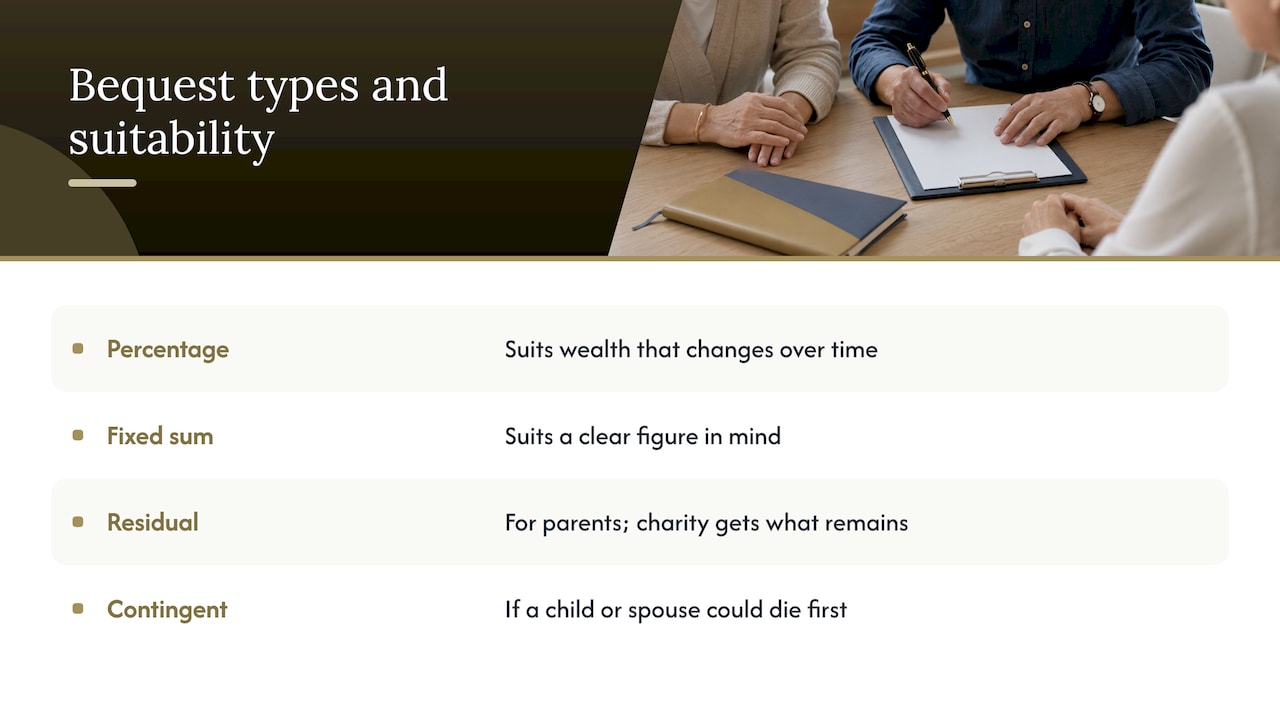
A percentage of the estate is common for people whose wealth will change over time. A fixed sum suits someone with a clear figure in mind. A residual gift is the most conservative for a parent: every family gift is paid first, and the charity takes what is left. A contingent gift is a quiet safeguard for families where a child or spouse could predecease you.
When the gift is a specific asset, think about what happens if you sell it before you die. A will can be drafted so the gift does not simply fail, but that is a drafting point to settle with your adviser, not to leave to chance.
Naming the charity correctly
This is where well-meant bequests go wrong. A will must identify who receives the gift. Charities publish model wording for exactly this reason.
Caritas Singapore’s template identifies the charity by its legal name, UEN and registered office, and specifies all or part of the estate residue or a sum, subject to funeral and testamentary expenses and just debts. TOUCH Community Services gives a similar clause naming the charity, its registered charity UEN and its registered office. The Singapore Heart Foundation provides a model clause for a sum for its general purposes, and the Catholic Foundation offers options for a percentage of residue, a cash sum, specific property by address, or a life insurance policy number.
A few practical points follow from these templates:
Use the exact legal name and UEN. The Catholic Lawyers Guild makes the point with a common example: a general reference to “the Church” is not good enough, and the specific entity must be named with its UEN. The same logic applies to any cause with several related entities, such as a parent body, a foundation and a local branch.
Say whether the gift is for general purposes. Several charities ask for gifts “for its general purposes”, which gives them flexibility to use the money where it is needed most.
Consider conditions carefully. The same Guild article notes that conditions can be attached, for example cash for faith formation or for the financially poor. A condition that a charity cannot meet can create problems, so clear wording matters.
Confirm the charity’s registered details when you draft, and again when you review. Organizations merge, rename and move offices.
Some charities cannot take earmarked gifts
Caritas Singapore, an umbrella body for over 20 Catholic charities, cannot accept legacy gifts made to specific causes or member charities. It allocates grants annually based on funding gaps, priorities and measurable impact. If you want to support one member charity, you would name that charity directly instead. This is a good example of why you read the recipient’s own legacy guidance before the will is finalized.
Checks before you sign
Do not use the charity as a witness
The Singapore Children’s Society states that a beneficiary charity cannot be a witness to the will or CPF nomination form due to conflict of interest. The STEP Singapore chapter’s summary adds that a gift to any person who attests the will, or that person’s spouse, is null and void. Choose independent witnesses who are not beneficiaries or married to one.
Muslim testators
The same STEP summary states that a Muslim testator can only will not more than one-third of the net estate, and only in favor of persons not otherwise entitled to share under Faraid. A Muslim reader planning a charitable gift should have it drafted with that limit in mind.
Overseas assets
If you own assets abroad, the Singapore Children’s Society notes that they can be listed in the will, with the liquidated funds bequeathed subject to the taxes, stamp duties and fees of the country where the asset is situated. For a high-net-worth family, foreign property or accounts are usually where a bequest quietly shrinks or stalls.
Validity of the will itself
A bequest is only as sound as the will. For a plain-language walk through execution requirements, see our guide to a valid will in Singapore. If your estate includes company shares, a business, or several property holdings, a standard will can fall short and the charitable clause needs to sit within a structure that works.
CPF, insurance and SRS: assets that skip your will
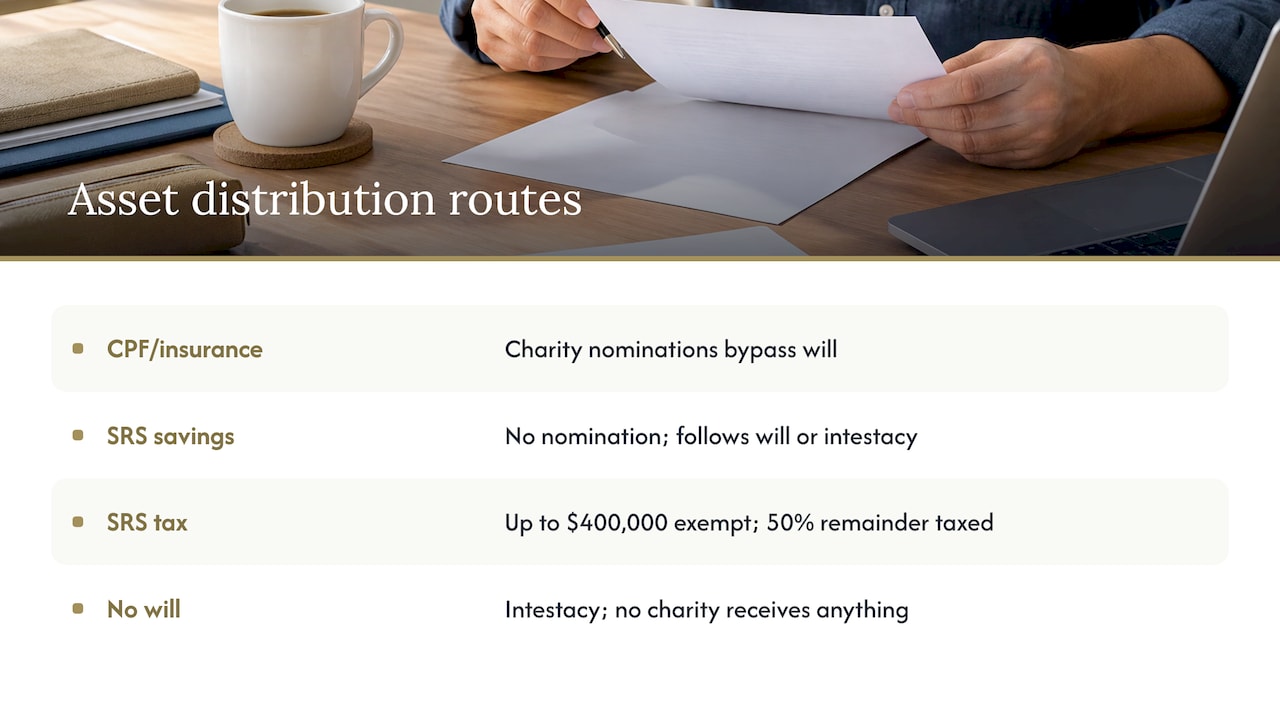
Many Singapore estates have a large part of their value outside the will. This matters for charitable giving in two directions: you may want to use these assets for a gift, or you may need to prevent them from surprising your executor.
TOUCH notes that charities can also be nominated in CPF and insurance policies. The Singapore Heart Foundation even publishes a CPF nomination entry with its UEN and address. Because these nominations operate separately from the will, a charity named in the will will not automatically receive them, and a charity named in a nomination is not covered by the will’s wording. Keep both documents aligned. Our article on common estate mistakes in Singapore covers how nominations and wills drift apart over time.
SRS (Supplementary Retirement Scheme) savings work differently again. IRAS states that SRS savings cannot be nominated to a beneficiary: on death the balance is deemed withdrawn, forms part of the estate and is distributed under the will or intestacy law. The same page gives a tax exemption of up to $400,000 for withdrawals on death, with 50% of the remaining amount subject to income tax. If you hold SRS money and want charity to benefit, your will is where that instruction has to be written.
Without a will at all, the Singapore Children’s Society reminds readers that the estate is distributed under the Intestate Succession Act, and no charity receives anything.
Tax: what applies to bequests and to lifetime gifts
Two separate questions are often mixed up.
Estate duty. IRAS states that estate duty has been removed for deaths on or after 15 February 2008. Earlier rules that exempted bequests to the Government or approved charities no longer matter for current deaths. So there is no estate duty bill for a charitable bequest to offset. Our piece on protecting assets beyond “no inheritance tax” explains where the real planning issues now sit.
Income tax deductions. The deduction is for gifts made while you are alive. IRAS says donors can claim up to 2.5 times the qualifying donation amount when giving to approved Institutions of Public Character (IPCs) or the Singapore Government, and that donations to charities without IPC status are not tax deductible. Only an IPC can issue tax deductible receipts, and the Charity Portal lets you check IPC status. IRAS’s e-Tax Guide adds that a qualifying donation is a free-will gift where the giver relinquishes all rights, control and ownership.
For a high-net-worth reader, the sensible reading is to treat the two as complementary. A bequest provides for the long term, after your family is secure. A lifetime gift to an IPC can be timed to your income tax position. The right balance depends on your income, your assets and your family, so work it through with an adviser before committing.
A worked illustration
Take a hypothetical parent with two children, a home, an investment portfolio and an insurance policy. Their wishes: both children provided for equally, a gift to a charity of their choice.
The will leaves the home and portfolio to the children in equal shares, after expenses and debts.
A residual or percentage clause, for example 5% of the estate, names the charity by its legal name and UEN.
A contingent clause provides that if one child predeceases, that share passes to the grandchildren, with the charity as the final fallback.
The insurance nomination and CPF nomination are checked so the family assets follow the same intention.
The witnesses are two independent adults who receive nothing under the will.
This is an illustration, not advice for any particular estate. But it shows how a bequest is one clause among several, and how its reliability depends on the rest being right.
What the executor does with your gift
The executor is the person you appoint to carry out the will. ICLG’s 2026 Singapore report states that an executor’s authority derives from the will, with the role of calling in estate assets, paying debts and expenses, then distributing the estate as a trustee. The Singapore Hospice Council guide adds that the executor owes fiduciary duties to the beneficiaries and may be sued by them if he or she fails to perform those duties.
Practical consequences for a charitable gift:
Debts and expenses are paid before a residual gift, so the charity receives what is left.
A gift of a specific asset needs an executor who can transfer shares, property or valuables properly.
A family member as executor may find a large, complex estate demanding while grieving. A corporate executor is a professional option, and it is one of the services we provide.
If you have a foreign element, ICLG notes that under section 5 of the Wills Act 1838 a will is formally valid if it conforms to the law of the place of execution, or of your domicile, habitual residence or nationality. Expats and families with overseas ties should have this reviewed.
How we help with a charitable bequest
Our Comprehensive Will (also called a Testamentary Trust) is priced at $1,250 to $1,900 one-off. It is where a charitable clause belongs, drafted alongside provision for your family. For assets outside the will, our Insurance & CPF Trust, set up via nomination, addresses how those assets pass. Business owners can look at the Business Value Protection Trust (a Buy-Sell Agreement), from $8,000 one-off, and our Schedule of Assets, Estate Liquidity Analysis & Asset Nomination service starts from $500 one-off, which gives your executor a clear picture of what you own and what the estate can pay. You can see the full list on our services page.
Our perspective
Most people who want to give to charity think of it as a single line in a will. In practice it is a decision about order: who is provided for first, what happens if plans change, and which assets carry the gift. We start with the family. Once your spouse, children and any dependants are secure, a charitable gift becomes simple to place: a percentage, a residue or a contingent fallback, each named with the charity’s exact legal details. What we focus on is the surrounding structure. Wills, living trusts, nominations and, for some families, a private trust company all work together. Our approach is personal and our consultations are accessible, because a legacy plan should be reviewed as your life changes, not signed once and forgotten. If you are thinking about leaving a gift, bring your list of assets and the charities you have in mind, and we will map out where each part of your wishes belongs. Joseph
FAQ
Can I leave a bequest to any charity in Singapore?
You can name any organization that is legally able to receive a gift, but you should name it by its exact legal name and UEN. Whether the charity is an approved IPC matters for lifetime tax deductions, so check its status on the Charity Portal. Some umbrella bodies cannot accept gifts earmarked for a member charity, so read the recipient’s legacy guidance first.
Will a charitable bequest reduce estate duty?
No, because Singapore removed estate duty for deaths on or after 15 February 2008. The 2.5 times tax deduction applies to qualifying donations to approved IPCs made while you are alive, not to gifts through your will.
Can I add a charity to my existing will?
Yes. TOUCH notes that a codicil, a formal amendment to a will, can add the gift to an existing will, and Caritas says a solicitor can help draft a new will instead. For a large or complex estate, a fresh will is often cleaner than several codicils.
Does my will cover my CPF and insurance?
Not automatically. These are usually passed through separate nominations, so a charity named in your will would not receive them unless the nominations say so. SRS balances do form part of the estate and follow the will, according to IRAS.
Sources
Recommended
Comments