


Blended Family Estate Planning in Singapore: A Guide


If you have a second spouse, children from an earlier marriage or stepchildren, Singapore’s default inheritance rules will not follow your intentions. They follow a fixed formula, and stepchildren are not in it. A written will, correct CPF nominations and, where the assets justify it, a trust are what make the plan yours. Elite Legacy Planning drafts customized wills and sets up trusts for affluent Singapore families, and the sections below show what each part of the plan has to do.
TL;DR
Without a valid will, a non-Muslim estate is split by statute: the spouse takes half and the children share the other half. Stepchildren receive nothing unless adopted.
Marriage generally revokes an earlier will, so a remarriage means a new will drafted in contemplation of that marriage.
CPF savings follow your nomination, not your will. Check it every time the family changes.
Homes depend on how title is held: joint ownership passes to the survivor, regardless of the will.
A trust can hold assets for minors or for a second spouse while protecting the children’s share.
Table of Contents
What the law does if you leave no will
The government’s My Legacy page confirms there is no legal requirement to make a will. Without one, your assets are distributed under the Intestate Succession Act. “Intestate” simply means dying without a valid will.
For a non-Muslim with a surviving spouse and children, section 7 of the Act gives half to the spouse and divides the other half among the children. The Act’s definition of child covers legitimate children and those adopted under written law in Singapore, Malaysia or Brunei. A stepchild you never formally adopted is not a child for this purpose. The Singapore Judiciary lists the same shares.
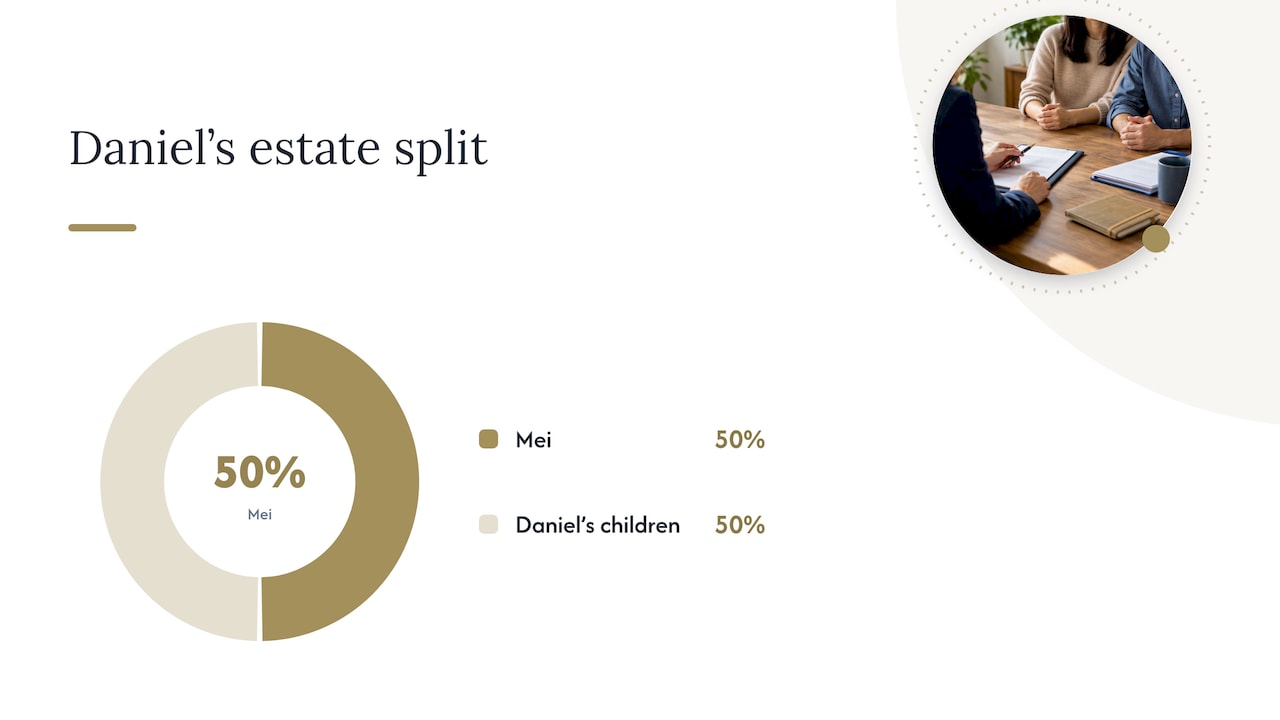
A worked example: Daniel remarries and dies without a will. He leaves his second wife, Mei, and two children from his first marriage. Mei receives 50% of the estate. The two children share the other 50%. Mei’s own children from her first marriage receive nothing from Daniel’s estate, and if Mei later dies, her share goes by her own arrangements, which may leave Daniel’s children with nothing from the half she inherited.
That last point is the core blended family risk: whatever passes to a second spouse outright can be redirected to that spouse’s own family afterwards.
Remarriage and your existing will
Section 13 of the Wills Act 1838 provides that marriage revokes a will, unless the will was expressed to be made in contemplation of that marriage. MoneySense likewise notes that a will is nullified when the testator marries or remarries.
Many people with a will from their first marriage assume it still stands. It may not. If you are about to remarry, have the new will drafted with that marriage expressly in mind, then review it again when children are born, adopted or come of age.
Making the will valid and workable
A will must be in writing and signed in front of two witnesses present together, who then sign in your presence, as section 6 of the Wills Act requires. A gift to a witness or the witness’s spouse is void under section 10, so a spouse or child should never witness. For the age and capacity requirements, MoneySense says the testator must be over 21 and of sound mind. Our guide to the three steps to a valid will goes through the formalities in more detail.
In a blended family, the harder work is in the content:
Name every person you intend to benefit. Stepchildren must be named. “My children” will not reach them.
Decide whether the second spouse receives assets outright or a right to use or income from them. Outright gifts can leave the family line. A testamentary trust, which takes effect after death under the will, can give a spouse income or residence while preserving capital for the children.
Choose executors who can act fairly. If a spouse and an adult child from the first marriage distrust each other, consider an impartial corporate executor. If beneficiaries are under 21, MoneySense notes two executors or trustees are needed to act for them.
Name guardians and trustees for minor children. Decide who manages money for them, separate from who raises them.
Our Comprehensive Will, also called a Testamentary Trust, is priced at $1,250 to $1,900 one-off and is built for exactly this kind of layered instruction.
Can you disinherit anyone?
Singapore gives most people wide testamentary freedom. ICLG’s 2026 Singapore report says it is unrestricted except for Muslims domiciled in Singapore, but is subject to the Inheritance (Family Provision) Act 1966. That Act lets the court order reasonable maintenance for dependants: a spouse, a child incapable of self-support through physical or mental incapacity, an infant son or an unmarried daughter.
For blended families, this means a will that leaves a second spouse very little, or a minor child very little, can still be challenged. Planning with this in mind, and documenting the reasons for your choices, reduces the risk of a dispute. See our article on family provision claims for who can claim.
CPF: the part your will does not control
CPF savings sit outside your estate. MoneySense states that CPF nominations and the right of survivorship take precedence over a will. The CPF Board explains that with a nomination, savings go to your nominees in the proportions you set. Without one, they go to the Public Trustee’s Office for distribution under the intestacy laws.
The CPF nomination form covers Ordinary, Special, MediSave and Retirement Account savings, unused CPF LIFE premiums and discounted Singtel shares. It does not cover CPFIS investments, Dependants’ Protection Scheme proceeds or properties bought with CPF savings. CPFIS investments form part of the estate and follow the will.
The practical consequence: a stepchild can only receive CPF savings if you nominate them. If your nomination from before the remarriage names only your first spouse or your biological children, it will be carried out as written. Review it alongside your will. Our article on stepchild inheritance and CPF goes deeper, and our Insurance & CPF Trust (via Nomination) is designed for people who want nominated money to be held and managed rather than paid out in one lump sum.
The family home
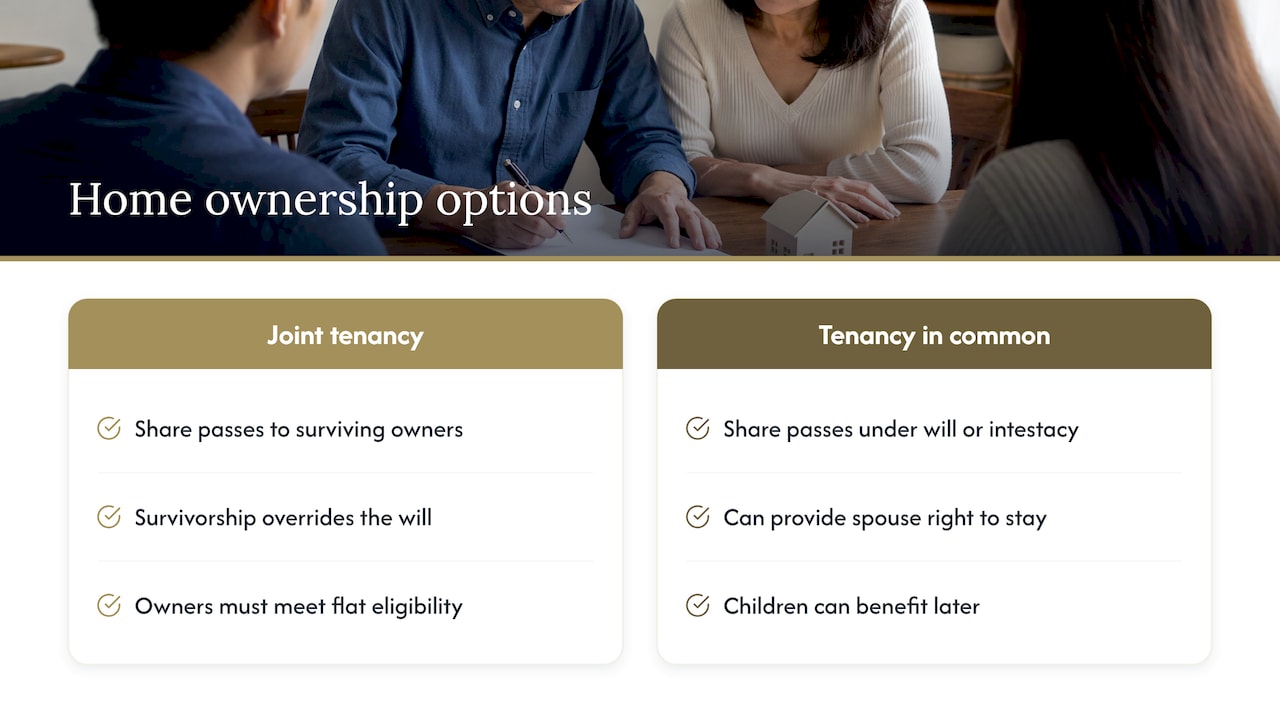
For many families the flat or house is the largest asset, and how title is held matters more than the will. HDB guidance says a joint owner’s share passes to the remaining owners, who must lodge a Notice of Death with the Singapore Land Authority. They can keep the flat if they are Singapore Citizens or Permanent Residents, at least 21, and meet eligibility conditions.
A sole owner’s or tenant-in-common’s share passes under the will or the Intestate Succession Act. After obtaining a Grant of Probate or Letters of Administration, the transmission application is due within six months. Beneficiaries who are not eligible to keep the flat can still receive sale proceeds.
So if you and your second spouse hold the home as joint tenants, your half goes to your spouse by survivorship, whatever your will says about the children. If you want your children to eventually benefit, consider holding as tenants-in-common and providing for your spouse’s right to stay through the will or a trust. Choose this deliberately, with advice, because it changes who controls the property after death.
Redistribution after death: the deed of family arrangement
Beneficiaries sometimes agree among themselves to share an inheritance differently from the will or the statute, using a deed of family arrangement. It depends entirely on everyone affected agreeing, which in a blended family is the very thing that cannot be assumed. A plan that works only if relatives cooperate is weaker than one that says clearly what you want while you are alive.
When a trust earns its place
MoneySense explains that a trust can control and protect family assets, provide for minor children or dependants with special needs, and hold assets outside the estate so that probate is not required. A testamentary trust made in a will takes effect after death and is irrevocable once in place. A living trust, set up in your lifetime, can also protect assets from creditors if the settlor is made bankrupt.
For blended families, a trust solves specific problems:
A second spouse is provided for during life, while the capital is secured for the children of the first marriage.
Minor children and stepchildren receive money at ages you choose, managed by a trustee you trust.
Assets can pass without waiting for probate.
The trustee’s income is taxable, and the trustee pays tax at the prevailing rate on the share of a non-resident beneficiary, according to MoneySense. Ongoing fees apply to trusts, so the structure should be sized to the assets and the family’s complexity. We offer Standby Trust and Living Trust options, and for families with substantial wealth a Private Trust Company, which lets the family keep tighter control over how a trust is run.
Business owners in a blended family
If you own a company, a spouse who inherits shares may end up sharing control with your business partners, and children from different marriages may end up in conflict over the same shares. A Business Value Protection Trust, also known as a Buy-Sell Agreement, from $8,000 one-off, sets out in advance how a share is valued and bought out so that your family receives its value. Our article on shares in a will covers the constitution traps.
A practical sequence
List everything you own, and how each item is held: sole name, joint tenancy, tenancy in common, CPF, insurance, company shares. Our Schedule of Assets, Estate Liquidity Analysis & Asset Nomination service starts from $500 one-off.
Write down who you want to benefit, including stepchildren, and in what form.
Check the non-will assets first: CPF nominations, insurance nominations and jointly held property.
Draft the will to fill the gaps, with trusts where the family needs them.
Choose executors and trustees who can act impartially.
Review after any life event: marriage, birth, adoption, divorce, a child turning 21, a business sale.
Portfolio Structuring & Estate Optimisation, from $1,500 one-off, helps align the portfolio itself with these decisions.
Blended families rarely fail because someone intended harm. They fail because each document was written at a different time, by a different version of the family. A will from the first marriage, a CPF nomination from before the children were born, a flat held jointly with a new spouse: each is valid, and together they contradict each other. We start with the whole picture rather than a single document. For affluent families that means looking at the will, the trusts, the CPF nominations, the property and the business side by side, then speaking plainly about who receives what and who controls it. Our consultations are personal and remain open afterwards, because a blended family’s plan needs revisiting as it grows. A trust is often the cleanest way to be fair to a second spouse and to children from an earlier marriage at the same time. It lets you say what you mean and have someone you chose carry it out. Joseph
Our view
Where to start
If your family has changed and your documents have not, a conversation with us is the fastest way to see where they conflict. We prepare customized wills, living and standby trusts, private trust companies and corporate executorships for Singapore families. See our estate planning services and published prices.
FAQ
Do my stepchildren inherit automatically in Singapore?
No. Under the Intestate Succession Act, a child means a legitimate child or a child adopted under written law. A stepchild who has not been adopted is not included, so they need to be named in your will or nominated for CPF.
Does my old will still apply after I remarry?
Usually not. Marriage revokes an earlier will unless it was made expressly in contemplation of that marriage. If you have remarried since signing, assume you need a new will.
Does my will control my CPF savings?
No. CPF savings pass to your nominees, and without a nomination they are distributed under the intestacy rules. Your will does not override either. Update the nomination whenever your family changes.
Can a child or spouse challenge my will?
In some cases. The Inheritance (Family Provision) Act 1966 lets the court order reasonable maintenance for certain dependants, such as a spouse or an infant son. A well-structured plan takes this into account from the start.
Sources
Recommended
Comments