


Avoid a 17% Surprise Bill: Trust Taxation Rules for Singapore Trustees


Resident beneficiaries pay tax on their share of entitlement at their own personal rates, while non-resident beneficiaries do not file individually. Their share is taxed at the trustee level at the flat trustee rate. Foreign trusts and certain locally-administered trusts can sidestep this entirely, but only when they meet strict, ongoing statutory conditions.
TL;DR:
Trust income not allocated to beneficiaries is taxed at the trustee level at 17%, potentially leading to higher taxes if income remains undistributed.
Resident beneficiaries must declare their trust entitlement on their tax return, unless the income is deemed exempt, while non-residents pay tax only at the trustee level without filing personally.
Trusts can qualify for exemptions if they meet ongoing statutory conditions, but failure to maintain proper records or timely declarations risks losing these benefits.
Trustees should hold reserves for potential late assessments on non-resident shares and regularly verify beneficiary residency status to avoid tax surprises.
Careful trust deed drafting and proactive compliance are crucial to maximizing exemptions, avoiding stamp duty pitfalls, and ensuring correct tax treatment.
Table of Contents
Trust Taxation Singapore: How the Trustee Gets Assessed
Trust income is called “statutory income” once it passes through allowable deductions, and the trustee is the default taxpayer on it. The Inland Revenue Authority of Singapore treats the trustee as a single taxable person, separate from the settlor and separate from any individual beneficiary, unless that income is specifically allocated and taxed at the beneficiary’s hands.
Here’s the mechanic in numbers. Say a discretionary trust earns $200,000 in statutory income for the year, after deducting trustee expenses and allowable costs. If none of that income is distributed or apportioned to a beneficiary during the basis period, the trustee is assessed on the full amount at 17%, producing a bill of $34,000. That figure changes the moment a share gets allocated to a beneficiary who is taxed directly instead.
A few mechanics worth locking in:
The trustee rate applies to statutory income that hasn’t been specifically apportioned to a named beneficiary in the relevant year.
Once income is allocated to a resident beneficiary’s entitlement, it drops out of the trustee’s assessment and moves to that person’s personal tax return.
Trust deeds that restrict distributions (common in structures built around the two-thirds rule for trust loans) can keep more income locked at the trustee level, which usually means a higher flat-rate bill rather than a lower personal-rate one.
That last point catches people off guard. A trustee holding income back “to be safe” can end up paying more tax than if the same amount had been distributed to a beneficiary in a lower personal tax bracket.
Tax on Resident Beneficiaries: Declaring Your Share of Entitlement
If you’re a Singapore tax resident entitled to trust income, you report it yourself. The IRAS framework requires resident beneficiaries to declare their share of entitlement in their personal income tax return, under the “Others” category on Form B or B1, using rates that scale with total income rather than the flat trustee rate.
This only applies to income you were legally entitled to receive during the year, not income the trustee simply held back at its discretion. A discretionary trust where no distribution decision was made doesn’t generate a reporting obligation for beneficiaries, because no one has a fixed entitlement yet.
Certain income types carry through as exempt for individuals even after passing through a trust, mirroring what would have been exempt if received directly:
Most Singapore dividend income already taxed at the corporate level.
Certain interest income exempted under specific IRAS provisions.
Capital gains, which Singapore generally does not tax for individuals.
Trustees carry a corresponding duty here. IRAS guidance requires trustees to notify beneficiaries of their share of entitlement so the beneficiary can meet their own filing deadline, and that notification should be documented, not verbal.
Pro Tip: Ask your trustee for a written breakdown of your entitlement before filing season, not after. A one-page letter showing the exempt and taxable components saves a scramble every April, and it’s the kind of record IRAS may ask for if your return gets queried.
Non-Resident Beneficiaries: Why the Trustee Pays and When
Non-resident beneficiaries never file for trust income at all. Under IRAS rules, the trustee pays tax on that share at the 17% trustee rate, and the liability stops there. No personal return, no separate assessment, no further exposure for the beneficiary living overseas.
The timing trap sits with the trustee, not the beneficiary. A Notice of Assessment covering a non-resident’s share can arrive well after the income year closes, sometimes years later if IRAS is reviewing the trust’s filings. By then, the trustee may have already distributed or reinvested the underlying funds.
A short checklist keeps that from becoming a liquidity crisis:
Identify beneficiary residency status every year, not just at trust formation, since residency can change.
Set aside a cash reserve equal to the estimated trustee-level tax on non-resident shares before making any distribution.
Track outstanding NOAs across multiple years, since assessments for older income years can still land.
Confirm the trust’s bank account can cover a lump-sum tax payment without forcing an asset sale.
Exemptions and Special Regimes for Trusts
Two exemption pathways matter most for Singapore trust taxation, and both demand active, ongoing compliance rather than a one-time application.
The first covers foreign trusts. Under the Income Tax (Exemption of Income of Foreign Trusts) Regulations, specified income from designated investments held by a qualifying foreign trust can be exempt from tax, provided the trust meets the regulations’ tests around settlor and beneficiary residency and the trustee makes the required annual declarations to the Comptroller.
The second covers locally-administered trusts under Section 13N/13Q of the Income Tax Act 1947. Relevant income can be exempt where prescribed conditions on trust structure and administration are met, though transitional and date-based rules affect trusts constituted from specific cutoff dates, which trust planners structuring new vehicles around 2027 and 2028 need to watch closely.
Both regimes share a weak point: recordkeeping.
Missing or late annual declarations under the foreign trust regulations can trigger additional assessments on income that would otherwise have been exempt.
Trustee companies must maintain the specific records the regulations require, not a general accounting summary.
A change in beneficiary or settlor residency mid-year can quietly break eligibility if no one updates the trust’s compliance file.
Losing an exemption doesn’t just mean paying tax going forward. It can mean back-assessments funded out of trust assets that were never budgeted for that purpose.
Filing and Compliance: Form T, Tax Reference Numbers, and Deadlines
Before a trust files anything, it needs its own Tax Reference Number, obtained through a FormSG application submitted to IRAS. Skipping this step is the single most common reason new trusts miss their first filing deadline.
Once that number exists, the process runs on a predictable annual rhythm:
Gather trust and estate income figures for the preceding calendar year, including all statutory income before allocation.
File Form T within the stated filing window, declaring both trustee-assessed income and amounts allocated to beneficiaries.
File electronically through myTax Portal using Singpass, which IRAS now expects for most trustee filings.
Watch for the Notice of Assessment, which may arrive well after filing and can cover income from an earlier year if IRAS reassesses.
If no physical letter shows up by the expected date, don’t assume there’s nothing owed. Check the myTax Portal directly, since digital notices sometimes replace paper ones without a separate alert.
Pro Tip: Set a recurring reminder for the Form T window the moment a trust is constituted, not the year income starts flowing. Trustees who wait for “meaningful” income before engaging with filing often miss the very first deadline entirely.
Practical Trustee Traps and Tax Planning Considerations
Cash flow, not tax rate, is where most trustees actually get hurt. A common blind spot is assuming that once income for a year is distributed, the trust’s tax obligations for that year are closed. NOAs covering non-resident beneficiary shares can land years afterward, by which point the cash may be gone.
Hold back a tax reserve calculated against outstanding, unresolved NOAs, not just the current year’s estimate.
Keep every statutory record and annual declaration the exemption regimes require, filed on time, every year, without exception.
Watch the stamp duty trap under Section 22C: when a beneficiary renounces an interest in residential property held in trust, IRAS treats it as a change in beneficial ownership, which can trigger Buyer’s or Seller’s Stamp Duty.
Escalate to a tax or trust professional the moment a trust holds property, has non-resident beneficiaries, or spans more than one generation.
One overlooked cost driver: stamp duty exposure under Section 22C isn’t triggered by income at all. It’s triggered by a change of hands on paper, which means a well-meaning renunciation can generate a duty bill with zero cash distribution to soften it.
What Happens if the Settlor Is a Singapore Tax Resident
A settlor who sets up a trust and stays in Singapore doesn’t automatically owe tax on the trust’s income once assets are properly transferred into the trust. Ownership, for tax purposes, generally shifts to the trustee, which is why the trustee, not the settlor, is the default taxpayer on statutory income.
That separation isn’t absolute. If the trust deed lets the settlor retain effective control over the assets, income, or distributions, whether through a revocable structure, retained powers of appointment, or an arrangement where the settlor is also the primary beneficiary, IRAS can look past the trust form and assess the income as if the settlor still owned it directly. This matters most for revocable trusts, where the settlor can unwind the arrangement and reclaim assets at will.
For an irrevocable trust with a genuinely independent trustee and no retained control, a resident settlor typically has no ongoing personal tax exposure on trust income once the transfer is complete. The settlor still needs to think about upstream tax: assets transferred into the trust don’t escape any tax that applied before the transfer, and gifting appreciated assets into a trust doesn’t create a capital gains event in Singapore given the absence of a general capital gains tax.
The practical lesson for anyone drafting a trust deed as a resident settlor is to be deliberate about control provisions. A deed drafted loosely, with the settlor able to direct distributions or revoke the trust unilaterally, risks collapsing the very tax separation the structure was meant to create.
Distributed Income Versus Income Retained in the Trust
Whether trust income gets distributed or retained changes who pays and often how much. Income properly allocated to a resident beneficiary’s entitlement shifts to that person’s personal tax return, taxed at their individual rate instead.
For a beneficiary in a lower income bracket, that shift can mean real savings.
This is exactly where trust deed design and discretionary decision-making intersect with tax outcomes. A trustee weighing whether to distribute income in a given year isn’t just making a governance call. They’re effectively choosing between two different tax rates depending on each beneficiary’s personal circumstances that year.
There’s a timing wrinkle too. Income allocated to a beneficiary who is a Singapore tax resident during the year it’s earned gets taxed at that beneficiary’s rate for that year. Income left retained doesn’t get a second chance at beneficiary-rate taxation later. Once it’s assessed to the trustee, it’s assessed. A subsequent distribution of the same after-tax funds to a beneficiary doesn’t trigger a second round of income tax, since the tax has already been settled at the trustee level.
Discretionary Trusts Versus Fixed Trusts: How Taxation Differs
The tax mechanics run the same for both trust types. What differs is who controls when income counts as “entitled” versus “retained,” and that control changes the practical tax outcome.
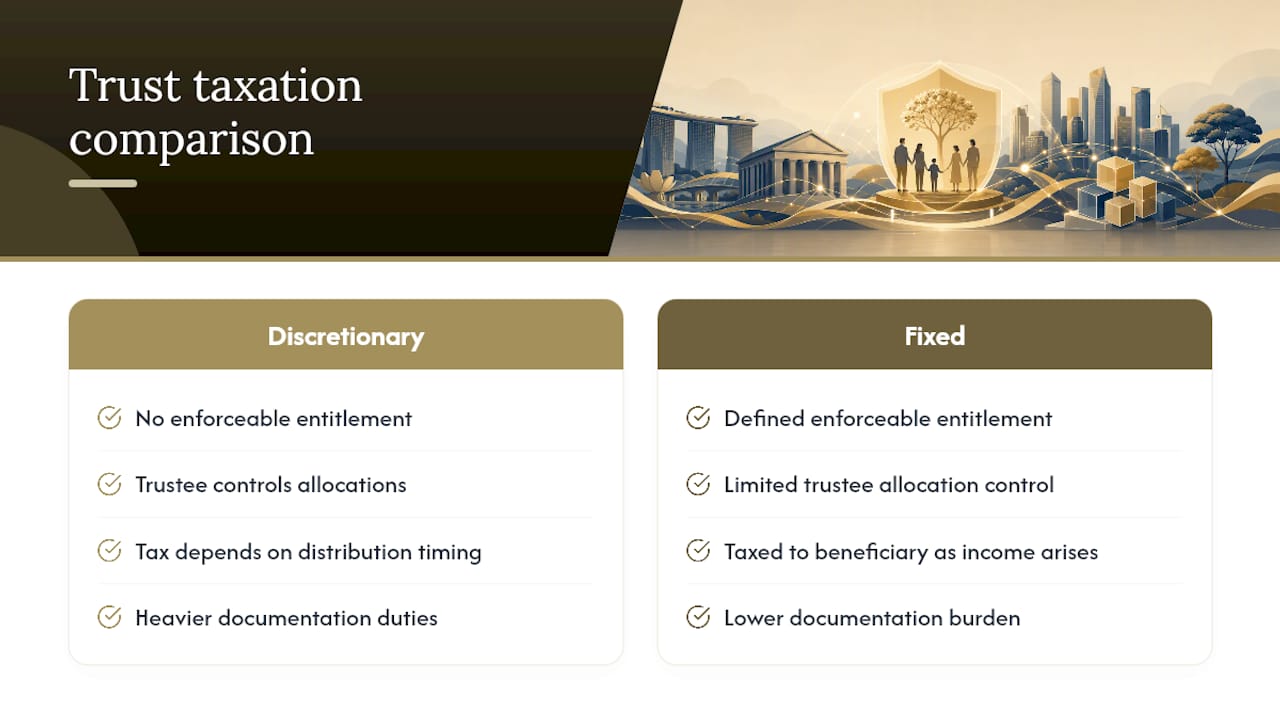
In a fixed trust, beneficiaries have a defined, enforceable entitlement to income or capital under the trust deed, set out in advance. Because that entitlement exists whether or not the trustee actually pays out, IRAS generally treats that income as belonging to the beneficiary for tax purposes as it arises, pushing it toward personal-rate taxation more consistently.
In a discretionary trust, no beneficiary has an enforceable right to any specific amount until the trustee actually exercises discretion to allocate it. This gives trustees a genuine planning lever: timing distributions to land in years when a particular beneficiary’s personal rate is more favorable than the flat trustee rate.
That flexibility is precisely why discretionary structures dominate high-net-worth and multi-generational planning in Singapore, and why testamentary trusts built into a will often default to discretionary terms. The tradeoff is administrative. Discretionary trustees carry heavier documentation duties, since every allocation decision needs a paper trail showing why and when discretion was exercised, both for IRAS purposes and to protect the trustee from later disputes among beneficiaries.
How Trust Deed Wording Shapes the Tax Bill
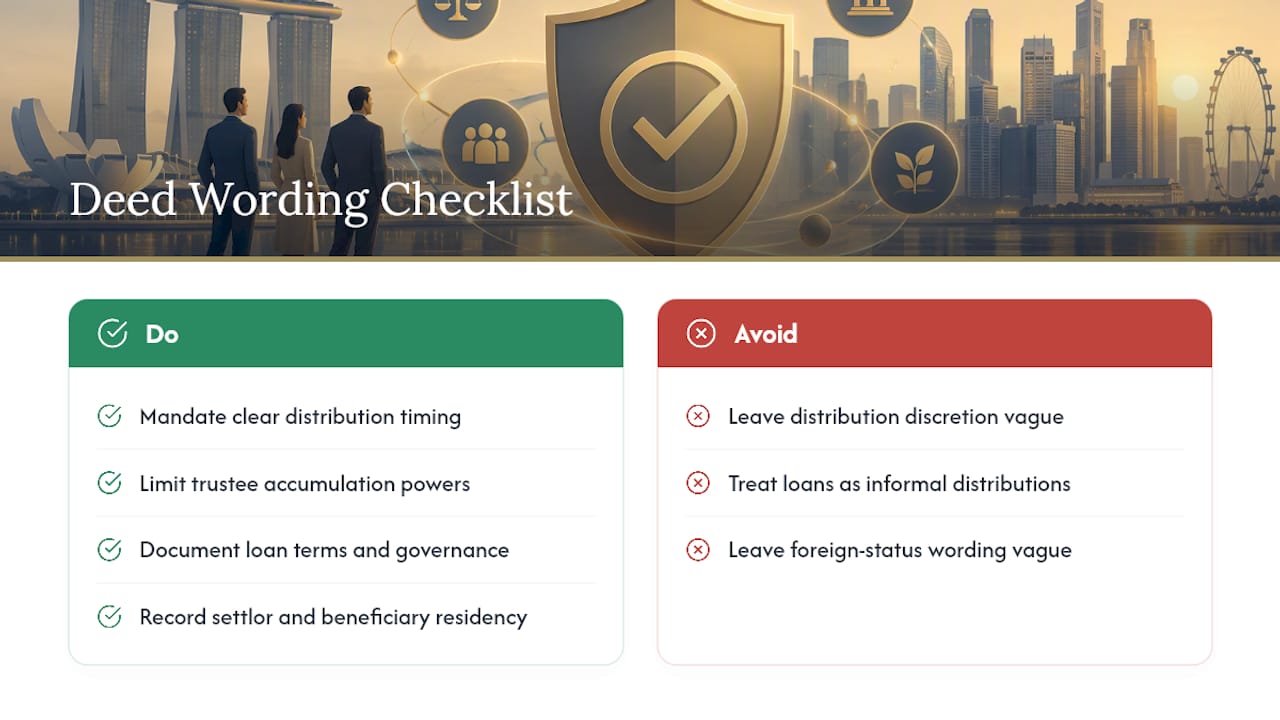
The trust deed itself often decides more about the tax outcome than people expect going in. Provisions on distribution timing, beneficiary classes, and trustee powers all feed directly into whether income lands at the trustee’s flat rate or a beneficiary’s personal rate.
A deed that mandates automatic annual distribution of income removes trustee discretion, which usually pushes income toward beneficiary-rate taxation by default, since entitlement is fixed rather than conditional. A deed that gives the trustee broad accumulation powers, letting income sit undistributed indefinitely, keeps more income parked at the flat trustee rate, for better or worse depending on the beneficiaries’ individual tax positions.
Deeds that restrict distributions under a two-thirds limit for loans from the trust create a related wrinkle. Funds structured as loans to beneficiaries rather than distributions of income don’t carry the same income tax characterization, but they do carry governance and documentation requirements that trustees often underestimate at drafting stage.
Deed language around foreign trust status matters just as much. A deed that doesn’t clearly document settlor and beneficiary residency, or that leaves the trustee’s declaration obligations vague, can complicate a trust’s ability to claim the foreign trust exemption later, even where the underlying facts would otherwise qualify. Getting the deed’s tax provisions right at drafting is far cheaper than trying to fix a structural gap after IRAS has already raised a query.
What Trustees Get Wrong Most Often
The misconception I run into constantly: clients assume that because the trustee pays tax on a non-resident beneficiary’s share, resident beneficiaries are covered too. They’re not. Every resident beneficiary with a fixed entitlement still has to declare it personally, and skipping that step is an easy way to end up with a mismatched IRAS record.
Good deed drafting and disciplined trustee administration aren’t paperwork for its own sake. They’re what actually preserves exemptions and keeps stamp duty exposure from ambushing a family years after a trust was set up. The trustees who plan for liquidity and compliance before a problem shows up are the ones who never have to explain a surprise tax bill to a beneficiary.
— Joseph
How Elite Legacy Planning Handles Trust Tax and Administration
Getting trust taxation right in Singapore takes more than reading IRAS guidance once and hoping the deed still matches it years later. Elite Legacy Planning works through the practical side: trust consultations that flag exemption risks before they become NOAs, private trust company structuring for families who want ongoing control over administration, and support around Form T, Tax Reference Numbers, and estate liquidity planning so trustees aren’t caught short when an assessment finally lands.

An engagement typically covers tax-aware trust drafting that anticipates how income will actually be distributed, trustee administration checks against the compliance requirements exemptions demand, and a Schedule of Assets, Estate Liquidity Analysis & Asset Nomination so cash reserves match real tax exposure instead of guesswork.
For families weighing a discretionary structure, testamentary trust, or standby trust, a trust consultation is the place to start before the deed gets drafted, not after. Book a consultation through the online booking page to walk through where a current or planned trust stands on tax and compliance.
FAQ
Do I Pay Tax on a Trust in Singapore?
It depends on your role. Resident beneficiaries pay personal tax on their share of entitlement, while the trustee pays the flat 17% rate on income retained at the trust level or allocated to non-resident beneficiaries.
Do Trusts Have Taxable Income in Singapore?
Yes, a trust’s statutory income is taxable, and someone always pays tax on it. Either the trustee at the flat rate, or the beneficiary personally once income is properly allocated to their entitlement.
Is a Trust Exempt From Income Tax in Singapore?
Not automatically. Specific exemptions exist for qualifying foreign trusts and prescribed locally-administered trusts under Section 13N/13Q, but both require meeting detailed conditions and filing annual declarations to keep the exemption alive.
What Are the Disadvantages of Putting Money in a Trust?
Trusts add administrative burden: trustees must file Form T, retain cash reserves for delayed assessments on non-resident beneficiaries, and maintain records to preserve any exemption. Renouncing a beneficial interest in trust-held residential property can also trigger stamp duty under Section 22C, an easy-to-miss cost.
Does Elite Legacy Planning Help With Trust Tax Compliance?
Elite Legacy Planning offers trust consultations and private trust company setup that build tax awareness into the deed from the start. Current pricing for specific services is listed on the services page.
Recommended
Comments