


Private Trust Company Singapore: Guide for HNW Families


A private trust company (PTC) in Singapore is a locally incorporated company that acts exclusively as trustee for trusts connected to a single family. For many high-net-worth families with significant consolidated wealth or with operating businesses to protect, a PTC is worth serious consideration. For families with simpler asset structures or smaller estates, a licensed corporate trustee will almost always be more cost-effective.
Three things to know before you read further:
Control and governance: Family members and trusted advisors can sit on the PTC board, giving the family direct influence over trustee decisions without needing to hold a trust company license themselves.
Regulatory constraint: A PTC cannot operate in isolation. Singapore law requires every PTC to engage a licensed trust company to handle trust administration and AML/CFT compliance.
Cost and time: Setup typically takes 10–18 weeks in straightforward cases. Recurring annual costs for the licensed administrator alone commonly range from S$30,000–S$80,000 per year, with audit, accounting, and tax advisory fees on top.
The two governing references are the Ministry of Law’s express trusts guidance and the Monetary Authority of Singapore (MAS) framework for licensed trust companies.
Table of Contents
What a private trust company actually is under Singapore law
Why families form a PTC: control, governance, and ring-fencing
Who qualifies: the connected persons test and its edge cases
Step-by-step: how to incorporate and launch a PTC in Singapore
Is a PTC right for your family? Decision criteria and alternatives
Practitioner perspective: pitfalls, design tips, and red flags
A note from Elitelegacyplanning on supporting families through PTC setup
How Elitelegacyplanning can help you establish a private trust company
What a private trust company actually is under Singapore law
Singapore law treats trusts primarily as express trusts, recognizing them by purpose and structure rather than by a rigid classification. A PTC sits within that express trust framework as a Singapore-incorporated company whose sole mandate is to act as trustee for trusts whose beneficiaries are connected to a single family.
The legal basis for the PTC’s exempted status is the Trust Companies (Exemption) Regulations, specifically Regulation 4. Under that regulation, a company that restricts its trustee activities exclusively to connected-family trusts is not required to hold a full MAS trust business license. That exemption is the structural foundation of the whole PTC model.
The exemption is not a license to operate without oversight. A PTC that claims exempted status still cannot carry out trust administration or AML/CFT functions itself. Those responsibilities must be delegated to a Singapore-licensed trust company. The exemption removes the licensing burden from the family vehicle; it does not remove the compliance burden from the structure.
On the corporate side, the PTC is incorporated with the Accounting and Corporate Regulatory Authority (ACRA) like any other Singapore company. Under section 145(1) of the Companies Act, it must have at least one Singapore-resident director. Its constitution must explicitly restrict the company to acting as trustee for connected-family trusts only. That restriction is what preserves the Regulation 4 exemption.

Why families form a PTC: control, governance, and ring-fencing
The core appeal is control. When a family uses a licensed corporate trustee, the trustee’s professional judgment governs every decision. A PTC flips that dynamic: the family appoints the board, and the board makes trustee decisions. Trusted family advisors, independent directors, and family members can all sit alongside each other, which means investment committee decisions, distributions, and asset disposals move at the family’s pace rather than an institution’s.
That governance flexibility translates into several concrete advantages:
Bespoke family charter: — The PTC’s constitution and any accompanying family charter can encode the family’s values, succession principles, and distribution philosophy in legally binding form.
Families holding operating businesses find the PTC particularly useful. A licensed corporate trustee managing an operating company faces institutional constraints around board representation, conflict management, and decision timelines. A PTC board, staffed with people who know the business can act quickly.
Pro Tip: The most common misconception is that a PTC gives the family freedom from professional oversight. It does not. The PTC is a control tool, not a deregulation tool. The licensed administrator remains a non-negotiable compliance partner, and families that treat it otherwise create serious regulatory exposure.
Key legal and regulatory requirements that shape every PTC
The regulatory framework is not complex, but it is non-negotiable. Every PTC in Singapore must satisfy the following:
Engage a licensed trust company — Under the Trust Companies (Exemption) Regulations, the PTC must retain a Singapore-licensed trust company to carry out trust administration and AML/CFT checks. This is a hard legal requirement, not a best practice.
Notify MAS where applicable — Families claiming exempted status under Regulation 4 should confirm notification and filing expectations with MAS. The MAS directory of licensed trust companies is the reference point for selecting a qualifying administrator.
A PTC that drifts outside these requirements does not simply face a fine. It risks losing its exempted status entirely, which would require it to obtain a full trust business license or restructure.
Who qualifies: the connected persons test and its edge cases
The Regulation 4 exemption turns entirely on the concept of “connected persons.” In practical terms, connected persons include family members by blood or legal adoption and entities controlled by or for the benefit of those family members. The PTC’s trusts must serve only those connected persons as beneficiaries.
The precision required here is greater than most families expect. Common edge cases that create problems:
Future non-family beneficiaries: — Charitable beneficiaries, business partners, or employees added to a trust at a later date can cause the PTC to breach its connected-person restriction.
Pro Tip: Before incorporating the PTC, map every current and anticipated beneficiary across at least two generations. Include stepchildren, adopted children, spouses, and any corporate entities the family controls. Then have counsel confirm each person’s status under the connected-person definition. Redoing this exercise after incorporation is expensive and sometimes impossible without restructuring.
Step-by-step: how to incorporate and launch a PTC in Singapore
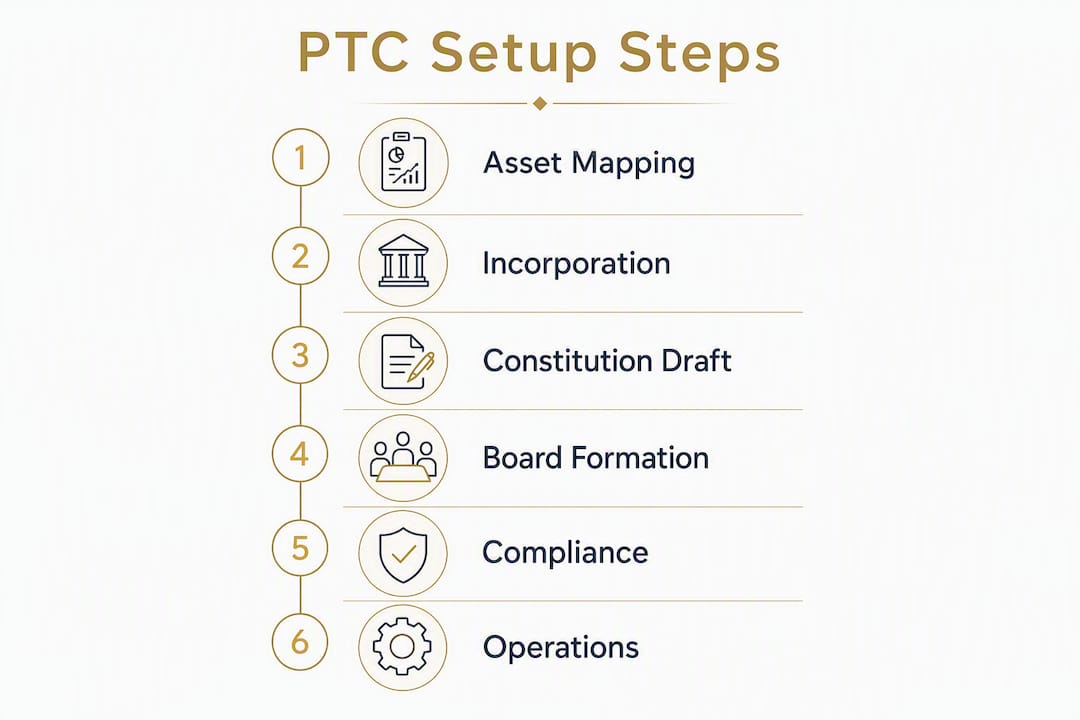
The process runs in four sequential phases. A straightforward matter takes 10–18 weeks from instruction to first trust funding; multi-jurisdictional structures with complex asset valuations or cross-border legal opinions typically take longer.
Family and asset mapping. Document every family member, their relationship to the settlor, and every asset intended to sit in the trust structure. Confirm connected-person status for all intended beneficiaries.
Draft the constitution and trust deed. The PTC’s constitution must restrict the company to connected-family trusts. The trust deed governs the underlying trust(s). Both documents need specialist trust and corporate counsel.
Incorporate with ACRA. File the company incorporation documents, including the constitution, with ACRA. Appoint at least one Singapore-resident director.
Select and appoint the licensed trust company. Identify a qualifying administrator from the MAS directory. Negotiate the administration agreement, which will govern AML/CFT responsibilities, reporting, and fees.
Complete AML/KYC onboarding. The licensed administrator will conduct due diligence on the settlor, beneficiaries, and any connected entities. This phase is frequently the longest, particularly for families with assets in multiple jurisdictions.
Execute board resolutions and governance documents. Adopt the family charter, investment committee terms of reference, and any protector deed. Hold the first board meeting and document it properly.
Fund the trust. Transfer assets into the trust(s) held by the PTC. Obtain any required valuations, legal opinions, or regulatory clearances for the assets being transferred.
Key documents checklist:
PTC constitution (restricting mandate to connected trusts)
Trust deed(s) for each underlying trust
Administration agreement with the licensed trust company
Board resolutions (appointment of directors, adoption of governance documents)
AML/KYC files for all settlors, beneficiaries, and connected persons
Family charter and investment committee terms of reference (where applicable)
Asset transfer documents and valuations
Phase | Typical duration | Common delay factors |
Family and asset mapping | 2–3 weeks | Complex family structures, multi-jurisdiction assets |
Drafting (constitution, trust deed) | 3–4 weeks | Bespoke governance requirements, protector arrangements |
ACRA incorporation | 1–2 weeks | Standard; rarely delayed |
Licensed administrator onboarding (AML/KYC) | 3–6 weeks | Multi-jurisdiction assets, complex beneficiary structures |
Trust funding and first board meeting | 1–3 weeks | Asset valuations, cross-border legal opinions |
Running a PTC: governance duties and ongoing compliance
Once the PTC is operational, two parallel governance tracks run continuously: the PTC board’s trustee duties and the licensed administrator’s compliance responsibilities.
Board-level duties include making trustee decisions on distributions, investments, and asset disposals; managing conflicts of interest among board members; holding regular board meetings (at minimum annually, but quarterly is common practice for active structures); and maintaining proper minutes for every decision.
Licensed administrator responsibilities cover AML/CFT periodic reviews, ongoing customer due diligence on beneficiaries, regulatory reporting to MAS where required, and the day-to-day mechanics of trust administration including record-keeping and accounting.
The split matters because families sometimes assume the licensed administrator handles everything. It does not. The board retains full trustee decision-making authority. The administrator handles compliance infrastructure and administration mechanics. Neither can substitute for the other.
Ongoing operational obligations include:
Annual ACRA return and IRAS corporate tax filing for the PTC entity
The governance cadence matters as much as the documents. A PTC with a well-drafted constitution but no functioning board process will accumulate undocumented decisions, missed AML/CFT reviews, and stale records. Regulators and courts look at what actually happened, not what the documents say should happen.
Realistic costs and timeline for establishing a PTC
Budget planning is where most families underestimate the commitment. The PTC shifts professional costs from a single licensed trustee fee into a bundle of ongoing obligations: administrator fees, audit, corporate secretarial, accounting, and tax advisory.
Cost item | Indicative range (one-time) | Indicative range (annual) |
ACRA incorporation | S$315–S$1,000 | — |
Trust deed drafting | S$15,000–S$60,000 | — |
PTC constitution drafting | S$10,000–S$40,000 | — |
Licensed administrator fees | — | S$30,000–S$80,000 |
Annual audit | — | S$8,000–S$15,000 |
Accounting and corporate secretarial | — | S$7,000–S$12,000 |
Tax advisory | — | S$3,000–S$8,000 |
Cost ranges above are practitioner estimates. Actual fees depend on asset complexity, the number of underlying trusts, and the licensed administrator selected.
Total annual operating costs for a straightforward PTC structure typically fall in the range of S$43,000–S$118,000, before any extraordinary legal work. Multi-jurisdictional structures with operating company assets sit toward the upper end.
Pro Tip: Budget a contingency of at least 20–30% on top of quoted fees for multi-jurisdictional matters. Cross-border legal opinions, foreign asset valuations, and extended AML/KYC onboarding for overseas beneficiaries are the most frequent sources of cost overruns.
How the PTC structure actually works: who does what
The structure has five key nodes, each with a distinct legal role:
Settlor(s): — The family member(s) who transfer assets into the trust(s). The settlor establishes the trust deed and defines the beneficial interests. After funding, the settlor typically has no ongoing legal role unless they also serve as a PTC director.
Legal title and beneficial interest are deliberately separated. The PTC holds legal title to the assets. The beneficiaries hold the beneficial interest. This separation is the foundation of the asset protection and succession planning benefits the structure provides.
Custody, investment management, and banking arrangements connect to the PTC as the legal owner of the assets. The licensed administrator coordinates AML/KYC enforcement at the trust level. Tax reporting flows through the PTC as a Singapore corporate entity, with separate analysis required for trust-level distributions and any foreign tax obligations.
Is a PTC right for your family? Decision criteria and alternatives
A PTC is not the right answer for every wealthy family. The decision turns on four factors:
Asset scale and complexity — Practitioners commonly recommend PTCs for families with significant consolidated wealth or where operating businesses are involved. Below that threshold, the recurring costs rarely justify the governance benefits.
Alternatives worth considering:
Living trust with a licensed trustee: For families whose primary goal is succession planning rather than governance control, a living trust administered by a licensed trustee is often simpler and more cost-effective.
When to prefer a licensed corporate trustee: cost efficiency matters, the family wants third-party independence, or the asset structure is straightforward. When to prefer a PTC: the family holds operating businesses, wants direct board control, or has complex multi-generational governance requirements.
Practitioner perspective: pitfalls, design tips, and red flags
The families that run into trouble with PTCs almost always make the same mistakes. These are the ones practitioners see most often:
Poor connected-person mapping. The single most common setup failure. Families draft the constitution without a complete beneficiary map, then discover years later that a stepchild or in-law falls outside the connected-person definition. Remediation requires restructuring.
Overly broad constitutions. A constitution that does not explicitly restrict the PTC to connected-family trusts risks losing the Regulation 4 exemption. Every word in the mandate clause matters.
Underestimating AML/KYC onboarding time. Families with assets in multiple jurisdictions or beneficiaries in high-risk countries routinely find that AML/KYC onboarding takes twice as long as expected. This delays trust funding and can create gaps in asset protection.
Treating the PTC as a way to avoid professional oversight. The licensed administrator is not optional. Families that try to minimize the administrator’s role to reduce costs end up with AML/CFT gaps that create regulatory exposure.
No succession plan for the board. The PTC constitution must address what happens when a family director dies, loses capacity, or becomes a conflicted party. Structures without clear succession provisions for the board become ungovernable.
The most fixable mistake is also the most common: the family skips the detailed governance drafting because it feels premature. A constitution drafted in a hurry, without a family charter or board succession provisions, will need expensive remediation within a decade. The drafting phase is the cheapest time to get it right.
Design tips from practitioners:
Draft the constitution tightly, with an explicit connected-person mandate and a clear amendment procedure.
Include a family charter that records the family’s values, distribution philosophy, and governance expectations. It is not legally binding in the same way as the trust deed, but it provides interpretive context for future trustees.
Structure independent oversight through a protector or advisory committee, not just through the licensed administrator.
Plan for future beneficiary changes by including a defined process for adding or removing beneficiaries within the connected-person framework.
When to walk away: small wealth pools, simple asset sets, families unwilling to fund ongoing administration, or families where governance consensus is unlikely. A PTC imposed on a family that cannot agree on board composition will create more conflict than it resolves.
Key Takeaways
A private trust company in Singapore gives high-net-worth families direct board control over trustee decisions, but it requires a licensed trust company administrator, costs S$43,000–S$118,000 annually to operate, and suits families with consolidated wealth above S$50 million or complex operating business assets.
Point | Details |
PTC suitability threshold | Practitioners recommend PTCs for families with wealth above S$50 million or with operating businesses involved. |
Licensed administrator is mandatory | Every PTC must engage a Singapore-licensed trust company for AML/CFT and trust administration under the Trust Companies (Exemption) Regulations. |
Annual operating costs | Recurring fees for administrator, audit, accounting, and tax advisory typically amount to substantial annual costs. |
Setup timeline | A straightforward PTC typically takes several weeks from instruction to first trust funding; multi-jurisdictional structures take longer. |
Elitelegacyplanning’s role | Elitelegacyplanning assists HNW families with PTC setup, constitutional drafting, trust deed preparation, and licensed administrator coordination in Singapore. |
A note from Elitelegacyplanning on supporting families through PTC setup
At Elitelegacyplanning, the families we work with on private trust company structures typically come to us at a specific inflection point: a business sale, a generational transfer, or the recognition that a single licensed trustee no longer fits the complexity of what they own. Our role is to map the family structure, coordinate the drafting of constitutional documents and trust deeds, and manage the engagement with a licensed trust company administrator so the family is not navigating three separate professional relationships alone.
This article is general information, not legal or financial advice. Every PTC structure turns on the specific facts of the family and its assets, and you should confirm current regulatory requirements with MAS, the Ministry of Law, or a qualified Singapore trust and corporate lawyer before proceeding.
How Elitelegacyplanning can help you establish a private trust company
Setting up a PTC in Singapore means coordinating corporate lawyers, trust deed specialists, a licensed trust company administrator, auditors, and tax advisors, often simultaneously. Most families find that the coordination burden is as demanding as the legal work itself.

Elitelegacyplanning handles the full setup process: family and beneficiary mapping, drafting of the PTC constitution and trust deed, coordination with a licensed trust company administrator for AML/CFT onboarding, and tax and audit coordination. For families who also need a will or a living trust alongside the PTC, those can be structured as part of the same engagement. A typical intake to actionable plan takes two to three weeks. From there, the incorporation and administrator onboarding phases follow the timeline outlined above.
Book a consultation to discuss whether a PTC fits your family’s structure and what the setup process would look like for your specific assets and beneficiaries.
This content is general information only and does not constitute legal, tax, or financial advice. Consult a qualified Singapore professional before making any structural decisions.
Useful sources and primary references
The sources below are the authoritative references for anyone researching PTC setup in Singapore. Each is worth reading directly before engaging advisors.
Express Trusts — Ministry of Law Singapore: The Ministry of Law’s primary guidance on express trusts in Singapore, including the statutory framework within which PTCs operate. Start here for the legal foundation.
Licensed Trust Companies — MAS: MAS guidance on licensed trust companies, including the directory of qualifying administrators and the regulatory obligations that apply to them. Use this to understand what the licensed administrator must do and to identify qualifying firms.
Trust Companies (Exemption) Regulations — Singapore Statutes Online: The primary statutory instrument governing PTC exempted status. Regulation 4 is the key provision. Read this before finalizing the PTC constitution.
Source | What you will find there |
Ministry of Law — Express Trusts | Statutory framework for express trusts; confirms how PTCs sit within Singapore trust law |
MAS — Licensed Trust Companies | Regulator guidance on administrator obligations; directory of licensed firms |
Trust Companies (Exemption) Regulations | Full text of Regulation 4; the legal basis for PTC exempted status |
Recommended
Comments