


Muslim Inheritance in Singapore: What You Need to Know

In Singapore, a Muslim’s estate is distributed under Faraid — the system of fixed Islamic inheritance shares — and the process runs through the Syariah Court, which issues an Inheritance Certificate used to identify lawful heirs and their portions. The legal anchor is the Administration of Muslim Law Act (AMLA), which makes Faraid the governing framework for any Muslim domiciled in Singapore who dies without a valid civil will covering their estate. Three actions get you started:
Try the calculator first. The Syariah Court’s Online Trial Inheritance Calculator lets you visualize distributions before you file anything. Results are informational only, not binding on any court.
Gather your documents. Death certificate, identity documents, proof of relationship, and marriage certificate are the core items. The full checklist is in Section 9 below.
Apply for an Inheritance Certificate via the SYC Portal using SingPass. Once approved, you affirm a Statutory Declaration (SD) before a Commissioner for Oaths and upload it within the 60-day validity window.
If you want to leave assets to someone outside the Faraid heirs — a non-Muslim spouse, a charity, a friend — a Wasiat (Muslim will) lets you do that for up to one-third of your net estate, provided it meets Singapore’s witness and form requirements.
Key Takeaways
Faraid governs Muslim inheritance in Singapore under AMLA, the Syariah Court issues the Inheritance Certificate, and a valid Wasiat can direct up to one-third of the net estate to non-Faraid beneficiaries.
Point | Details |
Faraid applies under AMLA | Any Muslim domiciled in Singapore who dies intestate has their estate distributed under Faraid by law. |
Use the calculator first | The Syariah Court’s Online Trial Inheritance Calculator estimates shares before you file — run it with your heir list and net estate value. |
Wasiat is capped at one-third | A Wasiat can only direct up to 1/3 of net assets to non-Faraid beneficiaries and requires two Muslim male witnesses who are not beneficiaries. |
Apply via SYC Portal | The Inheritance Certificate application runs through the SYC Portal with SingPass; affirm the SD within the 60-day validity window or restart. |
Get specialist help for complex estates | Business interests, overseas assets, blended families, or trust needs require a Syariah lawyer or estate planner — Elitelegacyplanning handles the full Syariah Court and civil probate process. |
Table of Contents
How Muslim inheritance law works in Singapore
Faraid is the Islamic law of inheritance. It allocates fixed shares of a deceased’s estate to defined categories of heirs, with those shares derived directly from the Quran and Hadith. You do not get to choose different proportions for Faraid heirs the way a civil will allows — the shares are set by religious law, not personal preference.
In Singapore, AMLA gives Faraid legal force. The Syariah Court issues an Inheritance Certificate that identifies who is entitled to share in the estate and in what proportions. The Court does not itself distribute assets or resolve factual disputes — it identifies heirs and shares based on the facts submitted to it.
A few practical points on scope:
Madhab selection. The Syariah Court’s tools accommodate different schools of Islamic jurisprudence (madhab). Singapore’s Muslim community is predominantly Shafi’i, and that is the default, but applicants from Hanafi, Maliki, or Hanbali backgrounds can indicate their madhab during the application process.
MUIS’s role. Majlis Ugama Islam Singapura (MUIS) provides guidance, educational resources, and administers Baitulmal (the Islamic treasury for unclaimed estates). MUIS does not issue Inheritance Certificates — that is the Syariah Court’s function.
The Syariah Court’s limits. It identifies heirs and shares; it does not make findings of disputed fact. If family members disagree about whether someone qualifies as a legal heir, that dispute needs to be resolved before or during the application.
Who and which assets fall under Faraid
Who is covered turns on domicile, not citizenship or race. A Muslim who is domiciled in Singapore at the time of death has their estate governed by Faraid under AMLA. Domicile is a legal concept — broadly, the country you treat as your permanent home. A Singapore PR who maintains a permanent home here is likely domiciled here; a foreign national working here temporarily may not be.

Non-Muslims cannot inherit under Faraid. A non-Muslim spouse, child, or sibling is excluded from the Faraid distribution. However, a valid Wasiat can direct up to one-third of the net estate to a non-Muslim beneficiary — more on that in Section 5.
Which assets typically fall under Faraid:
Real property held in the deceased’s sole name
Bank accounts without a valid nominee or joint account arrangement
Shares and investment accounts
Business interests (sole proprietorships, partnership shares)
Personal property (vehicles, jewelry, cash)
CPF is a notable exception. CPF savings are governed by the Central Provident Fund Act, not AMLA. A valid CPF nomination directs those funds outside the Faraid estate entirely. If there is no CPF nomination, the funds are paid to the Public Trustee and distributed according to intestacy rules — not automatically under Faraid.
Some assets, even after an Inheritance Certificate is issued, still require a civil grant from the Family Justice Courts (a Grant of Probate or Letters of Administration) before a bank or the Singapore Land Authority will transfer them. The Inheritance Certificate is a prerequisite, not the final step for those asset types.
Who inherits under Faraid and how the shares work
The table below shows the typical shares for common heirs under the Shafi’i school, which applies to most Singapore Muslims. Actual shares shift depending on which other heirs survive — Faraid is a system of interdependent shares, not a fixed menu.
Heir | Typical Share | Conditions |
Husband | 1/4 or 1/2 | 1/4 if there are children; 1/2 if no children |
Wife (or wives) | 1/8 or 1/4 (shared) | 1/8 if there are children; 1/4 if no children |
Son | Residuary (Asabah) | Takes remainder after fixed shares; receives twice a daughter’s share |
Daughter | 1/2 (one daughter); 2/3 (two or more, shared) | Becomes residuary if a son is present |
Father | 1/6 + residuary | 1/6 fixed share; takes residue if no male descendants |
Mother | 1/6 or 1/3 | 1/6 if there are children or multiple siblings; 1/3 otherwise |
Full brother/sister | Residuary or 1/6 | Only inherit when no children or father survive |
Worked Example 1 — Husband, two daughters, mother: Estate after debts and funeral costs: $300,000.
Mother: 1/6 = $50,000
Husband (with children): 1/4 = $75,000
Two daughters (no son present): 2/3 shared = $175,000 ($87,500 each)
Total: $300,000. No residue.
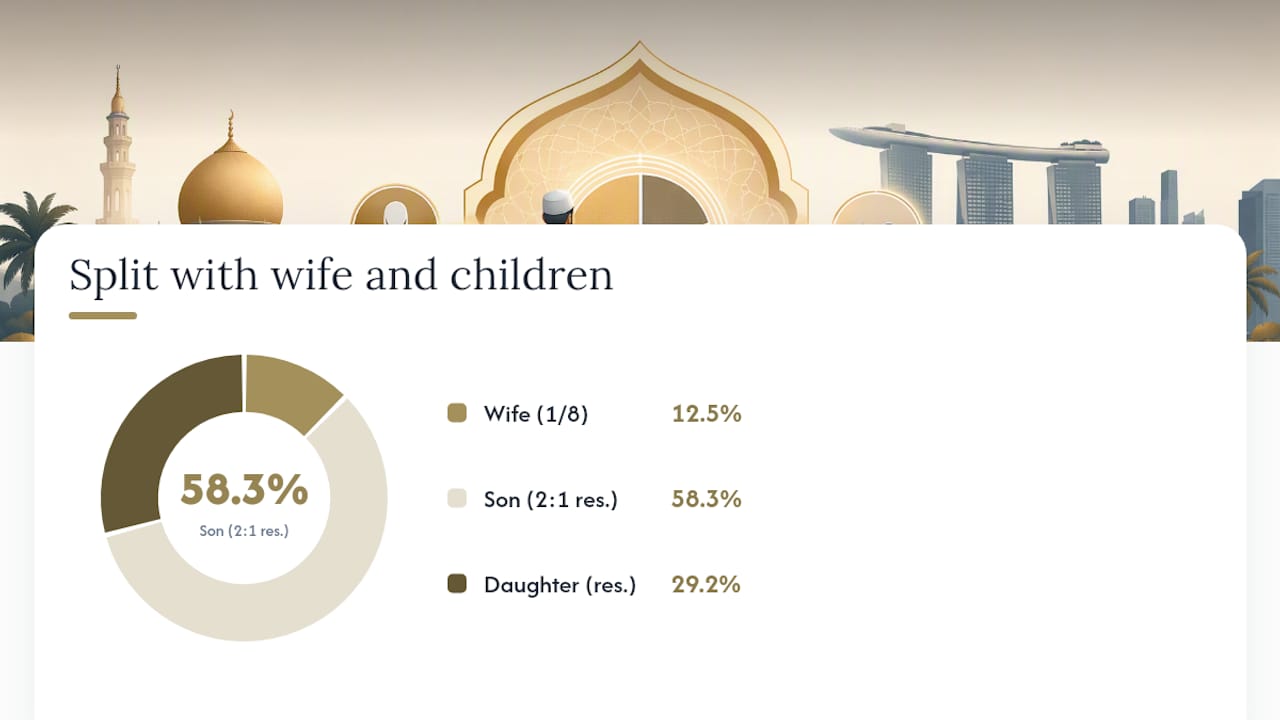
Worked Example 2 — Wife, one son, one daughter: Estate after debts: $400,000.
Wife (with children): 1/8 = $50,000
Remaining $350,000 goes to son and daughter as residuary heirs in a 2:1 ratio.
Son: $350,000 × 2/3 ≈ $233,333
Daughter: $350,000 × 1/3 ≈ $116,667
Debts, funeral expenses, and any valid Wasiat distributions are deducted from the gross estate before Faraid shares are calculated. Getting that order wrong is one of the most common errors families make, and it produces incorrect share figures for every heir.
Pro Tip: Edge cases — multiple wives, predeceased children whose own children may inherit by right of representation, or adopted children (who do not inherit under Faraid) — shift the calculation significantly. Run those scenarios through the Syariah Court inheritance calculator before assuming you know the outcome.
What a Wasiat can and cannot do
A Wasiat is a Muslim will. It is not a substitute for Faraid — it operates alongside it, within strict limits.
The one-third rule. A Wasiat can direct up to one-third of the net estate (after debts and funeral costs) to beneficiaries who are not Faraid heirs. A non-Muslim spouse, a charity, or a friend can receive a bequest this way. You cannot use a Wasiat to increase a Faraid heir’s share unless all other Faraid heirs consent after your death — and that consent must be given freely, not assumed.
Validity requirements in Singapore:
The testator must be Muslim, at least 21 years old, and of sound mind at the time of signing.
The Wasiat must be signed in the presence of two Muslim male witnesses who are not beneficiaries under the document.
The witnesses must also sign in the testator’s presence.
A common mistake is using a standard civil will format and assuming it satisfies Wasiat rules. It usually does not. Many DIY wills fail on the witness requirement alone — a non-Muslim witness, a female witness, or a witness who is also a beneficiary invalidates the document under Singapore’s requirements.
Checklist for a valid Wasiat:
Testator is Muslim, 21+, sound mind
Two Muslim male witnesses, neither a beneficiary
Bequest does not exceed one-third of net estate
Document clearly identifies the beneficiary and the asset or share being bequeathed
Debts are accounted for before the one-third is calculated
If there is no valid Wasiat and no civil will, the estate administrator will need Letters of Administration from the Family Justice Courts — a process that typically takes longer than probate where a will exists.
How to apply for an Inheritance Certificate at the Syariah Court
The application process runs entirely through the SYC Portal and requires a SingPass login. Here is the sequence:
Register or log in to the SYC Portal at syariahcourt.gov.sg using your SingPass credentials.
Complete the online application form. You will enter details about the deceased (name, NRIC, date and place of death, domicile) and list all potential heirs with their relationship to the deceased.
Upload supporting documents. Death certificate, identity documents for all heirs, marriage certificate(s), and any other relationship-proof documents the portal requests.
Download the Statutory Declaration (SD) template from your application dashboard once the Court has reviewed your submission.
Affirm the SD before a Commissioner for Oaths. This is a legal affirmation that the information you have provided is true. Commissioners for Oaths are available at law firms and some community legal clinics.
Upload the affirmed SD back to the portal within the 60-day validity window. Missing this deadline means starting the application again.
Pay the application fee. The current fee is payable via PayNow, eNETS, or credit card through the portal. The Inheritance Certificate is issued and available for download after payment is confirmed.
Key timelines to track:
Each submission step carries a processing time of approximately 7 working days.
The entire application, from initial submission to certificate download, must be completed within the 60-day validity period.
Once issued, the certificate is downloadable from your SYC Portal dashboard.
If your documents include anything not in English or Malay, you will need certified translations before uploading. Non-compliant documents are a leading cause of re-submissions and wasted time.
How the Syariah Court and Family Justice Courts work together
The Syariah Court and the Family Justice Courts play different roles, and both are often needed before an estate is fully distributed.
The Syariah Court’s job is identification: it issues the Inheritance Certificate that names the lawful heirs and their shares. It does not transfer property, close bank accounts, or resolve factual disputes about relationships. The Family Justice Courts (or the Public Trustee) handle the civil side — issuing the Grant of Probate (if there is a valid Wasiat or civil will) or Letters of Administration (if there is not) that financial institutions and the Singapore Land Authority require before they will release or transfer assets.
Syariah Court | Family Justice Courts / Public Trustee | |
Role | Identifies heirs and Faraid shares | Issues civil grants to effect asset transfers |
Output | Inheritance Certificate | Grant of Probate or Letters of Administration |
Scope | Muslim law (Faraid) | Civil law (estate administration) |
Disputes | Does not resolve factual disputes | Can adjudicate contested estates |
Trigger | Required for all Muslim intestate estates | Required when assets need a civil grant to transfer |
Practical sequence:
Obtain the death certificate → calculate the estate and outstanding debts → run the Syariah Court calculator to estimate shares → apply for the Inheritance Certificate via the SYC Portal → use the issued certificate to apply for probate or Letters of Administration at the Family Justice Courts where required → distribute assets to heirs.
Assets that typically require a civil grant before transfer:
Real property held solely in the deceased’s name (Singapore Land Authority requires a court order or grant)
Bank accounts above certain thresholds where the bank requires a grant
Shares held in the deceased’s sole name through CDP (Central Depository)
Motor vehicles registered solely in the deceased’s name
What happens when there are no eligible heirs
If a Muslim dies in Singapore with no lawful Faraid heirs — or if heirs have received their shares and a remainder is left — the unclaimed portion passes to Baitulmal, administered by MUIS. MUIS describes Baitulmal as the Islamic treasury that collects and manages estates with no rightful claimants.
Conditions that trigger Baitulmal:
No surviving Faraid heirs at all
All heirs have received their shares and a residue remains
Heirs are unknown or cannot be located after reasonable effort
If you believe an estate may pass to Baitulmal, contact MUIS directly. The administrative steps generally involve the Syariah Court confirming the absence of heirs in the Inheritance Certificate, after which MUIS takes over as trustee of the remaining estate.
One planning tool worth knowing: a Deed of Family Undertaking allows a Faraid beneficiary who has already received their lawful share to redirect that benefit to another person. This is not a way to override Faraid — the heir must first receive their share — but it gives families a legitimate mechanism to redirect assets after distribution if circumstances warrant it.
Documents you will need and how to handle the statutory declaration
Getting your documents right before you log into the SYC Portal saves significant time. The portal’s 60-day clock starts from your initial submission, and re-submissions reset your progress.
Core document checklist:
Death certificate of the deceased (original or certified true copy)
NRIC or passport of the deceased
NRIC or passport of all potential heirs
Marriage certificate(s) — original or certified true copy
Birth certificates for children claiming as heirs
CPF nomination details (if relevant to the estate)
Asset statements (bank accounts, property title, share certificates)
Wasiat or civil will, if one exists
Letter of authority if you are applying on behalf of another person
For foreign documents, certified translations into English or Malay are required. A certified true copy of a death certificate or a certified copy of a marriage certificate from a notary service speeds the process when original documents are held overseas or need authentication.
The Statutory Declaration (SD): Once the Syariah Court approves your initial submission, you download the SD template from your dashboard. You then appear before a Commissioner for Oaths — available at most law firms — who witnesses your affirmation that the information in the application is true and correct. You sign the SD in their presence, they stamp and sign it, and you upload the affirmed document back to the portal.
Pro Tip: Bring certified true copies of every document to the Commissioner for Oaths appointment, not originals. If the Commissioner needs to sight the originals, bring those too — but submit copies. The SYC Portal accepts scanned certified copies, not original documents by post.
Practical tools and sample templates
Three official tools do most of the heavy lifting for families navigating this process.
Syariah Court Online Trial Inheritance Calculator Available at syariahcourt.gov.sg, the calculator lets you input the deceased’s heirs and the estate value to see a projected distribution. Before you open it, prepare: a list of all surviving relatives (spouse, children, parents, siblings), the estimated net estate value after debts, and the madhab. Save or print the results — they are useful as a reference when completing the formal application, though they carry no legal weight.
Statutory Declaration template The SD template is available directly from your SYC Portal dashboard after your application is approved in principle. Do not use a generic SD template from another source — the Syariah Court’s version is specific to inheritance applications.
Wasiat templates and guidance MUIS publishes guidance on Wasiat requirements at muis.gov.sg. For a legally compliant Wasiat, the template is a starting point only — the witness requirements and the one-third calculation need professional review before signing.
When to consult a specialist
A straightforward estate — one wife, two children, no overseas assets, no business interests — can often be handled by the family with the SYC Portal tools and a Commissioner for Oaths. More complex situations usually need a Syariah lawyer or an estate planner from the start.
Situations that typically need professional help:
The deceased held business interests (sole proprietorship, partnership, company shares)
There are overseas assets subject to foreign law
The family includes a blended structure (children from multiple marriages, adopted children)
Heirs are in dispute about relationships or asset values
The estate is large enough that trust structures would reduce risk or tax exposure
A Wasiat needs drafting or reviewing for compliance with Singapore requirements
What a specialist typically does:
Reviews the estate structure and identifies which assets fall under Faraid versus civil law
Drafts or reviews the Wasiat for compliance with MUIS and Singapore requirements
Prepares the SD and coordinates the SYC Portal application
Applies for probate or Letters of Administration at the Family Justice Courts
Advises on trust structures — a living trust or private trust company can hold assets outside the Faraid estate, giving families more flexibility for complex succession goals
Typical engagement flow: Initial consultation to map the estate → document review and gap analysis → drafting of Wasiat and/or trust documents → SYC Portal application and SD coordination → Family Justice Courts application where required → distribution oversight.
A practitioner’s view on what actually goes wrong
The Syariah Court process is well-designed, but families consistently hit the same friction points. The 60-day validity window is the most punishing: if you submit your application and then take three weeks to gather documents before affirming the SD, you may find yourself restarting. Start document collection before you log into the portal, not after.
Witness errors on Wasiat documents are the second most common problem. A testator who asks a son-in-law to witness the Wasiat — not realizing the son-in-law is technically a beneficiary through the daughter — has invalidated the document. The two-witness rule sounds simple; in practice, finding two Muslim male witnesses who have no interest in the estate requires thought.
The third issue is debt sequencing. Families sometimes calculate Faraid shares on the gross estate, then discover there are outstanding loans, funeral costs, or a Wasiat bequest that reduces the distributable amount. Every heir’s share then needs recalculating. Do the debt and expense calculation first, always.
For readers ready to get professional support, booking a consultation with an estate planner who understands both the Syariah Court process and civil probate is the fastest way to avoid these delays.
Professional estate planning for Muslim families in Singapore
Muslim estate planning in Singapore sits at the intersection of Syariah law and civil procedure — and that intersection is exactly where most families need guidance. Elitelegacyplanning works with Muslim individuals and high-net-worth families to handle the full scope: comprehensive will drafting that meets Wasiat requirements, trust consultation for assets you want to hold outside the Faraid estate, and end-to-end coordination of the SYC Portal application and civil probate process.
Where most families spend weeks gathering documents and navigating two separate court systems alone, Elitelegacyplanning handles the sequencing — Syariah Court, Family Justice Courts, and asset transfers — as a single coordinated engagement. A first consultation covers your estate structure, identifies which assets fall under Faraid, flags any Wasiat compliance gaps, and produces a clear document checklist so nothing delays your application. Services are fee-based, and pricing details are available on the plans and pricing page. To get started, book a consultation online.
Sources
These are the primary official sources for Muslim inheritance in Singapore. Use them for current forms, fee schedules, and official guidance — do not rely on third-party summaries for legal requirements that change.
For applications, always download forms and SD templates directly from the SYC Portal dashboard — not from third-party sites — to confirm you are using the current version.
Recommended
Comments