


Living Trust Singapore: Privacy, Probate, and Protection

A living trust in Singapore is a private legal structure you create and fund during your lifetime, placing assets under a trustee’s management for your chosen beneficiaries, active from the moment it is funded and typically bypassing probate entirely. Three situations make it especially worth considering:
Privacy and probate avoidance: Unlike a will, a living trust does not pass through the public probate process, keeping your asset distribution private and faster.
Incapacity continuity: If you lose mental capacity, your trustee can manage assets immediately without waiting for court-appointed deputies under the Mental Capacity Act.
Flexible and cross-border distributions: You can set conditions, stagger payouts to minor children, and consolidate assets across multiple jurisdictions under one structure.
The sections below cover trust types, a step-by-step setup checklist, realistic costs, common pitfalls, and how Elitelegacyplanning can help you put the right structure in place.
Table of Contents
What is a living trust in Singapore and how does the law treat it?
A living trust, formally called an inter vivos trust, is created during the settlor’s lifetime; assets transferred into it are managed by a trustee for named beneficiaries, and the trust becomes active once funded. That last point matters: a trust deed sitting in a drawer with no assets transferred into it does nothing.
Four roles define every trust:
Settlor: The person who creates the trust and transfers assets into it.
Trustee: The individual or licensed company that holds legal title to trust assets and manages them according to the deed.
Beneficiaries: The people (or entities) who receive the benefit of those assets.
Trust deed: The governing document that spells out the trustee’s powers, distribution rules, and any conditions.
A living trust differs from a testamentary trust, which is created inside a will and only comes into effect after death. A living trust is active now.
Revocable vs. irrevocable is the other key distinction. A revocable trust lets you amend or dissolve it during your lifetime; an irrevocable trust generally cannot be changed once established, which is why it offers stronger asset protection but less flexibility.
On the legal framework: Singapore trusts are governed primarily by the Trustees Act (Cap. 337) and English common law principles. Private trusts do not require public registration, which is a significant privacy advantage. When a licensed trust company acts as trustee, it falls under the Trust Companies Act and the oversight of the Monetary Authority of Singapore (MAS), including KYC and AML obligations. For general public guidance on trusts, MoneySense provides accessible, government-backed explanations.
How a living trust actually works after you create it
The trust deed is just the beginning. What follows is the operational reality most guides skip.
Establish ongoing administration — Open trust bank accounts, set up accounting records, and agree on a reporting cadence with your trustee. Licensed trustees in Singapore have strict fiduciary duties, including prudent investment management and regular reporting.
Set distribution triggers and procedures — Specify what triggers a distribution: a child reaching 25, a beneficiary completing university, or your incapacity. A well-drafted deed lets the trustee act immediately when incapacity occurs, without court intervention, which is a practical advantage over relying solely on a will.
Pro Tip: The single most common and costly mistake is an unfunded trust. The deed is signed, the legal fees are paid, and then nothing is transferred. Verify every asset transfer in writing, confirm retitling with your bank and broker, and check the land title register for any property. An unfunded trust offers zero protection.
What types of living trusts are commonly used in Singapore?
Singapore’s trust framework accommodates several structures. The right one depends on your goals, asset complexity, and family situation.
Revocable living trust is the most common starting point. You retain control, can amend the deed, and the trust activates for incapacity management or seamless transfer on death. Best for: individuals who want probate avoidance and incapacity protection without giving up flexibility.

Irrevocable trust removes assets from your personal estate once transferred. That separation is what makes it useful for asset protection and certain tax planning scenarios. The trade-off is loss of control. Best for: business owners protecting assets from future creditors or families with specific tax structuring needs.
Discretionary trust gives the trustee broad discretion over how and when to distribute to beneficiaries. No beneficiary has a fixed entitlement until the trustee exercises discretion. Best for: family succession planning where circumstances may change and rigid distribution rules would be counterproductive.
Special-needs trust is designed for beneficiaries with disabilities who require lifelong financial support. The Special Needs Trust Company (SNTC), a government-backed entity, provides this service specifically for Singaporeans with special needs, offering a regulated and affordable option for families in this situation.
Standby / AssureTrust is a practical continuity structure where the trust is established and funded but remains largely dormant until a triggering event, typically incapacity or death. Elitelegacyplanning’s Standby / Living Trust product is built around this model.
Private Trust Company (PTC) is a bespoke corporate trustee structure set up specifically to administer one family’s trusts. It gives the family direct governance involvement while maintaining the legal separation of a corporate trustee. Best for: ultra-high-net-worth families with complex multi-generational succession needs. Elitelegacyplanning offers a dedicated Private Trust Company setup service for families at this level.
One important limitation: CPF savings cannot be placed in a trust under Singapore law. CPF nominations operate under a separate statutory regime. Always verify which specific assets are eligible for transfer before drafting the deed.
When deciding between an individual trustee and a corporate trustee, the practical question is continuity. An individual trustee may die, lose capacity, or simply become unavailable. A licensed trust company provides institutional continuity, regulatory accountability, and professional administration, which matters most for long-duration or complex trusts.
What are the real pros and cons of a living trust for Singapore families?
Benefits worth taking seriously:
Probate avoidance: Assets in a properly funded trust pass to beneficiaries without going through the Singapore courts’ probate and administration process, saving time and legal costs.
Privacy: Because private trusts are not publicly registered in Singapore, the distribution of your assets stays confidential. A grant of probate, by contrast, becomes a public document.
Incapacity management: A funded living trust allows the trustee to act immediately without court-appointed deputies, which is faster and less expensive than the Mental Capacity Act deputyship process.
Control over timing: You can specify that a child receives assets at 30 rather than 21, or that distributions are conditional on completing education. A will cannot do this with the same operational precision.
Cross-border asset consolidation: Families with property or investments in multiple jurisdictions can consolidate them under one trust structure, avoiding separate probate proceedings in each country.
Drawbacks that affect the decision:
Higher setup and ongoing costs: Legal drafting, trustee fees, and annual administration costs add up. Professional advice is recommended before establishing a trust because the ongoing accounting and legal complexity is real.
Funding burden: Every asset must be individually retitled. Miss one, and it falls back into your estate and goes through probate anyway.
Limited creditor protection in some structures: A revocable trust generally does not protect assets from creditors because you retain control. Creditor protection requires an irrevocable structure, and even then the outcome is fact-specific.
A will is still necessary: A living trust does not cover assets acquired after funding that were never transferred in, nor does it appoint guardians for minor children. You still need a will for those purposes.
LPA remains relevant: A Lasting Power of Attorney covers personal welfare and financial decisions outside the trust’s scope. A living trust and an LPA work together, not as substitutes.
Living trust vs. will: which one fits your situation?
The core trade-off is straightforward: wills are simpler and cheaper upfront but trigger public probate; living trusts cost more to set up and require active funding but deliver privacy, incapacity coverage, and faster asset transfer.

Dimension | Will | Revocable living trust |
Cost | Lower drafting cost; probate adds legal fees later | Higher setup cost; saves probate fees on death |
Privacy | Probate grant is a public record | No public registry for private trusts in Singapore |
Incapacity planning | Does not activate until death; requires separate LPA | Trustee acts immediately on incapacity, no court needed |
Funding requirement | None; covers all assets at death | Every asset must be individually retitled into the trust |
Multi-jurisdiction property | Separate probate in each country | Single trust structure can cover multiple jurisdictions |
When a will is enough: You have a straightforward estate, assets in one jurisdiction, no incapacity concerns, and privacy is not a priority.
When a living trust is the stronger choice: You hold property in more than one country, have minor children or a vulnerable beneficiary, want to avoid probate delays, or need a structure that activates immediately if you lose capacity. High-net-worth individuals and business owners in Singapore almost always benefit from a trust alongside a will, not instead of one.
How to set up and fund a living trust in Singapore
The process has more moving parts than most people expect. Work through this checklist with your advisors.
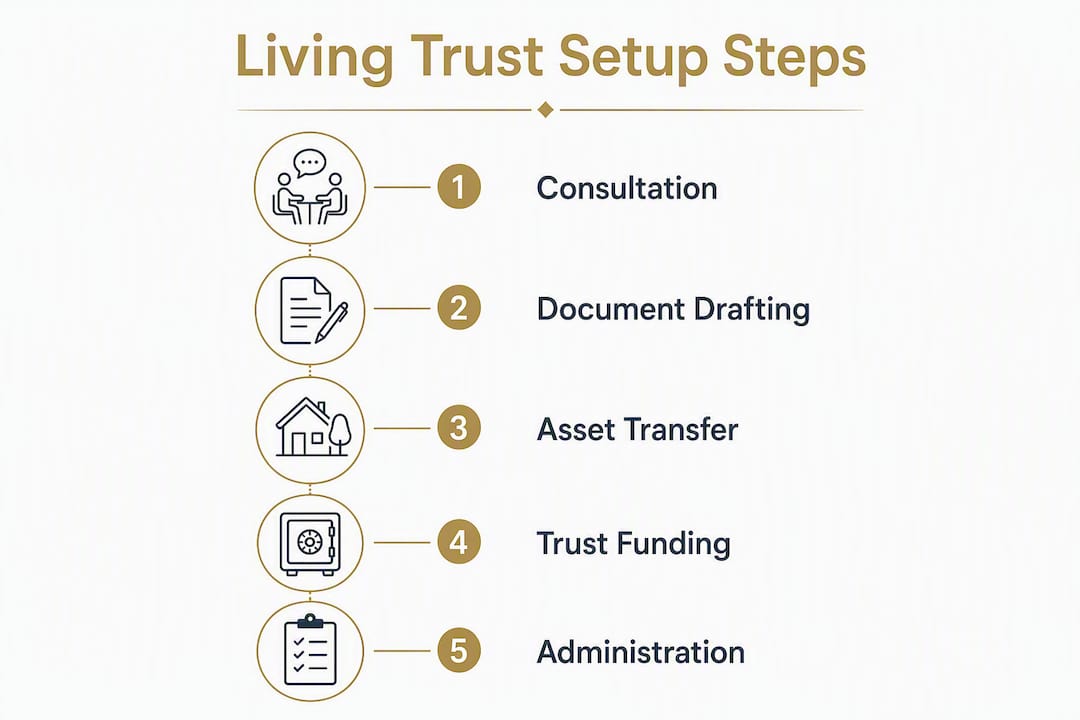
Inventory your assets. List every asset by type: bank accounts, brokerage accounts, shares, property, business interests, insurance policies. Note which are CPF-linked (cannot be transferred) and which are held jointly.
Engage a qualified estate planning advisor. Confirm they have experience with Singapore trust law and can coordinate with conveyancers and licensed trustees.
Define trust objectives and beneficiary terms. Decide on distribution conditions, ages, and any trustee discretion provisions before drafting begins.
Draft and review the trust deed. Review the trustee’s powers, investment mandate, succession of trustees, and exit provisions carefully. Ask for a redacted sample deed to benchmark governance clauses.
Select and onboard your trustee. Confirm licensing status with MAS if using a corporate trustee. Agree on fee schedules, reporting frequency, and investment policy in writing before signing.
Fund bank and brokerage accounts. Contact each institution with a trustee letter and account retitling instructions. Get written confirmation that the retitling is complete.
Transfer shares and business interests. Execute share transfer instruments. Update the company’s share register. For private companies, check the constitution for any transfer restrictions.
Fund property. This requires conveyancing. The title must be transferred to the trustee at the Singapore Land Authority. Check stamp duty implications with IRAS before proceeding.
Notify relevant service providers. Inform insurers, fund managers, and any other asset custodians of the new trust ownership.
Maintain an updated asset inventory. Any asset acquired after the trust is funded must be actively transferred in. A standing instruction to your advisor to review the inventory annually prevents gaps.
Documents you will need: Trust deed, asset transfer forms, trustee letters to banks and brokers, share transfer instruments, conveyancing instructions for land title changes, and written confirmation of each completed transfer.
Pro Tip: Property transfers into a trust trigger stamp duty and require a formal conveyancing process at the Singapore Land Authority. Engage your conveyancer at the same time as your trust lawyer, not after. Discovering a stamp duty issue after the deed is signed can delay funding by weeks and add unexpected costs. Check IRAS guidance on trust-related property transfers early in the process.
What does it cost and how long does it take?
Costs vary significantly by complexity, but the categories are consistent.
Cost category | What it covers | Indicative range |
Legal drafting fees | Trust deed preparation and review | Varies by complexity; full-service firms charge more than template services |
Trustee setup fee | Onboarding, KYC, account opening | Varies by provider; ask for an itemized quote |
Annual trustee / admin fee | Ongoing administration, reporting, compliance | Recurring; higher for licensed corporate trustees |
Conveyancing and stamp duty | Property title transfer into trust | Stamp duty is asset-value dependent; conveyancing fees vary by firm |
Tax and accounting | Trust income tax filings, IRAS compliance | Annual; depends on trust income and complexity |
DIY / template route | Online deed templates without legal advice | Documented DIY costs vary widely but carry significant legal and funding risks for complex or cross-border estates |
For a simple revocable trust with a single jurisdiction and limited assets, a full-service setup in Singapore typically takes 3–6 weeks from engagement to funded trust. Cross-border structures, property transfers, or private trust company setups take longer, often 2–4 months, depending on asset complexity and trustee onboarding requirements.
Always request an itemized fee schedule before engaging any provider. Ask specifically: what is included in the setup fee, what triggers additional charges, and what the annual administration fee covers. Vague bundled pricing is a red flag.
What are the red flags and common mistakes to watch for?
Checklist of red flags when evaluating providers and deeds:
Unfunded trust deed. The most common failure. The deed is signed but assets are never retitled. Verify every transfer in writing.
Opaque fee schedules. Any trustee who cannot provide a clear, itemized fee schedule before engagement is not ready to be your trustee.
Unlicensed corporate trustees. If a company is acting as trustee for compensation, verify its licensing status on the MAS register. Unlicensed trustees operating commercially are a regulatory and legal risk.
No KYC/AML procedures. Licensed trustees in Singapore are required to conduct customer due diligence. A trustee who skips this step is not compliant.
Guarantees of absolute creditor protection. No trust structure in Singapore provides unconditional creditor protection. Anyone who promises otherwise is either misinformed or misleading you.
CPF and nominee blind spots. A trust deed that purports to cover CPF savings is legally ineffective. Confirm the deed explicitly excludes CPF and that your CPF nominations are handled separately.
No succession plan for the trustee. What happens if your individual trustee dies or loses capacity? The deed must address trustee succession clearly.
Trustee selection criteria: Look for relevant experience with Singapore trust law, independence from your estate’s beneficiaries, transparent fee model, clear reporting cadence, and verifiable references. For corporate trustees, confirm MAS licensing and ask about their AML/KYC procedures and investment policy framework.
Pro Tip: Ask any prospective trustee for a redacted sample trust deed or a summary of their standard governance clauses. This tells you immediately whether their deed addresses trustee succession, investment mandates, and beneficiary dispute resolution, or whether it is a bare-bones template. A trustee who cannot or will not share this is not a trustee you want managing your family’s assets.
How Elitelegacyplanning approaches living trusts
Elitelegacyplanning works with Singapore residents and HNW families through a structured four-stage process: initial consultation and goals assessment, trust deed drafting and review, trustee onboarding and funding assistance, and ongoing lifetime advisory and administration.
The firm’s Trust Consultation & Lifetime Advisory service addresses the operational gap that catches most clients off guard: the trust is drafted but never properly funded. Elitelegacyplanning’s integrated funding assistance covers bank account retitling, share transfers, and coordination with conveyancers for property, so the trust is actually operational, not just documented.
For families who need a bespoke governance structure, the Private Trust Company option provides a dedicated corporate trustee vehicle with direct family involvement in governance. For clients who want a practical continuity structure without full PTC complexity, the Standby / Living Trust product delivers the same probate avoidance and incapacity protection in a more accessible format.
Services relevant to living trust clients include: trust consultation and lifetime advisory, standby/living trust setup, private trust company formation, deed drafting, funding assistance, conveyancing coordination, and corporate executorship.
Readers who are ready to take the next step can book a consultation online to discuss their specific asset profile and objectives.
Key Takeaways
A properly funded living trust is one of the most effective tools available to Singapore residents for combining probate avoidance, incapacity protection, and controlled multi-generational wealth transfer.
Point | Details |
Funding is non-negotiable | A trust deed without retitled assets provides no protection; verify every transfer in writing. |
Living trust vs. will | Trusts cost more upfront but deliver privacy, incapacity coverage, and probate avoidance that a will cannot match. |
CPF stays outside the trust | CPF savings cannot be placed in a trust; handle CPF nominations separately under the statutory regime. |
Combine your tools | A living trust works alongside a will and LPA, not as a replacement; each covers different gaps. |
Elitelegacyplanning | Offers end-to-end living trust setup, funding assistance, and lifetime advisory for Singapore residents and HNW families. |
Why most people set up a trust too late
The clients who get the most value from a living trust are almost never the ones who came in after a health scare or a family dispute. They are the ones who planned while everything was still calm: parents with young children who wanted to ensure assets would be managed sensibly if something happened to both of them, business owners who realized their company shares would be stuck in probate for months without a trust, and families with overseas property who had already watched a relative spend two years navigating foreign probate courts.
The mistake I see most often is treating a living trust as a product to buy rather than a structure to build. The deed is the easy part. The hard part is the funding, the trustee relationship, the annual reviews, and the discipline to transfer new assets in as your estate grows. That is where most DIY and low-cost approaches break down, and where the difference between a trust that works and one that looks good on paper becomes very real.
If you are reading this with a specific situation in mind, bring an asset inventory and your current will or draft deed to your first consultation. The conversation will be far more productive, and you will leave with a concrete plan rather than a general overview.
Elitelegacyplanning: end-to-end trust setup for Singapore families
For Singapore residents who want a living trust that is actually funded and administered, not just drafted, Elitelegacyplanning offers the full spectrum: Standby / Living Trust setup, Private Trust Company formation, Trust Consultation & Lifetime Advisory, and property trust coordination. The firm’s specialist focus on HNW clients means the process is built around complex estates, not simplified for the average case.

What sets Elitelegacyplanning apart from generic legal services is the end-to-end funding support. Most clients who come in after using a template service have a signed deed and zero funded assets. Elitelegacyplanning’s advisors coordinate directly with banks, brokers, and conveyancers to complete every transfer, so the trust is operational from day one. Lifetime advisory means the structure is reviewed as your estate evolves, not left static after the initial setup.
If you are ready to put a properly structured and funded trust in place, book your consultation online or visit the Standby / Living Trust service page to review the offering in detail.
This article provides general information about living trusts in Singapore and is not legal, tax, or financial advice. Consult a qualified Singapore lawyer or licensed trust company for guidance specific to your situation.
Useful sources and further reading
MoneySense: What is a trust? — Singapore government’s accessible overview of trust basics, roles, and terminology.
Trustees Act (Cap. 337) — The primary legislation governing trustee duties and powers in Singapore.
Trust Companies Act — Governs the licensing and regulation of trust companies by MAS.
RSBU: Living Trusts in Singapore — Detailed guide covering asset protection, MAS regulation, and common use cases for Singapore trusts.
IRB Law: An Overview to Trusts in Singapore — Practical legal overview of Singapore trust law, governing legislation, and private trust registration rules.
IRAS: Trust income tax — IRAS guidance on how trust income is taxed in Singapore, relevant for trustees and beneficiaries.
Singapore Judiciary: Probate and Administration — Official court guidance on the probate process a living trust helps you avoid.
Special Needs Trust Company (SNTC) — Government-backed trust service for Singaporeans with special needs; relevant for families planning long-term care.
Elitelegacyplanning: Standby / Living Trust — Service detail for Singapore residents ready to set up a living trust with professional funding support.
Recommended
Comments