


Grant of Probate in Singapore: A Step-by-Step Guide


A Grant of Probate is the court order that legally recognizes a named executor to collect, manage, and distribute a deceased person’s estate in Singapore. According to the Family Justice Courts, if you are the named executor, your first move is straightforward: locate the original will and the original death certificate, then run a quick eligibility check before filing.
Before you do anything else, gather these items:
Original will (not a photocopy — the Registry will inspect the original)
Original death certificate issued by the Registry of Births and Deaths
Your NRIC or passport as the named executor
A rough list of the deceased’s assets (bank accounts, property, CPF, investments)
Contact details for any other named executors, if applicable
Most executors handling a straightforward Singapore estate can self-file using the Probate eService. If the estate involves foreign assets, multiple executors, or a contested will, engaging a lawyer from the start saves time and avoids costly re-filings.
Key Takeaways
A Grant of Probate in Singapore requires a valid will, a named executor, and an approved Schedule of Assets before the court will issue the grant — the SOA is the most common bottleneck.
Point | Details |
Start with originals | Locate the original will and death certificate before opening any court application. |
Check eService eligibility | Sole executors with straightforward Singapore estates can file online via the Probate eService. |
File the SOA early | Submitting the Schedule of Assets with the Supporting Affidavit avoids a Supplementary Affidavit and weeks of delay. |
Budget for fees and time | Court fees start at S$200 for the originating application; a S$400 deposit is commonly required upfront. |
Elitelegacyplanning | Supports executors with SOA preparation, bank coordination, and full corporate executorship for complex estates. |
Table of Contents
What is a Grant of Probate in Singapore?
A Grant of Probate is a court order issued by the Family Justice Courts that formally recognizes the executor named in a will and authorizes that person to administer the deceased’s estate. Without it, banks, the Land Titles Registry, and most financial institutions will not release assets to anyone, regardless of what the will says.
Grant of Probate vs. Letters of Administration. The distinction turns on whether the deceased left a valid will. When there is a will and a named executor, the executor applies for a Grant of Probate. When there is no will (intestacy), or when the named executor cannot or will not act, the next-of-kin applies for Letters of Administration instead, and the estate is distributed under the Intestate Succession Act. The application process is similar, but the legal basis and the applicant’s authority differ.
The governing legal framework rests on three pillars: the Probate and Administration Act, which sets out the substantive rules for estate administration; the Family Justice (Probate and Other Matters) Rules 2024, which govern procedure; and Part 24 of the Family Justice Courts Practice Directions, which specifies filing requirements, prescribed forms, and documentary standards for non-contentious probate proceedings.
Who can apply for a Grant of Probate?
The core eligibility rule is simple: you must be the executor named in a valid will. That said, several edge cases come up regularly.
Multiple executors. When a will names more than one executor, all named executors may apply jointly, or one may apply with the others reserving their right to apply later (known as “power reserved”). If one executor has died or is incapacitated, a supporting affidavit explaining the circumstances is typically required.
Renunciation. An executor who does not wish to act can formally renounce the role by filing a Deed of Renunciation. Once renounced, that person cannot later reclaim the executorship without court permission.
Executor deceased or untraceable. If the sole named executor has died, the estate may need to apply for Letters of Administration with the will annexed rather than a standard Grant of Probate.
Before filing, run through this quick eligibility checklist:
There is an original, signed, and properly witnessed will
You are expressly named as executor in that will
The will has not been revoked by a later will or codicil
The estate is not small enough to qualify for a simplified Public Trustee route (see below)
No other executor has already obtained a grant for the same estate
For very small estates, the Public Trustee’s Office may administer the estate without a court grant, which can save time and cost for families with limited assets.
When do you actually need a Grant of Probate?
Not every asset in a Singapore estate requires a court grant to transfer. Knowing which assets do and which do not can save weeks of unnecessary filing.
Assets that typically require a grant:
Sole bank accounts held in the deceased’s name only
Private property held as tenants-in-common (not joint tenancy with right of survivorship)
Shares and securities in the deceased’s sole name
Outstanding debts owed to the deceased
Assets that often do not require a grant:
CPF savings (distributed directly to nominated beneficiaries outside the estate)
Life insurance proceeds with a valid nomination
HDB flat held under joint tenancy (passes by survivorship, not through the estate)
Some joint bank accounts, depending on the bank’s internal policy
The threshold matters here. Estates of relatively low value may qualify for simplified procedures through the Public Trustee or through direct release by financial institutions, without a full court grant. For more on small-estate strategies, the Estate Enhancement Strategies resource from Elitelegacyplanning covers these options in practical terms.
Pro Tip: Before filing anything, call each bank and institution holding the deceased’s assets and ask directly whether they require a Grant of Probate or will release funds under their own small-estate policy. Some banks release balances below a certain threshold on production of the death certificate and a statutory declaration alone. That one phone call can eliminate weeks of court filings.
What documents do you need before you file?
Gathering documents before you open the court application prevents the most common cause of delay: incomplete submissions. Here is what the Family Justice Courts expect.
Core documents:
Original will (the physical document — not a scan or photocopy)
Original death certificate
NRIC or passport of the executor(s)
Certified true copies of the will and death certificate where required
Court-specific filings you will prepare:
Originating Application (the formal application to the court)
Supporting Affidavit (sworn statement by the executor confirming the will’s validity and the deceased’s details)
Administration Oath (oath taken by the executor accepting the duties of the role)
Schedule of Assets (SOA) (a full inventory of the estate’s assets and liabilities with valuations)
Supplementary Affidavit (required if the SOA is filed separately after the Supporting Affidavit)
Per the Family Justice Courts’ guidance on supporting documents, the Supporting Affidavit and Administration Oath must generally be filed within 14 days of the Originating Application. If you file the SOA later, you must also file a Supplementary Affidavit confirming its accuracy — an avoidable extra step if you prepare the SOA upfront.
Additional evidence for specific assets:
Recent bank statements or account confirmation letters
Property title documents (from the Singapore Land Authority)
CPF statement (for informational purposes in the SOA)
All sworn or affirmed documents must be executed before a Commissioner for Oaths. Certified true copies of the will and death certificate carry a small fee (typically S$17 per copy for the will, per the court’s published schedule).
Pro Tip: Start drafting the Schedule of Assets the day you begin gathering documents. The SOA requires valuations for every asset — property, shares, bank balances, vehicles — and chasing those figures is the single biggest bottleneck in most Singapore probate applications. Getting bank confirmation letters and a property valuation early puts you weeks ahead.
How do you apply using the Probate eService?
The Probate eService is the Family Justice Courts’ online filing platform for straightforward Grant of Probate applications. It handles the bulk of the process digitally and attempts to retrieve the deceased’s information automatically from government records, which reduces manual data entry.
Who can use it: The eService is designed for cases with a sole executor, a valid Singapore will, and no complex foreign-law elements. Cases involving multiple executors, contested wills, or significant foreign assets generally cannot be processed through the eService and require manual filing instead.
Step-by-step eService workflow:
Run the eligibility check on the eService portal to confirm your case qualifies.
Create an eLitigation entry using your Singpass login.
Verify the deceased’s information — the system attempts to auto-retrieve details from government databases; review and confirm accuracy.
Upload scanned documents (will, death certificate, executor’s ID) as directed by the portal.
Make the deposit payment to cover estimated court fees (a deposit of S$400 is commonly required at this stage, per the court’s published fee schedule).
File the Supporting Affidavit and Administration Oath within 14 days of the Originating Application, sworn before a Commissioner for Oaths.
Present the original will at the Family Justice Courts Registry for physical inspection — the eService handles scanned copies initially, but the Registry requires the original for verification.
Download the Order in Terms once the court approves the application.
File the Schedule of Assets if not already submitted with the Supporting Affidavit.
Receive the Grant of Probate after the SOA is approved.
The Family Justice Courts have structured the process so that straightforward applications can be approved without a court hearing, which reduces the time and stress involved for families. That said, the eService is still evolving — keep your original documents organized and pre-book your Registry visit rather than assuming you can walk in.
Fee snapshot: The originating application fee is S$200. An optional printed grant costs S$30. Certified true copies of the will run S$17 each. A deposit (commonly S$400) is collected upfront and applied against the total fees due, per the Probate eService fee schedule.
What if your case is too complex for the eService?
Several situations push a probate application outside the eService’s scope and into manual filing territory.
Common triggers for manual filing or legal help:
Two or more executors acting jointly
A contested or disputed will
The deceased was domiciled outside Singapore, or the estate includes foreign property
The estate requires resealing of a foreign grant
Evidence of foreign law must be filed (for example, when the deceased held assets in another jurisdiction)
When foreign law is involved, Part 24 of the Practice Directions requires an affidavit of foreign law or a notarial certificate to be filed at the time of the Originating Application. This is not something most executors can prepare without legal assistance.
Manual filing process:
File through the Service Bureau at the Family Justice Courts (for self-represented applicants who cannot use eLitigation directly)
Swear all Supporting Affidavits and the Administration Oath before a Commissioner for Oaths before filing
Present original documents at the Registry as directed
Attend a hearing if the Registrar requires one
Submitting an eService application for a case that actually requires manual filing can result in rejection and re-filing fees. If you are unsure whether your case qualifies, a brief consultation with a lawyer before filing is cheaper than correcting a rejected application.
What are the court fees and how long does probate take?
Fee item | Amount (SGD) |
Originating Application | S$200 |
Printed Grant of Probate (optional) | S$30 |
Certified true copy of will | S$17 per copy |
Supporting Affidavit filing | Per court schedule |
Deposit (applied against total fees) | Commonly S$400 |
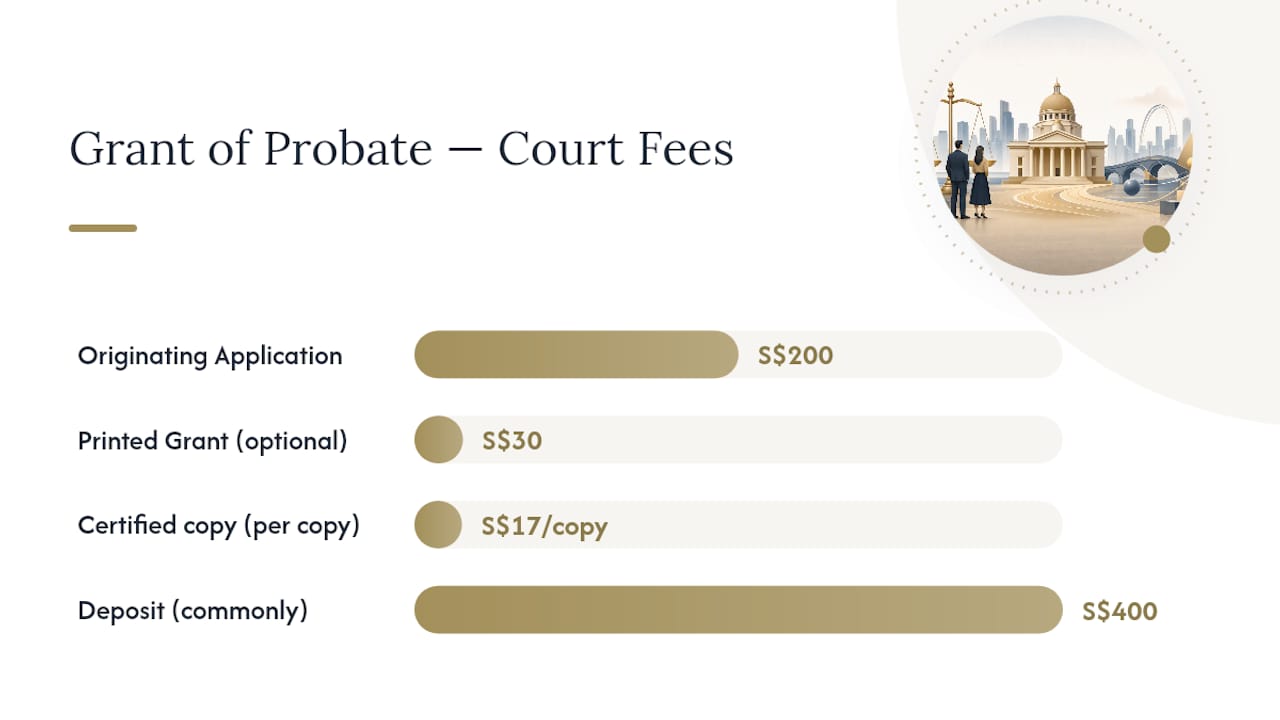
Source: Probate eService fee schedule, Family Justice Courts.
The deposit is collected upfront and offset against the fees that accrue as the application progresses. Any balance is refunded; if fees exceed the deposit, additional payment is required before the grant issues.
Timeline expectations:
For a straightforward eService case where all documents are in order and the SOA is filed with the Supporting Affidavit, the process from filing to grant issuance typically takes several weeks. Complex or manual cases that require a hearing, foreign-law evidence, or supplementary affidavits can extend to several months.
Common causes of delay:
SOA not filed at the same time as the Supporting Affidavit (triggers a Supplementary Affidavit requirement)
Missing or incorrect exhibits in the Supporting Affidavit
Original will not presented at Registry promptly
Foreign-law evidence missing or filed late
Asset valuations disputed or incomplete
Pro Tip: File the Schedule of Assets together with the Supporting Affidavit in a single submission. Doing so eliminates the need for a Supplementary Affidavit entirely and typically shaves weeks off the overall timeline. The SOA is the one document worth spending extra time on before you file anything.
Do you need a lawyer for a Grant of Probate?
MoneySense confirms that executors can apply for a Grant of Probate without a lawyer, and many do for straightforward estates. Whether self-representation is realistic depends on the estate’s complexity and your comfort with court forms.
Practical advantages of legal representation:
A lawyer prepares the Supporting Affidavit correctly, reducing the risk of rejection
Accurate SOA preparation, including proper asset valuations and liability treatment
Handling of foreign-law affidavits and notarial certificates
Managing objections or caveats filed against the estate
Direct liaison with banks, CPF Board, and the Land Titles Registry on your behalf
When self-representation is realistic:
The estate is in Singapore only, with no foreign assets
You are the sole executor
The will is clear and unambiguous
The asset list is straightforward (a few bank accounts, no contested property)
You are comfortable navigating eLitigation or the Service Bureau
Pros and cons at a glance:
Self-file pros: Lower cost, direct control over the process
Self-file cons: Risk of errors in affidavits, SOA valuations, or form selection; no buffer if a caveat is filed
Lawyer pros: Reduced error risk, faster resolution of complications, professional SOA preparation
Lawyer cons: Additional professional fees on top of court costs
Fee structures vary. Lawyers typically offer either a flat fee for straightforward probate matters or an hourly rate for complex estates. Getting a written quote before engaging is standard practice.
Common pitfalls and how to avoid them
Most probate delays in Singapore trace back to a handful of avoidable mistakes. Here is what practitioners see most often.
High-impact mistakes:
Late or incomplete Schedule of Assets. The grant cannot issue until the SOA is approved. Incomplete valuations or missing assets are the most common reason applications stall.
Incorrect asset valuations. Property must be valued at market value at the date of death. Using an outdated or estimated figure invites a Registrar query.
Missing original will at Registry inspection. The eService requires the original will to be presented physically. Executors who assume the scanned upload is sufficient arrive at the Registry unprepared.
Incorrectly sworn affidavits. Affidavits must be sworn or affirmed before a Commissioner for Oaths, not simply signed. A document signed outside that process is invalid and must be re-sworn.
Overlooked foreign-law evidence. If the deceased held assets abroad or was domiciled outside Singapore, the foreign-law affidavit must be filed with the Originating Application, not added later.
Practical steps to avoid each:
Obtain bank confirmation letters and a property valuation report before drafting the SOA
Pre-book your Registry visit for original document inspection rather than walking in
Confirm each bank’s certified true copy requirements before requesting copies
Check whether any institution requires a notarized copy rather than a court-certified copy
If foreign assets are involved, engage a lawyer in the relevant jurisdiction early
Pro Tip: Call the Service Bureau at the Family Justice Courts before your first visit. They can confirm which forms apply to your specific case type and whether any recent Practice Direction updates affect your filing. This is especially useful for cases commenced after October 15, 2024, when the Family Justice (Probate and Other Matters) Rules 2024 took effect.
Elitelegacyplanning regularly assists executors with SOA preparation and evidence coordination, which are the two areas where first-time filers most often encounter delays. A comprehensive will drafted with clear asset schedules also reduces the SOA preparation burden considerably.
How to use the Grant of Probate to collect assets
Once the Grant of Probate is issued, the executor holds legal authority to collect and distribute the estate. Here is the practical sequence.
Obtain certified true copies of the Grant. Self-represented applicants request copies through the Service Bureau. Lawyers use eLitigation. The fee per certified copy is set by the court’s published schedule. Most banks and institutions require at least one certified true copy before releasing funds.
Present the Grant to each bank. Bring the certified true copy, your NRIC, and the death certificate. Banks typically take one to four weeks to process the release of funds after receiving the Grant.
Handle CPF separately. CPF savings are not part of the probate estate and are distributed directly to nominees by the CPF Board. The Grant does not cover CPF.
Transfer property. For real property, the executor lodges the Grant with the Singapore Land Authority to effect a transfer of title. A conveyancing lawyer typically handles this step.
Pay debts and estate expenses first. Before distributing to beneficiaries, the executor must settle outstanding debts, funeral expenses, and administration costs from the estate funds.
Prepare a distribution account. A final account showing all assets collected, debts paid, and the net amount available for distribution should be prepared and shared with beneficiaries.
Notify IRAS if required. For estates with income earned after the date of death (rental income, dividends), the executor may need to file an estate income tax return. Check with IRAS directly for current requirements.
The gap between grant issuance and actual receipt of funds from banks is typically one to four weeks per institution, depending on the bank’s internal processes and the completeness of the documents presented.
Where to find the official forms and rules
Using outdated forms is a straightforward way to get a filing rejected. Always download forms from official sources.
Family Justice Courts probate guidance: The main landing page for probate and administration, covering when a grant is required, the application process, and links to supporting pages.
Probate eService: The online filing portal for eligible cases; also contains the sample fee schedule and eligibility information.
File supporting documents: Guidance on the Supporting Affidavit, Administration Oath, and SOA filing requirements, including the 14-day rule.
Part 24 of the Family Justice Courts Practice Directions: The authoritative procedural text for non-contentious probate proceedings; covers Form 162 and other prescribed forms, documentary requirements, and foreign-law affidavit rules. Applies to filings commenced after October 15, 2024.
Probate and Administration Act (Cap. 251): Available through the Attorney-General’s Chambers Statutes Online at sso.agc.gov.sg. The substantive law governing estate administration.
Wills Act (Cap. 352): Also on AGC Statutes Online; governs the formal validity of wills in Singapore.
Service Bureau, Family Justice Courts: For self-represented applicants who need physical assistance with filing, the Service Bureau provides sample forms and can guide you on current requirements.
Forms change when rules are updated. The Family Justice (Probate and Other Matters) Rules 2024 introduced changes that affect filings from October 15, 2024 onward. If you have a form from before that date, verify it is still current before submitting.
What executors often underestimate about this process
Administering an estate is one of the more emotionally demanding administrative tasks a person can take on. You are doing paperwork while grieving, often under pressure from beneficiaries who want answers on a timeline the court does not share.

The procedural side is manageable for most executors. What catches people off guard is the SOA. Gathering valuations for every asset at the date of death, tracking down bank confirmation letters, and reconciling a property valuation with the Land Authority takes time and persistence. That is where most applications stall, not because of legal complexity, but because the executor did not know to start those tasks on day one.
Foreign-law evidence is the other area where getting help early pays off. If the deceased held assets in another country, the affidavit of foreign law must be filed with the Originating Application. Discovering that requirement after you have already filed is expensive to correct.
The reassuring part: for a straightforward Singapore estate with a clear will, a sole executor, and assets held locally, the process is genuinely manageable. The Family Justice Courts have built the eService specifically to reduce the burden on families, and the guidance on their website is detailed enough to follow. The cases that need a lawyer are the ones with complications, not the majority.
How Elitelegacyplanning supports executors through probate
Probate administration is rarely just paperwork. For executors managing a significant estate, the Schedule of Assets preparation, bank liaisons, and post-grant distribution can consume months of focused effort alongside everything else life demands.

Elitelegacyplanning works with executors at every stage of the Singapore probate process: preparing the Supporting Affidavit and SOA with accurate valuations, coordinating with banks and the Land Titles Registry, obtaining certified true copies, and advising on trust structures where probate can be reduced for future generations. For executors who prefer full-service support, the firm’s corporate executorship offering handles the entire administration. For those who want to stay in control but need document review and SOA guidance, a targeted engagement covers exactly that.
If the estate involves a living trust or you want to explore how a trust structure could reduce the probate burden for your own estate in the future, Elitelegacyplanning’s advisors can walk you through the options. An initial consultation clarifies whether legal representation is needed for your specific filing and what the realistic cost looks like.
Book a consultation online or submit a payment request to engage Elitelegacyplanning’s probate support services directly.
Sources
This article is general information, not a substitute for advice from a qualified lawyer. Consult a qualified legal professional about your own circumstances before acting on anything here.
Recommended
Comments