


A Charitable Trust in Singapore: What It Is and How to Set One Up


A charitable trust in Singapore is a purpose trust: a legal arrangement that must be wholly and exclusively charitable, with no individual beneficiary who can enforce it directly. Before drafting anything, take three actions. First, confirm your intended purpose actually qualifies as charitable under the Charities Act 1994. Second, decide who will act as trustee. A licensed trust company, a private trust company, or a lawyer each carry different obligations. Third, prepare to register with the Commissioner of Charities once your structure is in place.
Confirm the trust’s purpose is wholly and exclusively charitable, not partly commercial or private.
Choose a trustee arrangement: Licensed Trust Company (LTC), Private Trust Company (PTC), or a qualified lawyer.
Prepare registration documents for the Commissioner of Charities under MinLaw’s guidance on charitable purpose trusts.
A charitable purpose trust must meet three tests to qualify at all: a clearly defined charitable purpose, demonstrable public benefit, and an exclusively charitable character, according to MinLaw. Miss any one of those, and the structure risks rejection or reclassification.
Key Takeaways
A valid charitable trust in Singapore requires an exclusively charitable purpose, a suitable trustee, and registration with the Commissioner of Charities to operate lawfully.
Point | Details |
Purpose must be exclusive | The trust’s object must be wholly and exclusively charitable according to MinLaw’s criteria. |
No legal beneficiaries | Enforcement rests with the Attorney-General and Commissioner of Charities, not individual claimants. |
Trustee choice shapes compliance | LTCs bring built-in AML/CFT checks; PTCs still need an LTC in the chain for those checks. |
Registration is not optional | File through the Charity Portal and maintain annual reporting once registered. |
Amendment needs a mechanism | A cy-près clause built into the deed avoids a costly court application later. |
Professional structuring pays off | Elite Legacy Planning combines charitable trust drafting with PTC and living trust services for one coherent estate plan. |
Table of Contents
When Is a Charitable Trust the Right Vehicle in Singapore?
A charitable trust tends to suit donors who want a long-term, largely passive giving vehicle rather than a hands-on philanthropic operation. Think university endowments, scholarship funds, or a testamentary gift written into a will that pays out to a cause for decades after the donor is gone. The structure is lean by design: no board meetings, no shareholders, no annual general meeting culture.
That simplicity cuts both ways. A trust gives you privacy and lower administrative drag, but it also means less hands-on control once the deed is signed and funded. A private foundation, usually set up as a company limited by guarantee, gives you a board, active decision-making power, and a vehicle where family members can sit as directors and shape grant-making year to year.
Choose a trust for passive, long-horizon giving with minimal ongoing administration.
Choose a foundation if you want a governing board and active family involvement in decisions.
Watch the threshold: smaller endowments and single-purpose gifts rarely justify a foundation’s overhead; more complex, multi-generational philanthropic programs are more appropriate for a foundation.
What Legal Rules Govern a Charitable Trust in Singapore?
The Charities Act 1994 is the backbone statute. It sets registration criteria, defines the powers of the Commissioner of Charities, and lays out ongoing obligations once a charity is on the register. Any organization or trust operating for charitable purposes generally falls within its scope, and registration is the gateway to formal oversight, tax treatment, and public credibility.
Three doctrinal points matter more than most guides let on:
A charitable trust is a purpose trust, not a trust for identifiable people. It exists to serve an objective (relief of poverty, advancement of education, advancement of religion, or another purpose beneficial to the community), not a list of named beneficiaries.
The trust itself is not a legal person. It cannot sue or be sued in its own name; the trustees hold that capacity.
Because there are no legal beneficiaries in the ordinary sense, enforcement sits with the Attorney-General and the Commissioner of Charities, not with people who merely benefit from the trust’s activities.
Registration requires demonstrating public benefit, per the Charity Portal’s criteria for registration. For precise statutory wording, including any amendments, the revised Charities Act on Singapore Statutes Online is the primary source to cite, not a summary blog.
How Do You Set Up a Charitable Trust in Singapore?
Setting up a trust in Singapore follows a fairly predictable sequence, but each step has traps for the unprepared.
Define the charitable object with precision. Vague language like “supporting good causes” will not survive scrutiny. Name the purpose category (poverty relief, education, religion, or another recognized community benefit) and describe it narrowly enough to satisfy the public-benefit test.
Draft the trust deed. Beyond the charitable object, the deed should set trustee powers, a cy-près clause for when the original purpose becomes impossible or impractical, and clear rules for amendment.
Decide inter vivos or testamentary. A trust created during your lifetime starts operating immediately; one created by will only takes effect on death, and drafting shifts accordingly (probate timing, executor coordination).
Fund the trust. Cash, shares, and property are all common. Property transfers carry stamp duty implications and require formal conveyancing steps, so timing the transfer against your broader estate plan matters.
Appoint trustees and open accounts. Once trustees are named, expect the receiving bank to run anti-money-laundering checks on the settlor, the trustees, and the source of funds before releasing full access.
Register with the Commissioner of Charities once the structure and funding are settled.
Pro Tip: Draft the cy-près clause before you need it. If your named purpose becomes obsolete, illegal, or impossible decades from now, a well-drafted fallback lets the trustees redirect funds to a similar cause without a court application.
Who Can Act as Trustee, and What Compliance Applies?
Trustee choice shapes almost everything downstream. Three arrangements are common in Singapore.
A Licensed Trust Company (LTC) operates under Monetary Authority of Singapore oversight and is often mandatory once a trust structure involves certain licensed activities or larger, more complex asset pools. LTCs bring built-in anti-money-laundering and counter-terrorism-financing infrastructure, which matters when donors, beneficiaries, or funding sources cross borders.
A Private Trust Company (PTC) is a company set up specifically to act as trustee for a family’s or donor’s own trusts, rather than for the public. A PTC gives more control over trustee decisions but usually cannot conduct AML/CFT checks itself. It must still engage a licensed trust company to run those checks, per MinLaw’s guidance on express trusts.
A lawyer acting as trustee is common for smaller or simpler charitable trusts, though exemptions from full trust-company licensing typically apply only within narrow professional conduct rules.
LTCs suit larger, cross-border, or higher-risk structures.
PTCs suit families who want direct control but still need an LTC in the compliance chain.
Lawyers suit smaller, single-purpose trusts with straightforward funding.
Pro Tip: Ask any prospective trustee how they manage conflicts of interest when trustee fees or related-party transactions are involved. A vague answer is a warning sign.
How Do You Register and Report a Charitable Trust in Singapore?
Registration runs through the Charity Portal, the operational system run by the Commissioner of Charities and the Ministry of Culture, Community and Youth. Organizations seeking Institution of a Public Character (IPC) status, which unlocks tax-deductible receipts for donors, file additional documentation beyond basic charity registration.
Once registered, obligations don’t stop. Annual reports and financial statements are due on a set schedule, fundraising activities must follow Safer Giving guidance, and material changes to your objects, trustees, or governance structure can trigger a Commissioner review.
Confirm eligibility against the Charity Portal’s registration criteria before filing.
Calendar your annual reporting deadlines the same week you register, not the week before they’re due.
Notify the Commissioner proactively when trustees change or the trust’s activities shift, rather than waiting for a routine audit to surface it.
What Happens When a Charitable Trust Ends Up in Court?
Enforcement of a charitable trust rests almost entirely with the Attorney-General and the Commissioner of Charities. Because there are no legal beneficiaries in the conventional sense, individuals who feel wronged by how a trust is run generally cannot sue in their own name. That single structural fact drives most of the practical risk.
Understand that standing to sue is narrow. Factual beneficiaries or the public generally need AG or Commissioner involvement to bring a claim.
Study the reasoning in Lian Chee Kek Buddhist Temple v Ong Ai Moi [2023]. The High Court reinforced that a charitable trust is a purpose trust, not a legal person, and that enforcement ordinarily runs through the Attorney-General and Commissioner rather than disgruntled individuals.
Build governance safeguards into the deed itself: clear trustee removal provisions, conflict-of-interest disclosure clauses, and a defined dispute-resolution pathway.
The 2023 High Court decision in the Lian Chee Kek Buddhist Temple case underscored that charitable trusts are purpose trusts lacking legal beneficiaries, with enforcement resting on the Attorney-General and Commissioner of Charities rather than individual claimants, as detailed in Singapore Law Gazette’s analysis.
Weak drafting doesn’t just risk a bad outcome in court. It risks summary dismissal before the merits are even heard, because the claimant never had standing to begin with.
Charitable Trust or Private Foundation: Which Fits Your Goals?
A charitable trust and a private foundation solve different problems, and the right choice usually comes down to how much control you want to keep.
Cost and administration: a trust is generally cheaper to run, with no board, no company secretary, and fewer compliance layers than a company limited by guarantee.
Control: a foundation, structured as a company limited by guarantee, gives family members active seats at the table for ongoing grant-making decisions.
Family governance: multi-generational philanthropic programs, where children and grandchildren are meant to participate in decisions, tend to favor a foundation.
Scale and complexity: donors with a single, well-defined charitable purpose and a passive role usually find a trust sufficient; those managing multiple programs, staff, or public fundraising campaigns often outgrow it.
Can a Charitable Trust Be Changed or Wound Up in Singapore?
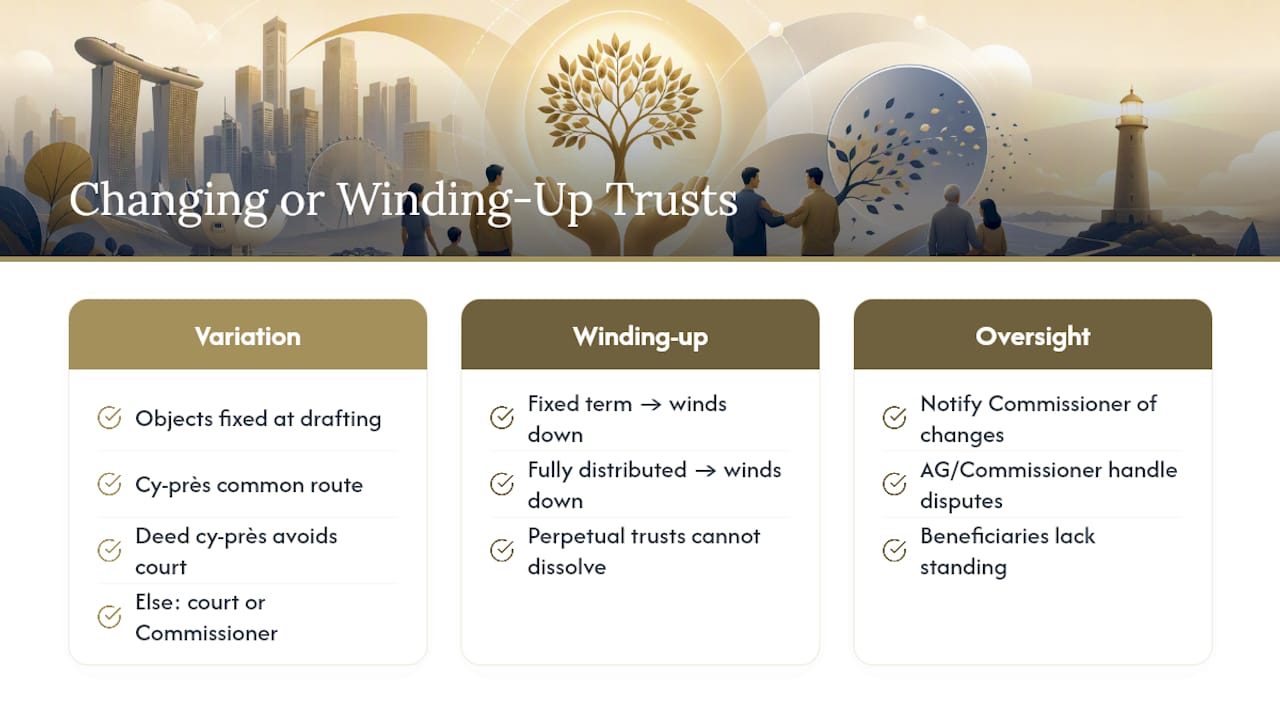
Yes, but not by simply changing your mind. A charitable trust’s objects are fixed at the point of drafting, and altering them later requires either a mechanism built into the original deed or, absent that, court or regulatory intervention.
The most common lawful route to change is a cy-près application, used when the original charitable purpose has become impossible, impractical, or obsolete. If the deed includes a cy-près clause naming how trustees should redirect funds to a similar purpose, that internal mechanism can avoid a court application entirely. Without one, trustees typically need to apply to the court or seek Commissioner of Charities guidance to redirect assets to an analogous charitable purpose.
Termination follows a similar logic. A trust set up for a fixed term, or one that has fully distributed its assets according to its terms, winds down naturally. A trust intended to run in perpetuity cannot simply be dissolved by trustee agreement. Any variation or termination affecting a registered charity typically requires notifying the Commissioner of Charities, since changes to governing documents, trustees, or purposes are exactly the kind of material change the Charities Act expects to be reported.
Because factual beneficiaries lack ordinary standing to challenge trustee decisions, disputes over variation or winding-up tend to route through the Attorney-General or Commissioner rather than private litigation. That is one more reason to draft amendment and termination clauses carefully at the outset, when you still have full control over the wording, rather than relying on regulatory discretion decades later.
Why Professional Advice Matters More Than Most Donors Expect
Complex asset mixes, cross-border beneficiaries, or a family that wants a say in future giving all push a charitable trust question into territory where a template deed won’t hold up. If your estate spans multiple jurisdictions, read up on cross-border tax planning before finalizing structure. Elite Legacy Planning integrates charitable trust planning with wills, private trust company setup, and living trust structures, so your philanthropic goals sit inside one coherent estate plan rather than a patchwork. Bring a rough asset list and your intended charitable purpose to the first meeting.
— Joseph
How Elite Legacy Planning Helps You Set Up a Charitable Trust
If you have read this far, you already know the hard part of a charitable trust isn’t the paperwork. It’s getting the trustee structure, the deed language, and the compliance layer right the first time, since fixing a defective purpose clause after registration is far harder than drafting it correctly at the outset.
Elite Legacy Planning works directly with affluent individuals and families across Singapore who want their philanthropic giving built into a broader estate plan, not bolted on as an afterthought. Our trust consultation and lifetime advisory service walks you through purpose drafting, trustee selection between an LTC, a PTC, or legal counsel, and the funding mechanics that trip up first-time settlors. For clients with more complex, multi-asset estates, our Private Trust Company service gives you a dedicated trustee vehicle built around your family’s specific goals.
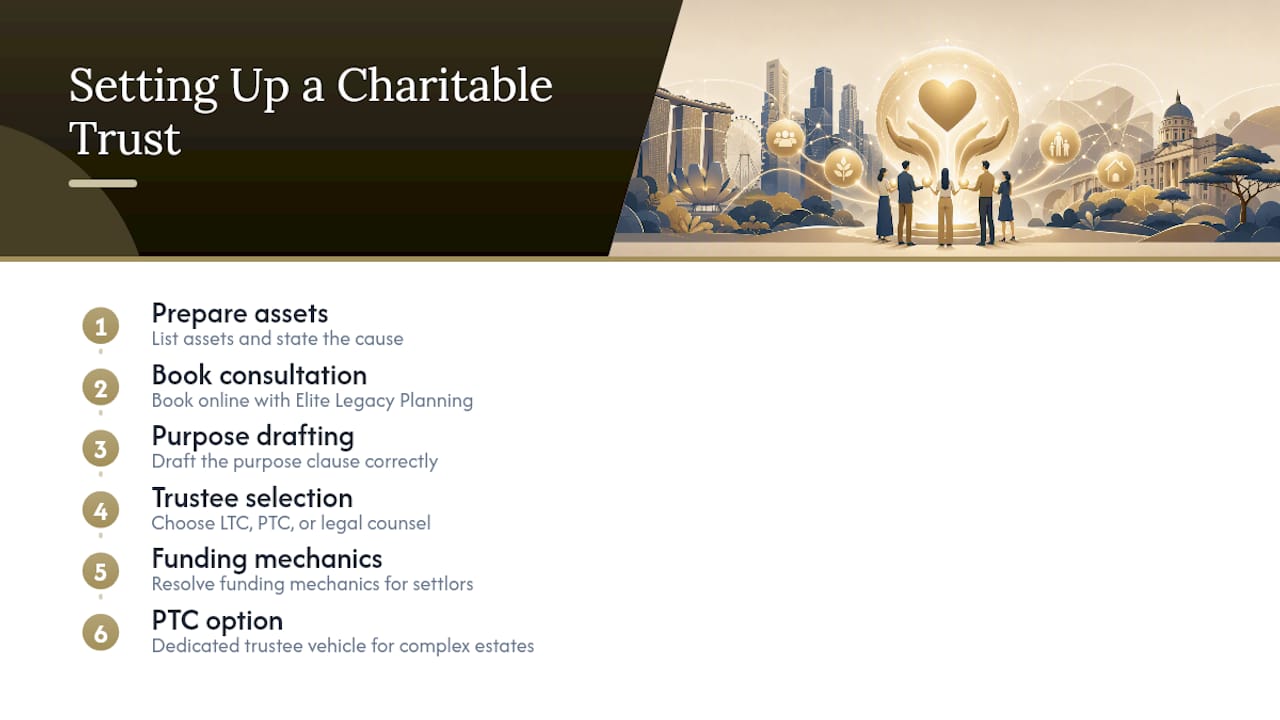
Bring a list of the assets you intend to commit and a clear statement of the cause you want to support. Book a consultation online and we will map out a structure suited to your goals and your timeline.
Sources
This article is general information, not a substitute for advice from a qualified lawyer. Consult a qualified legal professional about your own circumstances before acting on anything here.
Recommended
Comments